Testing different Peltier coolers by cooling/freezing water - Part 4 - TEC12708
TL;DR
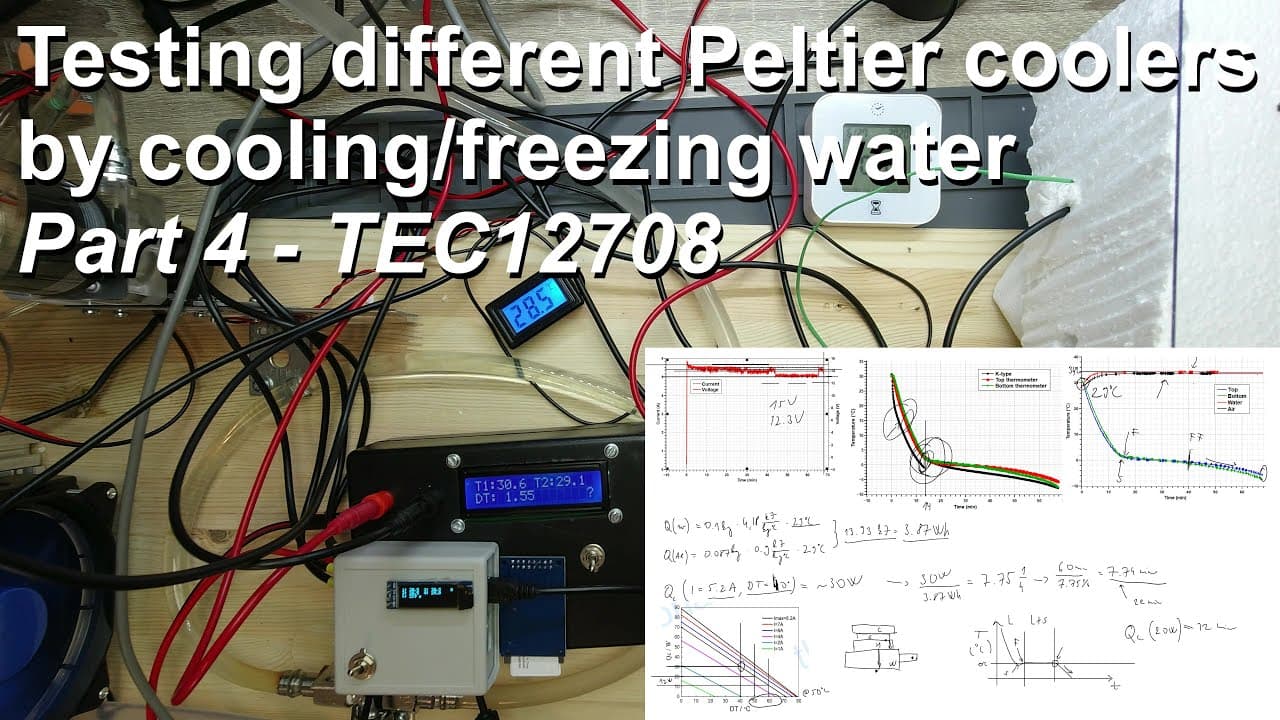
The TEC trap 708 effectively lowers temperatures, achieving ice formation during a one-hour test.
Transcript
Rock'em area this is another testing video where I am testing the TEC trap 708 so the a time per unit and in this video I am going to continue my freezing test which means that we have this aluminum top here or container which will be filled up with 100 grams of water and then I will apply some current on the device I will apply the correct current... Read More
Key Insights
- 😎 The TEC trap 708 cooling system applied a current of approximately 5.25 amperes to achieve its cooling effect.
- 💦 The experiment highlighted the importance of controlling for ambient temperature, which affected water and air temperatures throughout the test.
- 🥵 Ice formation in the water was a critical indicator of the TEC trap's success, showing its effective heat absorption during the cooling process.
- 💦 Comparative analysis with previous units confirmed the TEC trap 708 as a superior cooling solution based on the efficiency and temperature drop observed.
- 👻 The methodology used multiple sensors, allowing for detailed tracking of temperature gradients and overall performance evaluation.
- 🥶 Recorded data indicated that the cold side achieved temperatures below the freezing point, illustrating the unit's capability.
- 😎 The results emphasized the significance of maintaining consistent current levels to maximize cooling efficiency.
Install to Summarize YouTube Videos and Get Transcripts
Explore YouTube Video Summarizer or Get YouTube Transcript Extractor
Questions & Answers
Q: What is the purpose of the TEC trap 708 freezing test?
The freezing test aims to evaluate the performance of the TEC trap 708 in cooling water to freezing temperatures. By applying the correct current and monitoring temperature changes over one hour, the experiment aims to assess the efficiency of the device in real-time cooling conditions.
Q: How does the TEC trap 708 compare to earlier cooler models?
The TEC trap 708 demonstrates improved cooling performance compared to previous units, such as the six and three ampere models. This is evident from the results showing it can achieve lower temperatures more effectively, indicating it is a more robust cooling solution.
Q: What methodology was used to measure temperature changes during the experiment?
Temperature changes were measured using several sensors, including two K-type thermocouples and thermometers placed in and around the cooling system. This arrangement allowed for a comprehensive view of both the cold and hot sides' temperatures throughout the experiment.
Q: What challenges were faced regarding the water's temperature during the test?
A significant challenge was the lack of stirring, which created temperature gradients in the water. Without agitation, some areas cooled faster than others, complicating the measurement of precise temperatures and delaying the overall freezing process.
Q: What were the results regarding the temperature of the water at the end of the test?
After one hour of testing, the temperature readings indicated that the water reached as low as -7 degrees Celsius near the cold side, with significant ice formation observed. This demonstrated the TEC trap 708's capacity to effectively cool and freeze the water.
Q: How did the experiment control for accuracy in the measurements?
To improve measurement accuracy, a power meter was used alongside multimeters to cross-verify voltage and current, ensuring that readings were precise. Various thermometers also logged data on SD cards to create a comprehensive record of the temperature changes during the experiment.
Summary & Key Takeaways
-
The video details an experiment with the TEC trap 708 to measure its efficiency in cooling water down to freezing temperatures over one hour.
-
Multiple temperature sensors were used to track the cold and hot sides of the device, yielding insights into its cooling performance relative to previous models.
-
The experiment concluded with effective cooling, evidenced by ice formation, indicating that the TEC trap 708 outperforms earlier versions in maintaining low temperatures.
Read in Other Languages (beta)
Share This Summary 📚
Summarize YouTube Videos and Get Video Transcripts with 1-Click
Try YouTube Summary with ChatGPT & Claude or YouTube Transcript Generator
Explore More Summaries from Curious Scientist 📚

![Building a coil winder [Part 6] - A few improvements thumbnail](/_next/image?url=https%3A%2F%2Fi.ytimg.com%2Fvi%2F3eyxG_g2iUA%2Fhqdefault.jpg&w=750&q=75)


![Building a Peltier cooler-based cooling box - First iteration, improvements [Part 2/6] thumbnail](/_next/image?url=https%3A%2F%2Fi.ytimg.com%2Fvi%2F0YlNw0EGnzI%2Fhqdefault.jpg&w=750&q=75)
Summarize YouTube Videos and Get Video Transcripts with 1-Click
Try YouTube Summary with ChatGPT & Claude or YouTube Transcript Generator