How Can Graph Engineering 10x Your Claude or Codex AI Workflows?
TL;DR
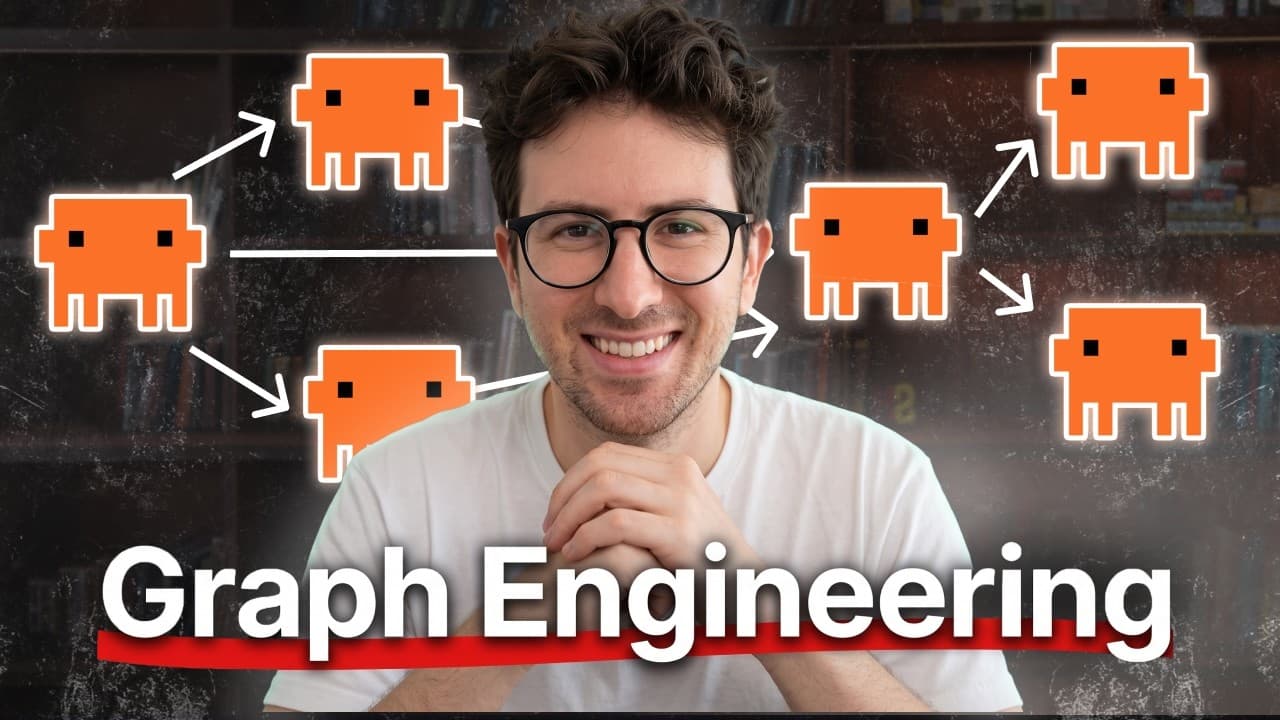
Graph engineering makes Claude or Codex workflows more reliable by organizing AI work into connected jobs, checks, handoffs, parallel paths, loops, and human approvals. A planner can divide startup research among customer, competitor, distribution, pricing, and risk investigations before a skeptic challenges weak findings and a merger creates a one-page recommendation. Read on to see when this structure improves real AI work.
Transcript
I came on here to talk about a term I keep seeing going viral on Twitter. It's graph engineering. You've seen it. I've seen it, too. And I'll be honest, the first time I saw it, my reaction was, "Okay, is this a real thing or did we just invent another phrase to make everyone feel behind?" Because AI has this funny habit where every few weeks there... Read More
Key Insights
- Graph engineering is the practice of designing work around AI as a managed workflow of steps, dependencies, checks, handoffs, loops, and approvals. It replaces a single messy conversation with a process whose components and decision points can be examined independently.
- Prompt engineering is about asking AI a better question, while context engineering is about supplying better information. Graph engineering operates at the workflow level by determining which jobs exist, how their outputs move, what can run concurrently, and where verification or approval occurs.
- A graph is a collection of jobs connected by arrows, and its state is the shared information accumulated as work progresses. This vocabulary mirrors ordinary operations such as classifying a support request, checking account history, finding a policy, drafting a response, and deciding whether human review is required.
- Knowledge graphs help AI understand how information connects across customers, companies, products, tools, issues, features, and teams. They are valuable when an answer depends on relationships across multiple entities rather than retrieval of a nearby text passage that merely resembles the question.
- Agent graphs help AI understand how work should move among specialized roles. A planner can divide the task, researchers can investigate independent angles concurrently, a skeptic can challenge unsupported findings, a synthesizer can merge reliable evidence, and a human can approve the consequential decision.
- The diamond pattern is a reusable workflow that begins with one question, splits into parallel paths, checks the resulting work, and merges it into one answer. It fits startup validation because customer pain, competitors, distribution, pricing pressure, and risks can be investigated separately.
- Independent checking is essential because AI research becomes less trustworthy when the same model both produces and evaluates an answer. A dedicated skeptic should identify unsupported claims, stale evidence, overlooked competitors, unjustified confidence, and confusion between customer pain and willingness to pay.
- Graph engineering is most appropriate for work involving multiple steps, sources, paths, risks, or approvals. Deep research, support triage, code review, sales preparation, feedback synthesis, go-to-market planning, and recurring content production benefit more than simple naming exercises or short email summaries.
Install to Summarize YouTube Videos and Get Transcripts
Explore YouTube Video Summarizer or Get YouTube Transcript Extractor
Questions & Answers
Q: What is graph engineering for Claude or Codex?
Graph engineering turns a messy AI task into a workflow that can be managed. It defines the jobs, their order, parallel branches, checks, handoffs, loops, shared state, and points where a human approves the work.
Q: How is graph engineering different from prompt engineering and context engineering?
Prompt engineering concerns how you ask AI a better question, while context engineering concerns how you give AI better information. Graph engineering designs the work around AI so the entire task does not remain inside one messy, giant chat.
Q: What do graphs, arrows, and state mean in an AI workflow?
A graph consists of jobs connected by arrows. Each job is a workflow step, the arrows show what happens next, and state is the shared information accumulated as the work progresses.
Q: Why is one AI response risky for startup research?
In one pass, the same model may decide what matters, research the market, interpret evidence, write a recommendation, and judge its own confidence. That places substantial trust in one blob of text and could influence work that consumes years of a person's life.
Q: How can graph engineering improve startup idea validation?
A planner can split the question into customer, competitor, distribution, pricing, and risk research. A skeptic then attacks weak findings, a merger converts surviving evidence into a one-page recommendation, and a human approves the decision before acting.
Q: How does graph engineering help with customer support?
A support workflow can classify the issue, check the customer's account history, search documentation for the correct policy, and draft a response. It can then decide whether the risk requires human review before the response goes out.
Q: Which AI workflow steps can run in parallel?
Independent work can happen concurrently when it does not depend on another result. For content production, one researcher can find examples while another finds counterarguments, and separate work can examine the audience angle and practical workflows before the outputs merge.
Q: When should you use graph engineering instead of a straight-line AI chat?
Use graph engineering when work has multiple pieces, sources, checks, risks, or approval points, especially when independent tasks can run concurrently. Straight-line chat can work for simple tasks, but complex sequential conversations can become slow, fuzzy, and difficult to trust.
Summary & Key Takeaways
-
Definition: Graph engineering designs work around AI as connected steps, checks, handoffs, loops, and human approvals.
-
Compare: Prompt engineering improves the question, context engineering improves supplied information, and graph engineering improves the surrounding workflow.
-
Definition: A graph is a set of jobs connected by arrows, while state is the shared information accumulated so far.
-
Step 1: A planner breaks a startup question into customer, competitor, distribution, pricing, and risk research.
-
Step 2: Independent researchers investigate separate angles concurrently where their work does not depend on another result.
-
Step 3: A skeptic tries to eliminate weak findings and unsupported conclusions.
-
Step 4: A merger converts the surviving evidence into a one-page recommendation.
-
Step 5: A human approves the decision before consequential action is taken.
-
Compare: Straight-line chat handles work sequentially, while a graph allows planning, parallel work, checking, merging, and approval.
-
Who: Planners divide work, researchers investigate, skeptics challenge findings, mergers synthesize evidence, and humans approve final decisions.
Read in Other Languages (beta)
Share This Summary 📚
Summarize YouTube Videos and Get Video Transcripts with 1-Click
Try YouTube Summary with ChatGPT & Claude or YouTube Transcript Generator
Explore More Summaries from Greg Isenberg 📚





Summarize YouTube Videos and Get Video Transcripts with 1-Click
Try YouTube Summary with ChatGPT & Claude or YouTube Transcript Generator