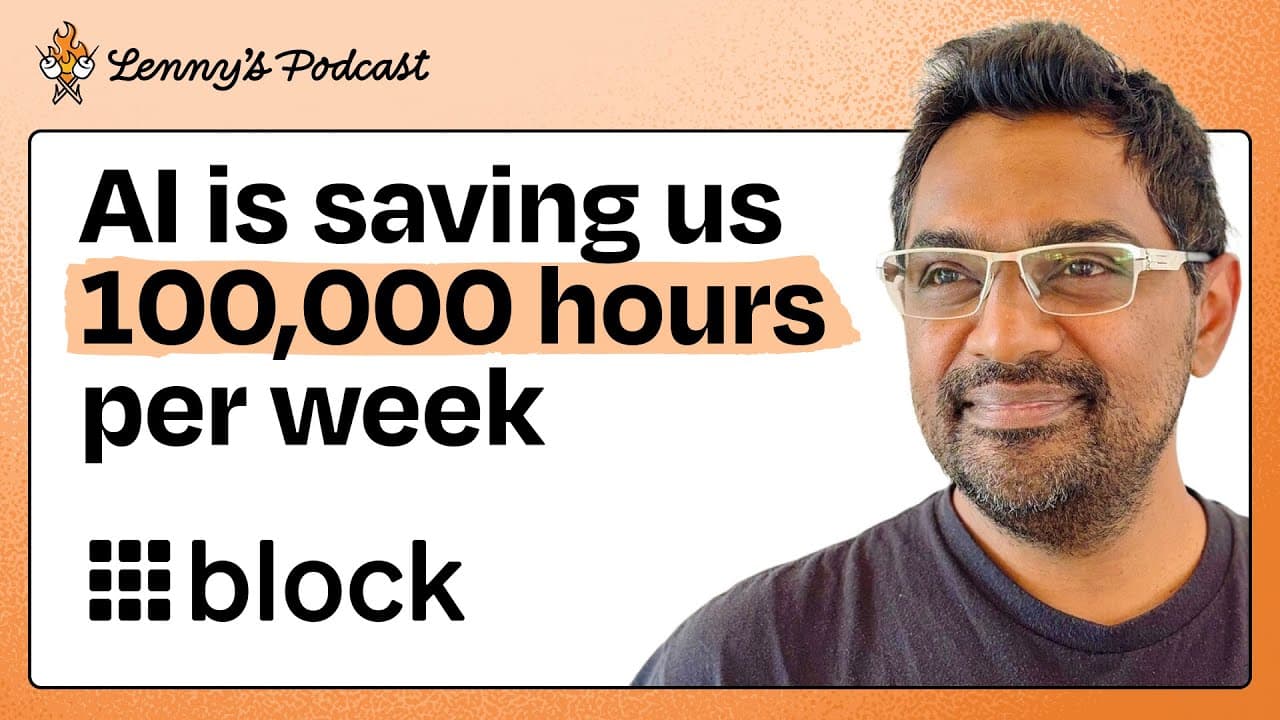
How Block Uses AI Agents to Save 8-10 Hours Weekly
TL;DR
AI-forward engineering teams at Block report saving about 8 to 10 hours per week using Goose, their internal open-source agent. Surprisingly, non-technical employees show the most impact from AI tools. Block's shift from a GM structure to a single functional org, where all engineers report into one team, was key to becoming AI-native.
Transcript
There's a lot of talk about productivity gains through AI. There's this camp of people are like so overhyped. Nothing's working. Nobody's actually adopting this at scale. We see a significant amount of games. We find engineering teams that are very very AI forward are reporting about 8 to 10 hours saved per week. Whenever I hear a stat like this, I... Read More
Key Insights
- AI-forward engineering teams at Block are reporting roughly 8 to 10 hours saved per week, and that number is going up. The CTO frames current results as 'the worst it will ever be' — today's baseline.
- Non-technical people, not engineers, are showing the most impact from AI agents and programming tools. Those who embrace AI to optimize their particular workday and set of tasks benefit most.
- Goose is Block's internal open-source agent. One engineer had Goose watch his work, and after discussing a feature over Slack or email, he'd later find Goose had already built it and opened a PR on Git.
- Code quality has almost nothing to do with building a successful product, according to Dhanji. Many engineers assume the two are linked, but he calls this a counterintuitive lesson from experience.
- Block's shift from a GM structure to a functional org structure was the key to its AI-native transformation. All engineers now report into one team with a single head of engineering, rather than separate practices per business.
- Dhanji's 'AI manifesto' letter to Jack Dorsey sparked the transformation. Written while he was a part-time senior engineer, it argued Block should pursue AI centrally to be ahead of the game as an AI-native company.
- LLMs sitting idle overnight and on weekends is seen as wasteful. Dhanji believes agents should work all the time, building in anticipation of what teams want, changing how engineers work in a couple of years.
- Block's early success as separate businesses (Square, Cash App) used independent CEOs reporting to Jack. That portfolio model suited a mature phase but blocked the singular focus needed to go deep on industry-changing technology.
Install to Summarize YouTube Videos and Get Transcripts
Explore YouTube Video Summarizer or Get YouTube Transcript Extractor
Questions & Answers
Q: How much time is Block saving with AI agents?
Block finds that engineering teams which are very AI-forward report saving about 8 to 10 hours per week, and that number is going up. The company's internal open-source agent, Goose, drives much of this by their own measure. The CTO stresses this is the worst it will ever be — the current results represent a baseline, and the value is changing every day as the tools improve.
Q: What is Goose and how does it work at Block?
Goose is Block's internal open-source AI agent that employees use to build things and automate work. In one example, an engineer had Goose watch his activity; while he discussed a potentially useful feature with a colleague over Slack or email, a few hours later he found Goose had already tried to build that feature and opened a PR for it on Git, anticipating the work autonomously.
Q: Which teams benefit most from AI at Block?
Interestingly, it is not the engineering team that benefits most. The most surprising and amazing impact comes from non-technical people using AI agents and programming tools to build things. According to Dhanji, the people who embrace AI to optimize for their particular workday and their particular set of tasks show the most impact from these tools, more than the engineers do.
Q: Why did Block change from a GM structure to a functional org structure?
In its mature phase, Block ran businesses like Square and Cash App as a portfolio of independent companies, each with its own CEO reporting to Jack and separate engineering and design teams. To go deep on industry-changing technology like AI, Block needed singular focus, so it moved all engineers into one team and all designers into one team, with single heads of engineering and design. This was the key to its AI-native transformation.
Q: What was the AI manifesto Dhanji wrote to Jack Dorsey?
About two and a half years ago, Jack Dorsey gathered around 40 top executives weekly to discuss the business, and added Dhanji to the group. Dhanji noticed no one was paying attention to AI, so he wrote a letter — his AI manifesto — arguing Block should pursue AI, do it centrally, and get ahead to become an AI-native company. It took on a life of its own and led to his promotion to CTO.
Q: Does code quality matter for building a successful product?
According to Dhanji, one of the most counterintuitive lessons he learned is that code quality has almost nothing to do with building a successful product. A lot of engineers think code quality is important to a product's success, but in his experience the two have nothing to do with each other. This challenges a common assumption held by many engineers and product leaders.
Q: How will engineers work differently in a couple of years?
Dhanji envisions AI agents working continuously rather than sitting idle overnight and on weekends when humans aren't present. He believes there's no need for that idleness — the LLMs should be working all the time, trying to build in anticipation of what teams want. This shifts engineering toward always-on agents that proactively anticipate and prepare work rather than only responding to direct prompts.
Q: What were the first changes Dhanji made after becoming CTO?
His main focus was getting Block to think like a technology company again, reversing an identity drift toward calling itself a financial services or fintech company. He gathered the top individual contributors to talk to each other, launched about eight or nine special projects staffed with two to five engineers each, and reinstituted the company-wide hack week to spark a sense of building technology and pushing the frontier again.
Summary & Key Takeaways
-
Dhanji R. Prasanna is CTO of Block, overseeing a team of over 3,500 people (the description cites more than 4,000 engineers over two years). He became CTO after writing an AI manifesto to Jack Dorsey while a part-time senior engineer, arguing Block needed to pursue AI centrally to become an AI-native company.
-
Block's internal open-source agent, Goose, saves AI-forward engineering teams about 8 to 10 hours a week, a number that keeps rising. Surprisingly, non-technical employees — not engineers — show the most impact, as those who adapt AI to their specific tasks and workday gain the most.
-
The biggest lever was organizational, not a tool: Block moved from a GM structure of independent businesses with separate engineering and design teams to a single functional org where all engineers and designers report into one team, enabling deep, singular focus on AI and platform technology.
Read in Other Languages (beta)
Share This Summary 📚
Summarize YouTube Videos and Get Video Transcripts with 1-Click
Try YouTube Summary with ChatGPT & Claude or YouTube Transcript Generator
Explore More Summaries from Lenny's Podcast 📚



Summarize YouTube Videos and Get Video Transcripts with 1-Click
Try YouTube Summary with ChatGPT & Claude or YouTube Transcript Generator