What Skills Should You Learn in 2026?
TL;DR
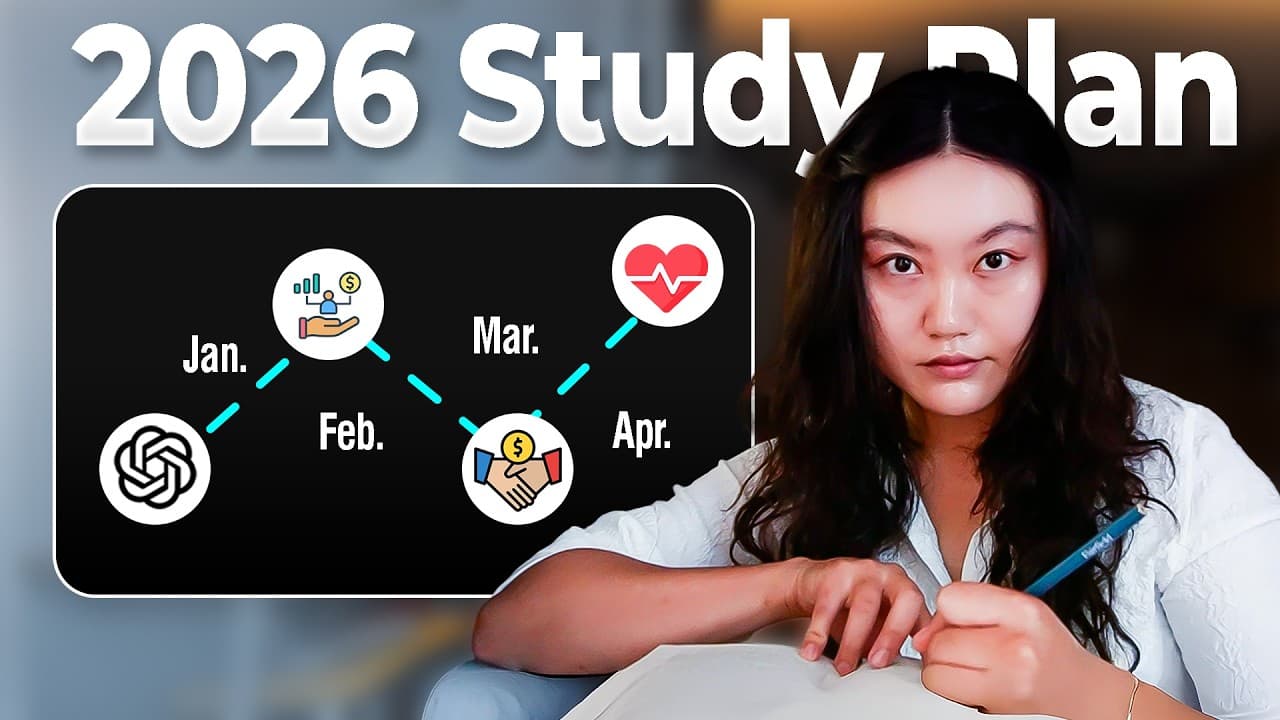
The three most important skills to learn in 2026 are personal finance and investing, artificial intelligence, and business. Financial literacy and an emergency fund give you freedom to explore, AI lets anyone build software at low cost, and business turns interests into sustainable income. Owning a business also legally cuts your taxes significantly.
Transcript
Learning is literally my favorite thing in the world, especially these days with the speed of the world progressing at a dizzyingly fast rate. The future belongs to those who do not stop learning. So, in this video, I want to share with you guys some of the most important skills to learn in 2026, in my opinion, which of course I'm also going to be ... Read More
Key Insights
- Personal finance and investing is the first key skill for 2026, driven by economic changes, potential layoffs, the impact of AI, and general market instability, which signal a need to hedge and capture opportunities.
- Basic financial literacy is not taught in school, so most people lack it; core topics include budgeting, setting financial goals, credit, insurance, taxes, and investing.
- An emergency fund is cash set aside for unexpected events like losing a job or spontaneous expenses; common advice is to save 3 to 6 months of money to cover your current lifestyle.
- Diversification matters more now because AI stocks account for roughly 44% of the S&P 500 market capitalization per a JP Morgan stat, so investing in the S&P 500 alone is no longer as diversified.
- Diversifying and creating additional income streams hedges against economic instability, and freelancing, side gigs, or starting a business is more doable now than it used to be.
- AI is a critical skill because anybody who wants to build software products can now do so without coding, faster and at lower cost, and more companies are integrating AI into daily workflows.
- AI adoption is only at about 1% maturity according to a McKinsey study, because integrating AI solutions into existing businesses requires significant work, creating consulting and freelancing opportunities.
- Owning a business legally cuts taxes substantially; the creator earned more at Meta but had lower take-home pay than with her own business earning less, calling it an open secret for paying less tax legally.
Install to Summarize YouTube Videos and Get Transcripts
Explore YouTube Video Summarizer or Get YouTube Transcript Extractor
Questions & Answers
Q: What are the most important skills to learn in 2026?
According to the creator, the three most important skills to learn in 2026 are personal finances and investing, artificial intelligence, and business. Financial literacy gives you the freedom to explore options, AI empowers you to freelance or build things at very low cost and minimal resources, and business is what turns the things you are interested in from a hobby into something sustainable that makes money for you.
Q: Why is personal finance a key skill to focus on in 2026?
Going into 2026 there is a lot of talk about economic changes, potential layoffs, the impact of AI, and general market instability. For the creator, these are signals to focus on learning more about personal finances and investing so she can capture opportunities that become available and hedge herself in case things do not go well. It provides confidence and freedom to explore other interests like AI.
Q: How much money should you keep in an emergency fund?
An emergency fund is cash set aside just in case something happens and you need that money, whether something bad like losing your job or something good like spontaneously getting married and needing to spend more. The common advice cited is to save 3 to 6 months worth of money that can cover your current lifestyle. Building up this fund is one of the first things you should focus on.
Q: Is investing in the S&P 500 still considered diversified?
The creator notes it is less diversified than it used to be. The S&P 500 represents the 500 biggest US companies, and common advice is to invest in it to be diversified. However, she cites a JP Morgan stat that AI stocks now account for roughly 44% of the S&P 500 market capitalization, meaning big tech and AI stocks dominate it. She is personally diversifying more globally and across different sectors.
Q: Why should you learn AI as a skill in 2026?
The creator sees more and more opportunities in AI. There are two major takeaways: first, anybody who wants to build software products can now do so without knowing how to code, very fast and at lower and lower cost, so there is no excuse anymore. Second, more companies are focused on integrating AI into their daily workflows, opening opportunities in AI freelancing, agencies, or building your own software product.
Q: How mature is AI adoption in businesses right now?
The creator references a McKinsey study showing that AI is only at around 1% maturity right now, because there is a lot of work that goes into integrating AI solutions into existing businesses. She can personally attest to this because part of her company does B2B consulting and AI solutions, and much of their work is helping companies figure out how to integrate AI into their existing workflows, which creates significant opportunity.
Q: How does owning a business affect your taxes?
The creator says owning a business effectively cuts your taxes down by so much. She was shocked to realize that when working at Meta she made a lot more money, but her take-home was actually less than when she started her own business, even though she was making way less money. She describes having your own business as the open secret for how people legally pay much less in taxes.
Q: What is a lifestyle business and how does its growth differ from a job?
A lifestyle business maximizes freedom, letting you do the things you want and work with people you enjoy, rather than being a venture-backed startup focused on hyper growth or massive revenue and profit. Unlike a full-time job, where money and satisfaction grow linearly as you put in time and expertise, a business follows an exponential curve, with slower growth in the first few years.
Summary & Key Takeaways
-
Learning is essential in 2026 as the world progresses at a fast rate. The creator, Tina, a YouTuber, entrepreneur, and former Meta data scientist, shares the most important skills to learn: personal finance and investing, artificial intelligence, and business, all of which she is personally learning too.
-
Personal finance covers four areas: basic financial literacy (budgeting, credit, insurance, taxes), building a 3-to-6-month emergency fund, investing while diversifying beyond an S&P 500 now dominated by AI stocks at 44% of market cap, and creating multiple income streams to hedge instability.
-
AI empowers anyone to build software cheaply without coding, and companies increasingly integrate AI into workflows despite only 1% maturity. Business turns hobbies into sustainable income; a lifestyle business maximizes freedom, legally reduces taxes, and offers exponential rather than linear growth compared to a full-time job.
Read in Other Languages (beta)
Share This Summary 📚
Summarize YouTube Videos and Get Video Transcripts with 1-Click
Try YouTube Summary with ChatGPT & Claude or YouTube Transcript Generator
Explore More Summaries from Tina Huang 📚


Summarize YouTube Videos and Get Video Transcripts with 1-Click
Try YouTube Summary with ChatGPT & Claude or YouTube Transcript Generator