How to Learn Data Analytics: Skills, Roadmap and Tips
TL;DR
Start with SQL and Excel, then add one BI tool such as Power BI or Tableau, and learn Python last. Job posting data shows SQL in almost half of data analyst listings and Excel in four of ten. Learn each skill by studying, then building a portfolio project to prove it.
Transcript
data nerds if I had to start over again I'd be following this approach for learning how to become a data analyst and I'm not only going to be covering what technical skills you should be learning using real world data of course but also get into breaking down these skills so you can learn them quicker and land a job faster during this AI boom that ... Read More
Key Insights
- SQL is the most requested data analyst skill, appearing in almost half of job postings, with Excel in about four of ten, so these two form the base of any learning plan.
- Python and Tableau each appear in nearly one third of data analyst job postings, followed by R and Power BI at nearly one fifth, and other skills drop off quickly.
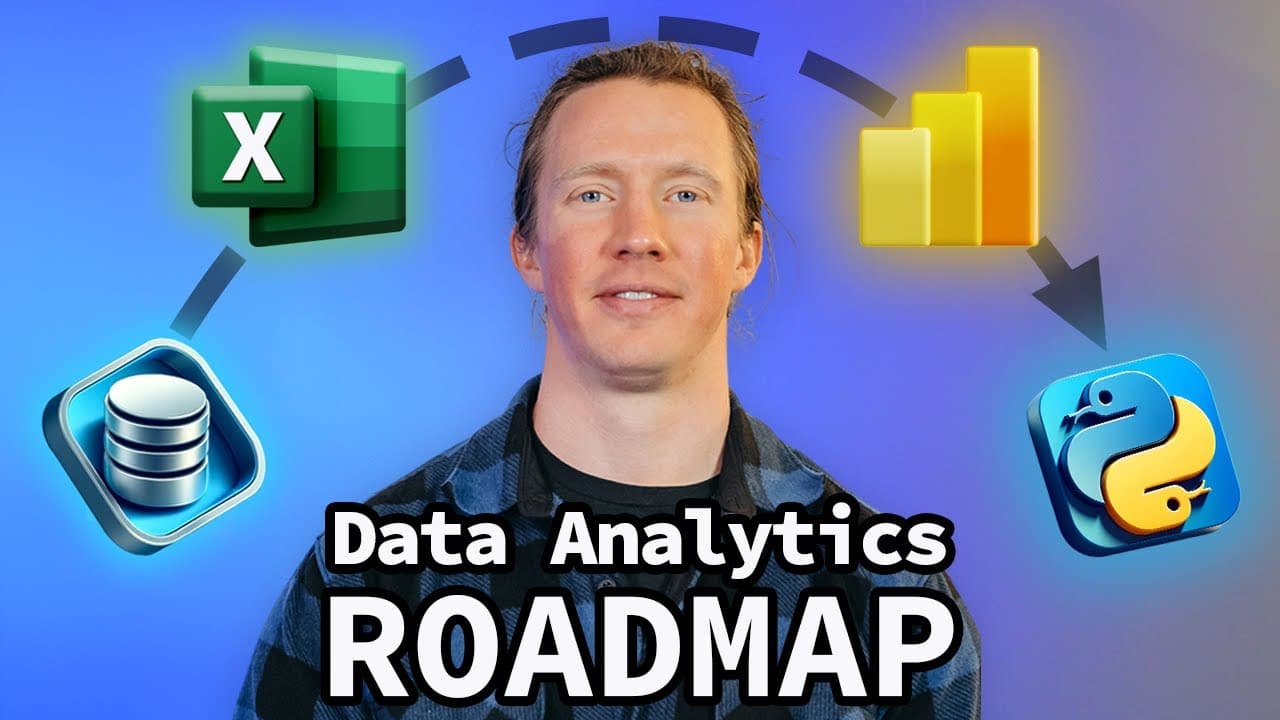
- Data analyst skills fall into four technology groups: databases (SQL), spreadsheets (Excel), business intelligence tools (Power BI and Tableau), and programming languages (Python and R).
- The job-ready tier is Excel and SQL, because they are the most common in postings and many other skills depend on knowing databases and spreadsheets first.
- Learn only one BI tool, because once you know Power BI or Tableau, the other is easy to pick up. Power BI can be learned in less than a weekend.
- Python and R are advanced skills not needed for an entry-level job, and if you pick one, Python is safer because it is multi-purpose and more widely accepted.
- The most effective learning approach has two steps: learn a skill from a reputable source, then build a portfolio project with real-world data to retain it and show experience to employers.
- Chatbots speed up learning by explaining coding errors in full and answering follow-up questions, replacing the slower routine of checking several search results one by one.
- The World Economic Forum's Future of Jobs report places data analysts among the top 15 jobs set to grow over the next decade, with growth estimates of up to 40%.
Install to Summarize YouTube Videos and Get Transcripts
Explore YouTube Video Summarizer or Get YouTube Transcript Extractor
Questions & Answers
Q: What are the most in-demand skills for a data analyst?
Based on over 3 million collected job postings, SQL is the top skill, appearing in almost half of United States data analyst postings. Excel follows in four of ten jobs. Python and Tableau each appear in nearly one third, and R and Power BI in nearly one fifth. Other skills drop off quickly.
Q: In what order should I learn data analyst skills?
Follow three tiers. First learn the job-ready skills, Excel and SQL, which are the most common in postings and underlie other tools. Second, learn one business intelligence tool, Tableau or Power BI. Last, learn an advanced programming language, with Python recommended over R. The advanced tier is not needed for an entry-level job.
Q: Do I need to learn both Power BI and Tableau?
No. The speaker recommends learning only one of the two business intelligence tools, because once you learn one, the other is fairly easy to pick up. Power BI was learned in less than a weekend. Both depend on getting data from spreadsheets or databases, so learn those first.
Q: Should a data analyst learn Python or R?
Choose one, and the speaker recommends Python. It is a multi-purpose programming language with more use cases and wider acceptance, which makes it the safer pick. It is harder to learn, though. The speaker has been working to master it for seven years and is still learning, so expect a longer path.
Q: How can I learn data analytics skills faster?
Use a two-step approach: learn something, then build something. Learn from reputable sources such as Coursera, DataCamp, or YouTube tutorials. Then apply it in a portfolio project using real-world data that you clean, analyze, and visualize. Building the project helps you retain the skill and shows employers real experience.
Q: Why build a portfolio project when learning data analytics?
A portfolio project is a practical demonstration of your skills. You take real-world data, clean it, analyze it, and visualize it, then share it on sites like LinkedIn or GitHub. It reinforces what you learned and gives you real-world experience to list on your resume and show employers.
Q: Is data analytics a safe career choice?
The speaker believes data analytics is not going away soon and cites the World Economic Forum's Future of Jobs report. It places data analysts among the top 15 jobs set to grow over the next decade, with estimated growth of up to 40%, and other data jobs show similar rates. Job security still depends on having the right skills.
Q: How can AI chatbots help me learn data analytics?
Chatbots make fixing errors faster. Instead of pasting an error into Google and checking several links, you can paste it into a chatbot and get a full breakdown of what went wrong. You can also ask follow-up questions about how you made the mistake, which reinforces your learning.
Summary & Key Takeaways
-
The speaker, a former data analyst, gathered over 3 million job postings in two years using a web scraper and an app. The data shows SQL in almost half of data analyst jobs, Excel in four of ten, Python and Tableau in nearly a third, and R and Power BI in nearly a fifth.
-
Skills group into four tool types: databases with SQL, spreadsheets with Excel, BI tools like Power BI and Tableau for dashboards, and programming languages like Python and R. Programming was the least used in the speaker's own analyst work, partly because colleagues often cannot check code.
-
The roadmap has three tiers: job-ready skills (Excel and SQL), specialized skills (one BI tool), and advanced skills (Python or R, with Python recommended). Learning pairs studying from sources like YouTube with building portfolio projects, and chatbots help fix coding errors faster.
Read in Other Languages (beta)
Share This Summary 📚
Summarize YouTube Videos and Get Video Transcripts with 1-Click
Try YouTube Summary with ChatGPT & Claude or YouTube Transcript Generator
Explore More Summaries from Luke Barousse 📚

Summarize YouTube Videos and Get Video Transcripts with 1-Click
Try YouTube Summary with ChatGPT & Claude or YouTube Transcript Generator