How to Use SQL for Practical Data Analytics
TL;DR
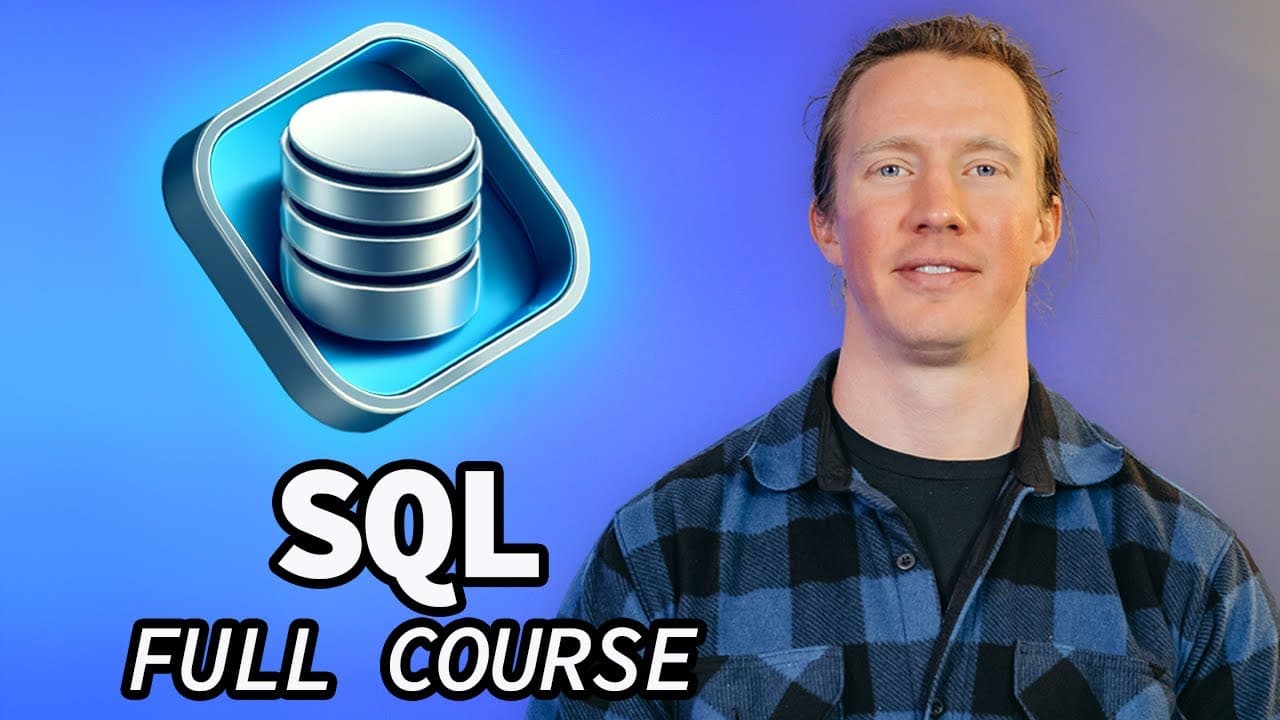
SQL lets analysts create, read, update, delete, and examine data stored in databases. Start with queries, comparisons, wildcards, aliases, operations, aggregations, NULL values, and joins, then advance to PostgreSQL, data types, date functions, CASE expressions, subqueries, CTEs, and UNION operators. Reinforce these skills by analyzing real job-posting data and publishing the completed project on GitHub.
Transcript
data nerds welcome to this full course tutorial on how I use SQL for data analytics this is the course I wish I would have had when I first started learning this tool as it's a super easy to learn skill when taught properly and I feel like you can strongly master the basics by the end of this video now this tool is one of the most highly sought aft... Read More
Key Insights
- A database is a collection of data designed to hold far more information than an Excel file, which the course says can contain only around a million rows. Databases can support very large collections while giving analysts a structured location from which to request and examine information.
- SQL is a structured query language used to request data and extract insights from databases. Its capabilities are summarized through CRUD: CREATE and INSERT INTO add records, SELECT retrieves needed data, UPDATE modifies existing records, and DELETE removes records from the database.
- Relational databases store structured data in rows and columns, with identifiers connecting related tables. The course illustrates this structure through job-posting and company tables, where IDs establish relationships between available jobs and the organizations responsible for those listings.
- Non-relational databases support structured and unstructured information through formats such as key-value pairs, graphs, and documents. They are commonly described as NoSQL databases, with NoSQL meaning "not only SQL" rather than "not SQL," because their supported models extend beyond relational tables.
- Database infrastructure can run locally, on company-controlled servers, or through cloud providers. Local databases are useful for learning, development, and testing, while on-premises servers give companies direct control and serverless services shift server-management responsibilities to providers such as AWS, Google Cloud, and Azure.
- SQL editors can come from database providers, cloud platforms, or general code editors. PostgreSQL and MySQL provide applications for accessing databases and monitoring tables, cloud providers offer browser interfaces, and the course uses VS Code to organize SQL files and work with the project database.
- Advanced SQL analysis is built from data types, table manipulation, date functions, CASE expressions, subqueries, CTEs, and UNION operators. These techniques extend basic filtering and aggregation by helping analysts transform tables, express conditional logic, structure complex queries, and combine compatible results.
- The capstone project turns SQL concepts into a portfolio artifact by analyzing data science job postings. Its queries identify top-paying jobs, the skills attached to those jobs, in-demand skills, top-paying skills, and optimal skills, after which the completed analysis can be published on GitHub and shared on LinkedIn.
Install to Summarize YouTube Videos and Get Transcripts
Explore YouTube Video Summarizer or Get YouTube Transcript Extractor
Questions & Answers
Q: What is SQL used for in data analytics?
SQL is used to request data from databases and extract information needed for analysis. Its commands support CRUD operations: creating or inserting records, reading selected data, updating existing records, and deleting records. For analysts, the central workflow involves writing queries that retrieve and examine relevant information, then applying comparisons, calculations, aggregation, joins, and other techniques to answer practical questions.
Q: What is the difference between relational and non-relational databases?
Relational databases organize structured data in rows and columns, then connect related tables through identifiers. A job-posting database, for example, can link a jobs table to a companies table using IDs. Non-relational databases support a broader range of structures, including key-value pairs, graphs, and documents. They are called NoSQL databases, meaning "not only SQL," because they can accommodate formats beyond relational tables.
Q: What does CRUD mean in SQL?
CRUD stands for create, read, update, and delete, four major operations SQL can perform on stored data. Commands such as CREATE and INSERT INTO add structures or records, SELECT retrieves specific information, UPDATE changes existing records, and DELETE removes records. These operations show that SQL is not limited to reading data for analysis, although deletion requires particular care because it removes information.
Q: Where can a SQL database be stored and queried?
A SQL database can run locally on a personal computer or remotely on a server. Companies may control their own internal servers through an on-premises setup, while cloud providers such as AWS, Google Cloud, and Azure can manage server infrastructure for a price. Queries can be written through database-provided applications, cloud interfaces in a web browser, or code editors such as VS Code.
Q: Which SQL topics should beginners study first?
Beginners should start by understanding databases, tables, and the purpose of queries. The course then develops practical ability through basic SQL keywords, comparisons, wildcard matching, aliases with AS, operations, aggregations, NULL values, and joins. It also covers SQL order of execution. Practice problems appear throughout the sequence so learners can apply each group of concepts before moving into advanced database work.
Q: Which advanced SQL techniques are covered in the course?
The advanced chapter covers setting up PostgreSQL and installing VS Code before moving into technical database work. Its topics include data types, table manipulation, database loading, date functions, CASE expressions, subqueries, common table expressions, and UNION operators. Practice problems accompany several sections, giving learners opportunities to use these techniques before beginning the final job-posting analysis project.
Q: How does the SQL capstone project analyze job data?
The capstone uses the dataset that powers data nerd. Tech, an application providing insights into data science job postings. Five queries investigate top-paying jobs, the skills required by top-paying jobs, skills with strong demand, skills associated with high pay, and the most optimal skills. The project applies the course concepts to a real-world analytical problem instead of leaving them as isolated syntax exercises.
Q: How can the completed SQL project be used in a portfolio?
The course guides learners through creating a repository, writing five analytical queries, and publishing the finished project on GitHub. The resulting portfolio artifact demonstrates database querying through a focused analysis of data science jobs and skills. A final section also covers sharing the project on LinkedIn, allowing learners to present both their SQL work and the conclusions produced from the job-posting dataset.
Summary & Key Takeaways
-
The course begins with the foundations of SQL, databases, and queries. It distinguishes relational databases, which organize structured data in related rows and columns, from non-relational databases that support additional formats. It also introduces CRUD operations and explains where databases and SQL editors can run, including local computers, company servers, cloud platforms, and code editors.
-
The practical lessons progress from basic querying to comparisons, wildcards, aliases, operations, aggregation, NULL values, joins, and SQL order of execution. Advanced instruction covers setting up PostgreSQL and VS Code, selecting suitable data types, manipulating and loading tables, working with dates, writing CASE expressions, organizing analysis with subqueries and CTEs, and combining results with UNION operators.
-
The capstone project uses the job-posting data behind data nerd. Tech to investigate the data science employment market. Its five queries examine top-paying jobs, skills associated with those jobs, in-demand skills, top-paying skills, and the most optimal skills. The finished work becomes a portfolio project that learners can publish on GitHub and share on LinkedIn.
Read in Other Languages (beta)
Share This Summary 📚
Summarize YouTube Videos and Get Video Transcripts with 1-Click
Try YouTube Summary with ChatGPT & Claude or YouTube Transcript Generator
Explore More Summaries from Luke Barousse 📚
Summarize YouTube Videos and Get Video Transcripts with 1-Click
Try YouTube Summary with ChatGPT & Claude or YouTube Transcript Generator