Will We Be Warned About Catastrophic Events Like Asteroids?
TL;DR
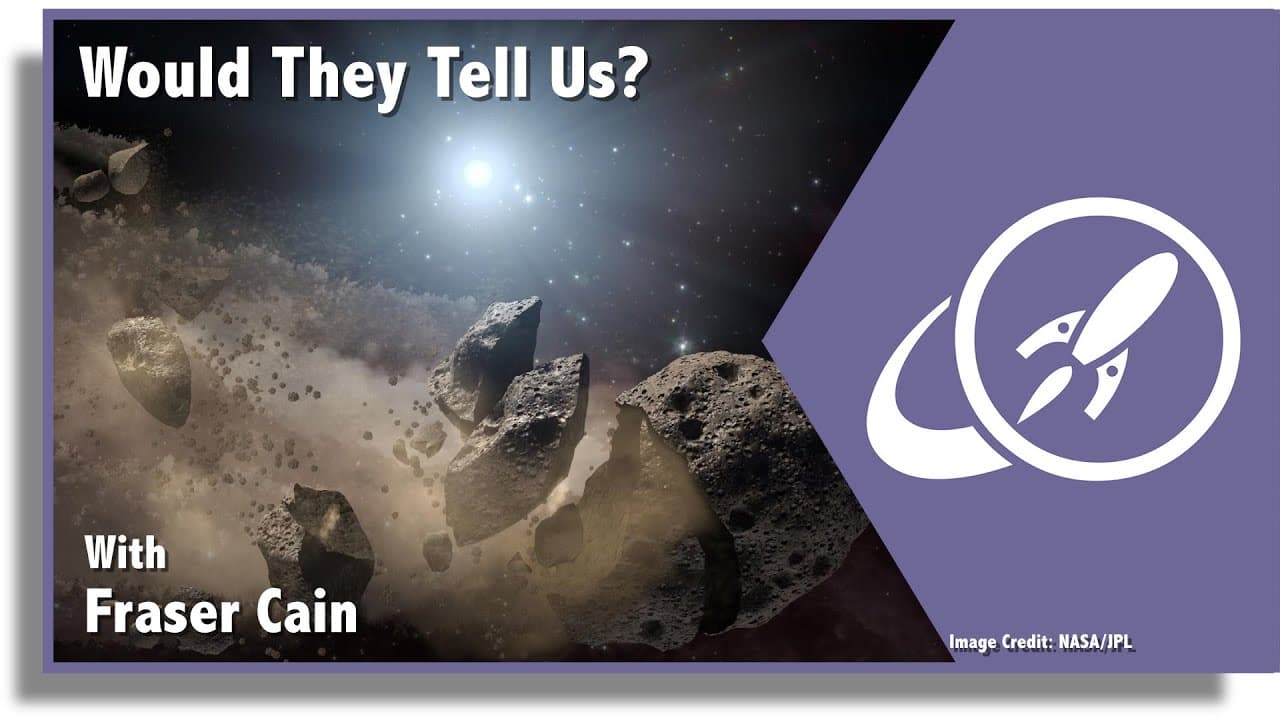
If a catastrophic event like an asteroid impact is confirmed, it is likely that the public would be informed rather than kept in the dark. Astronomers continually monitor the sky for potentially dangerous objects and share findings to ensure global awareness and collaborative response efforts, similar to how climate change threats are communicated.
Transcript
it's question showtime your questions my answers as always wherever you are across my channel if a question pops into your brain just write it down i'll gather them up and i will answer them here and just a reminder i record this show every monday at 5pm pacific time on my youtube channel so if you didn't get an answer in the comments you want to j... Read More
Key Insights
- 🌐 Detection of imminent catastrophic events is a transparent global effort to communicate and find solutions.
- 🆘 Solar system configuration assessments help identify the uniqueness of our planetary system compared to exoplanetary systems.
- 👽 Challenges in detecting alien breakthrough starshots involve advanced detection methods like monitoring intense lasers for potential signs.
- 🤗 China's evolving transparency on space missions indicates a gradual shift towards open disclosure of rover findings on Mars.
- 👾 Exploring space junk utilization for in-situ resource applications present dismantling complexities and legal impediments.
- 😀 Aspiring astrophysicists face competitive positions, requiring extensive education, dedication, and additional career planning.
- 🤩 Potential opportunities for grand tour missions involving multiple star systems rely on future propulsion advancements and complex astronomical alignments.
Install to Summarize YouTube Videos and Get Transcripts
Explore YouTube Video Summarizer or Get YouTube Transcript Extractor
Questions & Answers
Q: What would astronomers do if they detected an imminent catastrophic event, like an incoming asteroid?
If an astronomical event with the potential to impact Earth were detected, astronomers would collaborate, study, and communicate findings openly to find solutions.
Q: Are there solar systems similar to ours, or is our system atypical?
Initially perceived as normal, our solar system is now understood to have comparable configurations as other discovered planetary systems.
Q: How feasible is it to detect an alien breakthrough starshot, and what methods could be used?
Detecting a breakthrough starshot would likely involve observing massive lasers or potential thermal signatures from fusion drive propulsion systems.
Q: Will China disclose their rover findings on Mars similar to NASA's transparency?
China has been gradually improving its transparency, sharing rover discoveries on websites but with delays compared to NASA.
Q: Can space junk be repurposed through in-situ resource utilization for future space missions?
Utilizing space junk for in-situ resource utilization poses challenges due to complex dismantling processes and overcoming legal and velocity obstacles.
Q: What are the career prospects and challenges for aspiring astrophysicists?
Becoming an astrophysicist requires substantial time, funding, and dedication, with fierce competition for limited positions and the need for a backup plan.
Q: Could the concept of a grand tour mission involving multiple star systems align in the future?
A grand tour mission spanning multiple stars is plausible by utilizing gravitational slingshots, although current propulsion limits may require waiting for complex astronomical alignments.
Q: How can dark matter concentration around planetary objects be measured?
Dark matter distribution within planetary systems may lead to observable impacts like increased radiation, potentially enabling indirect measurement methods.
Q: Is multicellular life necessary for extraterrestrial life, or could single-celled organisms dominate?
Single-celled organisms are more common in astrobiological expectations, with the transition to multicellular life being rare and potentially not a requirement for intelligent life forms.
Summary & Key Takeaways
-
Explanation of how astronomers detect potential catastrophic events, like asteroids, and the process of ruling out dangerous impacts.
-
Insight into the variety of planetary systems found beyond our solar system and how our solar system's configuration compares.
-
Discussion on the challenges of detecting and intercepting potential alien spacecraft and the role of lasers in detection.
Read in Other Languages (beta)
Share This Summary 📚
Summarize YouTube Videos and Get Video Transcripts with 1-Click
Try YouTube Summary with ChatGPT & Claude or YouTube Transcript Generator
Explore More Summaries from Fraser Cain 📚


Summarize YouTube Videos and Get Video Transcripts with 1-Click
Try YouTube Summary with ChatGPT & Claude or YouTube Transcript Generator