Why Isn't the Asteroid Belt Considered a Planet?
TL;DR
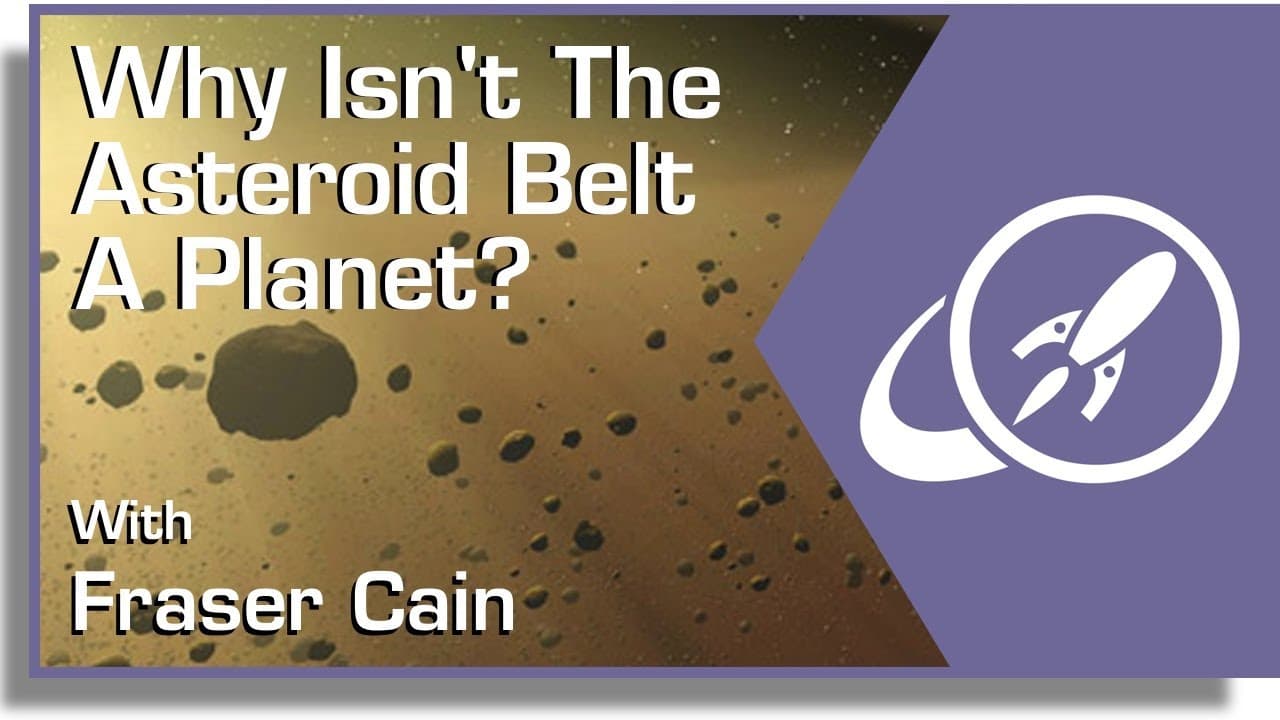
The asteroid belt isn't a planet because its mass is only about 4% of the Moon's and is made up of dispersed debris from various origins rather than a single body. Jupiter's gravity creates unstable gaps, known as Kirkwood gaps, preventing the formation of a planet in that region. This results in asteroids with distinct chemical compositions, indicating they formed in different areas of the solar system.
Transcript
beyond the orbit of Mars lies the asteroid belt it's a vast collection of rocks and Ice left over from the formation of the solar system starts about two astronomical units and ends around four astronomical units objects in the asteroid belt range from Tiny Pebbles to series at 950 km across well Star Wars and other sci-fi has it all wrong the obje... Read More
Key Insights
- 👾 Objects in the asteroid belt are widely spaced apart, making spacecraft navigation through it safe.
- 💆 The entire asteroid belt contains only a small fraction of the mass of our moon.
- 💥 The asteroid belt is not the result of a planet explosion or collision, as the chemical compositions of asteroids vary.
Install to Summarize YouTube Videos and Get Transcripts
Explore YouTube Video Summarizer or Get YouTube Transcript Extractor
Questions & Answers
Q: Is flying a spacecraft through the asteroid belt dangerous?
No, flying through the asteroid belt is not dangerous as objects are hundreds of thousands of kilometers apart, and there is no tactical advantage in doing so.
Q: How much mass does the entire asteroid belt have?
The entire asteroid belt, if formed into a single mass, would only make up around 4% of the mass of our moon.
Q: Could the asteroid belt be remnants of an exploded planet?
No, because explosions or collisions wouldn't have thrown material out of the solar system. Also, the different chemical compositions of asteroids suggest they formed in different regions of the asteroid belt.
Q: What are the Kirkwood gaps?
The Kirkwood gaps are gaps in the asteroid belt where asteroid orbits would be in resonance with the orbit of Jupiter. Jupiter's gravity destabilizes asteroids within these gaps, preventing a single planet from forming.
Summary & Key Takeaways
-
The asteroid belt, located beyond Mars, is a collection of rocks and ice remnants from the solar system's formation.
-
Objects in the asteroid belt are widely separated, ranging from small pebbles to large series.
-
The idea that the asteroid belt was formed by a planet explosion or collision is disproven by the different chemical compositions and the presence of Kirkwood gaps.
Read in Other Languages (beta)
Share This Summary 📚
Summarize YouTube Videos and Get Video Transcripts with 1-Click
Try YouTube Summary with ChatGPT & Claude or YouTube Transcript Generator
Explore More Summaries from Fraser Cain 📚
Summarize YouTube Videos and Get Video Transcripts with 1-Click
Try YouTube Summary with ChatGPT & Claude or YouTube Transcript Generator