What Is AI and How Can It Amplify Intelligence?
TL;DR
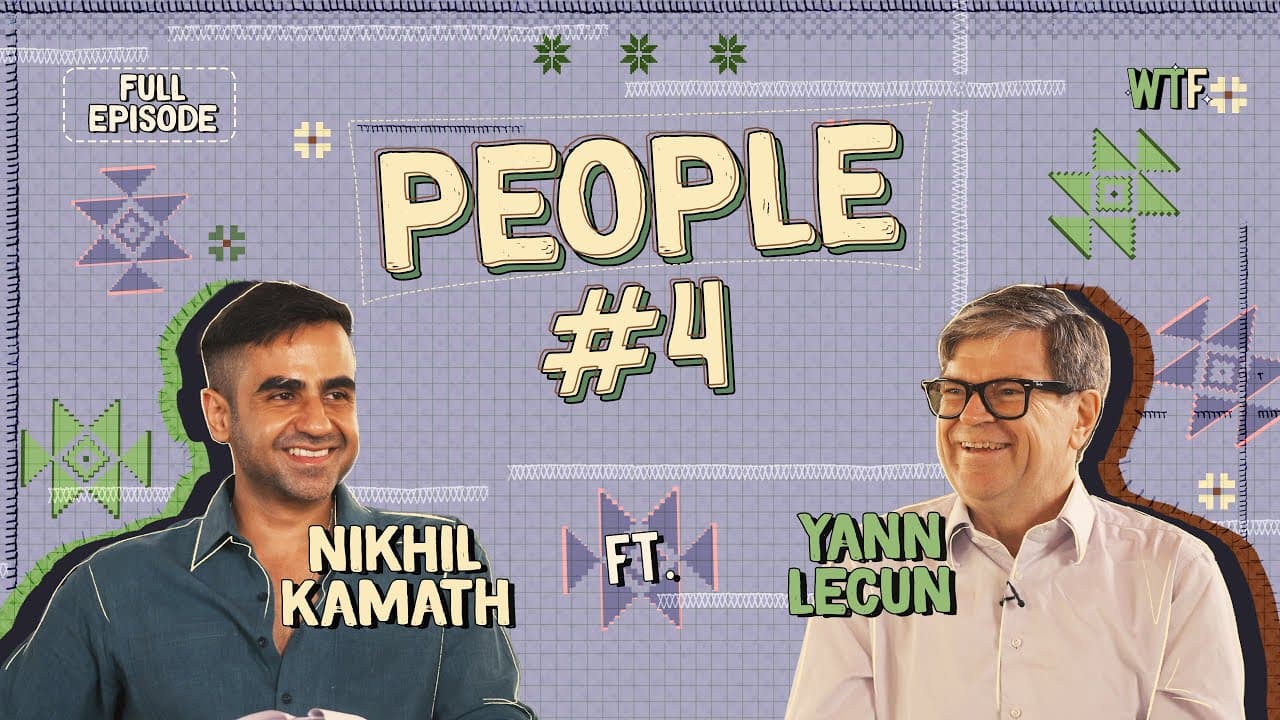
Artificial intelligence addresses different aspects of intelligence, including logical reasoning, searching for solutions, optimization, and building useful models of how the world works. Yann LeCun argues that intelligent machines can help uncover the nature of intelligence and amplify humanity’s ability to make rational decisions, discover facts, and solve major problems.
Transcript
I thought we could use today to figure out a what is AI how did we get here what likely next as an Indian 20-year-old who wants to build a business in AI a career in AI what do we do today today like right now yeah hi Yan good morning and you care thank you for doing this pleasure the very first thing we like to do is get to know you a bit more uh ... Read More
Key Insights
- Science is an attempt to understand the world, while engineering is an attempt to create new things. The boundary is not absolute because scientists often need new technology to collect evidence, and engineers may need deeper understanding before they can build something successfully.
- Building an intelligent machine is presented as a practical way to investigate intelligence. A working system can test whether a proposed mental model is correct while also producing technology whose consequences may become important for humanity.
- Scientific progress is a collective process driven by collisions among ideas from many contributors. Public memory tends to associate major advances with only a few individuals, even though many less visible researchers contribute to the development and validation of important ideas.
- Intelligence has multiple aspects, so defining AI from only one perspective resembles blind people encountering different parts of an elephant. Historical approaches have often concentrated on one capability, such as reasoning, while overlooking other components of intelligent behavior.
- Early artificial intelligence focused heavily on logical reasoning and searching for solutions. A problem can be represented as a space of possible answers, paired with a method for evaluating whether a candidate solves the problem or performs better than alternatives.
- Optimization is the mathematical framing of searching for a solution that minimizes or improves a measurable quantity. In the traveling salesman example, the goal is to find the shortest circuit that visits every specified city.
- Many human mistakes are attributed to limited knowledge, intelligence, or inadequate mental models of how the world works. Better understanding could support more rational decisions and improve humanity’s ability to identify, organize around, and solve difficult problems.
- Artificial intelligence can amplify human intelligence by expanding access to information, knowledge, and problem-solving capability. LeCun connects this goal with education, arguing that making people smarter is central to addressing problems such as climate change and failures of collective decision-making.
Install to Summarize YouTube Videos and Get Transcripts
Explore YouTube Video Summarizer or Get YouTube Transcript Extractor
Questions & Answers
Q: What is artificial intelligence according to Yann LeCun?
Artificial intelligence is not defined as a single capability because intelligence has many different aspects. LeCun compares its history to blind people encountering different parts of an elephant. Early researchers often treated intelligence primarily as logical reasoning and solution search, but that perspective addressed only one part of the broader question of what intelligence is.
Q: What is the difference between a scientist and an engineer?
A scientist primarily tries to understand the world, while an engineer primarily tries to create new things. LeCun says the distinction is difficult to define because the roles overlap. Understanding the world may require building new instruments or systems, and creating useful technology may require discovering new principles about how the world works.
Q: Why does Yann LeCun want to build intelligent machines?
LeCun sees building an intelligent machine as the most practical way to uncover the mysteries of intelligence. Constructing a working system allows an engineer or scientist to test whether a proposed mental model is correct. The effort therefore combines a scientific goal, understanding intelligence, with a practical goal, creating technology that could significantly affect humanity.
Q: How did early artificial intelligence model reasoning?
Early AI research treated reasoning as a process of searching through possible solutions to a problem. A system needs a space of candidate solutions and a way to measure whether each candidate is good. It can then search for the answer that best satisfies the chosen criterion, such as the route with the shortest total length.
Q: What is optimization in artificial intelligence?
Optimization is the mathematical formulation of searching for the best solution according to a measurable objective. LeCun illustrates it with the traveling salesman problem, where a route must visit every specified city. The length of each possible circuit can be evaluated, and the objective is to find the circuit with the smallest length.
Q: Why is intelligence compared with blind people examining an elephant?
The elephant analogy shows that intelligence contains several distinct aspects that can look like the whole phenomenon when viewed separately. One person touching an elephant’s side might describe a wall, while another encounters a different part. Similarly, AI researchers have historically focused on individual capabilities, such as reasoning, while ignoring other dimensions of intelligence.
Q: How can AI help humanity solve major problems?
AI can help by amplifying human intelligence and improving access to information and knowledge. LeCun argues that many problems persist because people lack sufficient understanding, make mistakes, or cannot organize effectively around solutions. Better mental models could support more rational decisions and accelerate the discovery of technological or organizational responses to problems such as climate change.
Q: Why does Yann LeCun reject the idea of a single AI godfather?
LeCun dislikes the label because science is not an isolated or purely individual pursuit. Progress emerges from interactions among many people’s ideas, followed by demonstrations or theoretical work that test whether hypotheses are correct. Although public memory highlights only a few individuals, he believes much more credit should go to the many contributors involved.
Summary & Key Takeaways
-
Yann LeCun describes science as an effort to understand the world and engineering as an effort to create new things. The two pursuits frequently overlap because scientific discovery depends on technology, while constructing intelligent machines may be the most practical way to investigate intelligence and test theories about how it works.
-
Artificial intelligence cannot be reduced to one simple capability because intelligence has many aspects. Early AI research emphasized logical reasoning and searching through possible solutions. Problems such as finding the shortest circuit through a collection of cities illustrate how reasoning can be formulated as optimization with measurable criteria for comparing possible answers.
-
LeCun argues that many human problems arise from insufficient knowledge, intelligence, or accurate mental models of the world. He sees education and access to information as essential responses. AI can contribute by amplifying human intelligence, supporting more rational decisions, and helping humanity organize itself to discover solutions more effectively.
Read in Other Languages (beta)
Share This Summary 📚
Summarize YouTube Videos and Get Video Transcripts with 1-Click
Try YouTube Summary with ChatGPT & Claude or YouTube Transcript Generator
Explore More Summaries from Nikhil Kamath 📚




Summarize YouTube Videos and Get Video Transcripts with 1-Click
Try YouTube Summary with ChatGPT & Claude or YouTube Transcript Generator