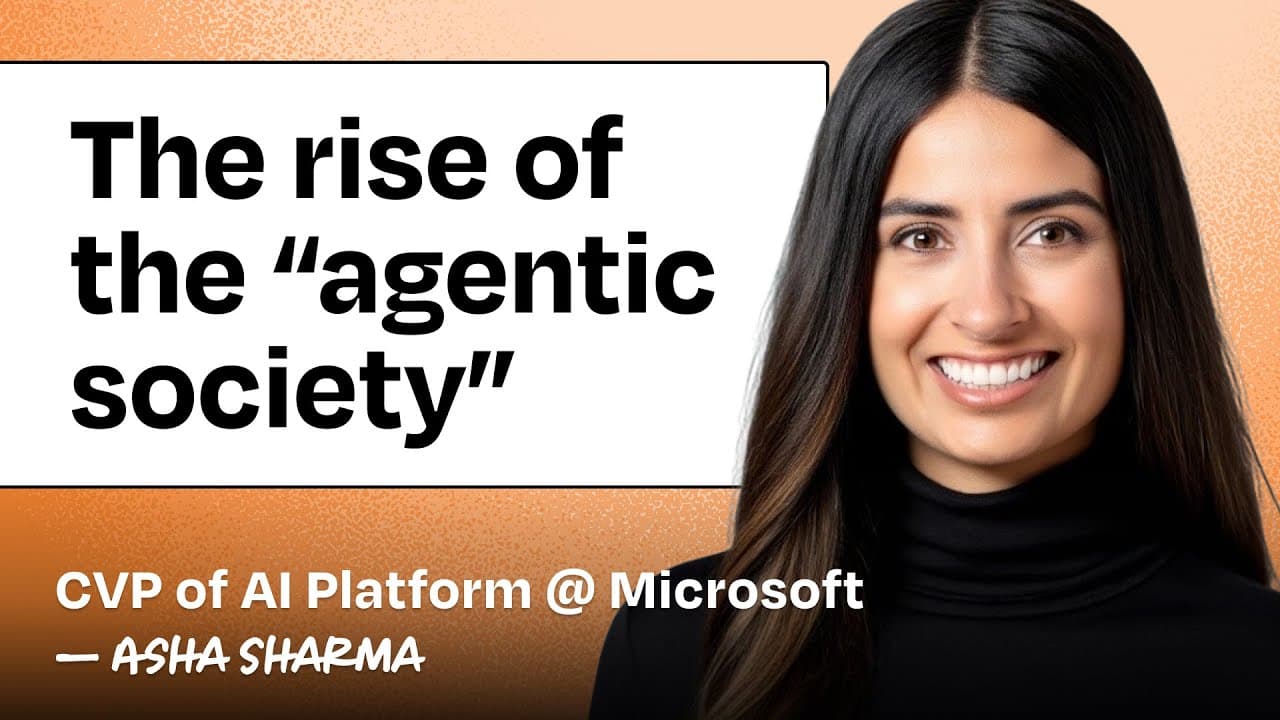
How Do 80,000 Companies Build With AI? Asha Sharma on Products as Organisms and the Death of Org Charts
TL;DR
AI transforms product development by turning static artifacts into “products as organisms” that learn and improve through interactions. Asha Sharma explains why agents can meet exponential demand for productivity, why the org chart may become a flatter “work chart,” and why companies increasingly tune models toward specific outcomes. Read on to understand the emerging product, interface, planning, and organizational shifts.
Transcript
You said that we're just starting to scratch the surface of what an agentic society actually looks like. We're approaching this world in which the marginal cost of the good output is approaching zero. We're going to see exponential demand for productivity and output. The way that you scale to that is with agents. When all of that happens, the org c... Read More
Key Insights
- AI products are evolving from static artifacts to dynamic organisms that learn and adapt over time.
- The traditional organizational chart is being replaced by task-based networks, emphasizing agility and collaboration.
- Post-training of AI models is becoming more important than pre-training, allowing for fine-tuning and optimization.
- Successful AI companies follow a three-phase pattern: AI fluency, process improvement, and growth inflection.
- Code-native interfaces are rising, potentially replacing traditional GUIs as the primary user interface.
- An agentic society is emerging, where agents perform tasks traditionally done by humans, reshaping work structures.
- Reinforcement learning is crucial for optimizing AI models, offering a competitive advantage through continuous improvement.
- Optimism and energy are vital leadership traits, inspiring teams to embrace AI's transformative potential.
Install to Summarize YouTube Videos and Get Transcripts
Explore YouTube Video Summarizer or Get YouTube Transcript Extractor
Questions & Answers
Q: How is AI transforming product development and organizational structures?
AI is enabling products to move from static artifacts to living systems that improve through interactions. As agents take on more work, organizations can shift from layered org charts toward flatter “work charts” organized around tasks and output.
Q: What does Asha Sharma mean by “product as organism”?
A product as organism is a product that can think, live, learn, and improve as it receives more interactions. Instead of shipping a mostly static artifact and making occasional updates, teams tune models toward desired outcomes and continuously ingest data and feedback.
Q: Why could AI agents become essential for scaling productivity?
Asha describes a future in which the marginal cost of good output approaches zero and demand for productivity and output grows exponentially. She argues that agents provide the means to scale enough work to meet that demand.
Q: Why might the org chart become a “work chart”?
When agents can perform and scale more tasks, companies may no longer need as many organizational layers. The focus shifts from a hierarchy of roles toward the actual network of work that must be completed.
Q: How are advances in AI models changing products?
Models have become more efficient and have developed expertise in particular domains. More recently, they can call tools and functions and take action, enabling a new category of products rather than merely static software experiences.
Q: How can product teams plan AI roadmaps when models change rapidly?
Asha frames planning around the current “season” of AI rather than assuming a fixed long-term roadmap. She identifies an initial season of AI prototyping, a period focused on models and reasoning models, and the current advent of agents.
Q: Why does the conversation describe post-training as the new pre-training?
As models become effective enough to power products, companies increasingly want to tune them toward particular outcomes. The discussion presents this post-training work as an important way to shape products that improve through ongoing interactions.
Q: Who is Asha Sharma, and what perspective does she bring to AI product development?
Asha Sharma is chief vice president of product for Microsoft’s AI platform, overseeing AI infrastructure, foundation models, and agent toolchains while leading applied engineering, responsible AI, and growth. She previously served as COO at Instacart and VP of product at Meta, where she ran Messenger, Instagram Direct, Messenger Kids, and remote presence.
Summary & Key Takeaways
-
AI is driving a shift from 'product as artifact' to 'product as organism,' where products continuously learn and adapt. This transformation requires organizations to rethink their structures, focusing on task networks rather than hierarchical charts. Successful AI integration involves post-training and fine-tuning to optimize model performance.
-
The rise of code-native interfaces suggests a move away from traditional GUIs, aligning better with AI's capabilities. This shift, along with the emergence of an agentic society, where agents handle tasks, is reshaping how companies operate. Reinforcement learning is key to maintaining a competitive edge in this new landscape.
-
Leadership in the AI era demands optimism and the ability to generate energy and clarity. Companies must embrace AI fluency and focus on continuous learning and improvement. The future of work and product development lies in leveraging AI to enhance productivity and innovation.
Read in Other Languages (beta)
Share This Summary 📚
Summarize YouTube Videos and Get Video Transcripts with 1-Click
Try YouTube Summary with ChatGPT & Claude or YouTube Transcript Generator
Explore More Summaries from Lenny's Podcast 📚





Summarize YouTube Videos and Get Video Transcripts with 1-Click
Try YouTube Summary with ChatGPT & Claude or YouTube Transcript Generator