How Do Tariffs Affect the Dollar, Bonds, and Bitcoin?
TL;DR
Tariffs alone are unlikely to cause a recession because services account for $14.3 trillion of personal consumption, compared with $2.3 trillion for durable goods, and current hard data remains stable. The larger investment risks are rising long-term yields, AI-driven disruption, and weakening confidence in the dollar, while broader liquidity trends may support emerging markets and Bitcoin.
Transcript
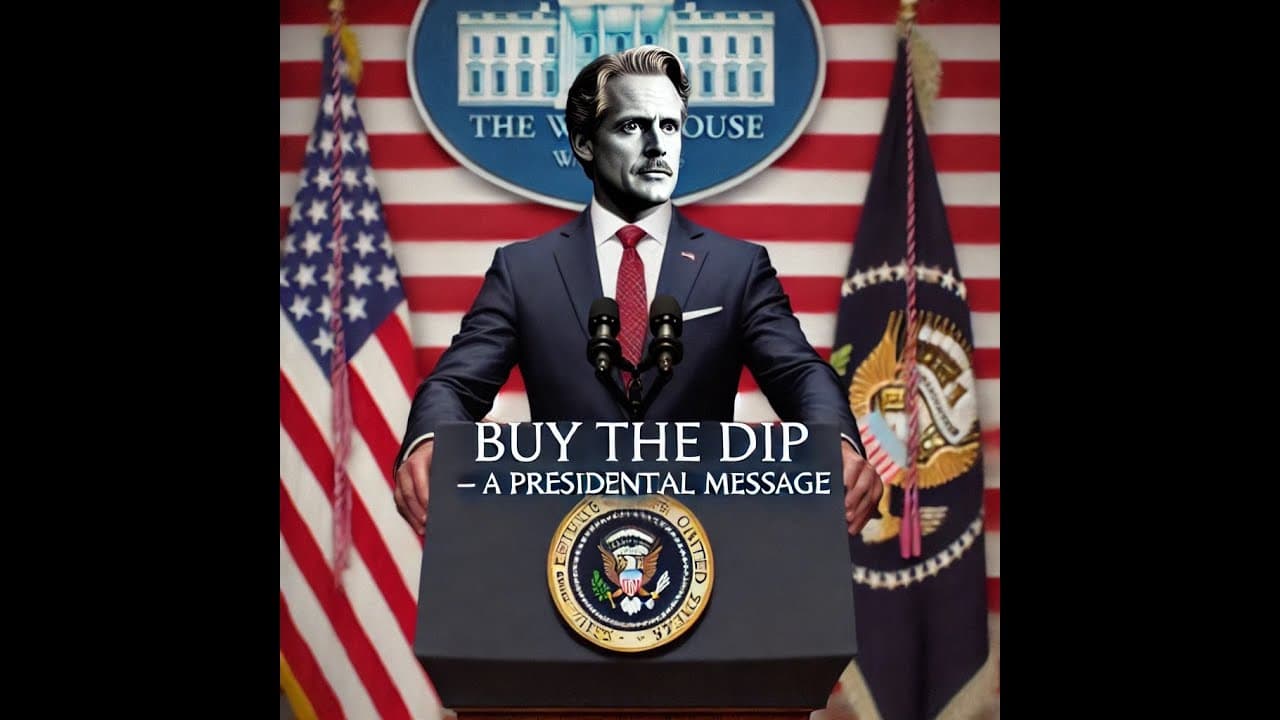
Um, another week, uh, president says to buy stocks again. Never thought I'd, uh, be saying that in my, uh, career in this business, uh, unless I was in an emerging market. Uh, sentiment finally starting to shift, but the hard data continues to disappoint bears. I'll spend some time on that. Uh, Taiwan dollar spent a lot of time writing about it, ta... Read More
Key Insights
- The US economy is primarily service-based, with $14.3 trillion spent on services compared with $2.3 trillion on durable goods. Because tariffs apply to physical imports rather than most services, historical comparisons with the goods-heavy economy of the early 1900s can exaggerate their present economic importance.
- Private domestic final purchases are running near 3%, according to the measure highlighted repeatedly by Powell. This stability suggests that underlying domestic demand remained intact even though quarterly GDP was negative and included weaker government activity and unusual trade-related components.
- Initial jobless claims are the preferred real-time recession signal because widespread economic contraction should produce substantial layoffs and insurance filings. Claims returned to 226,000 after a 15,000 increase associated with New York and holidays, providing no evidence of the massive service-sector job losses expected in a recession.
- Corporate buybacks are on pace for their biggest year, supported by strong earnings results. Companies generally do not commit cash to unusually large repurchases when they expect their businesses to deteriorate severely or when they are preparing for broad layoffs.
- Market breadth is strong because the S&P 500 advance-decline line closed at an all-time high. The S&P 500 excluding the Magnificent Seven is also unchanged for the year, indicating that weakness was concentrated in seven stocks that experienced multiple compression rather than across the entire market.
- A weaker dollar acts as a global liquidity stimulus because more than 65% of global debt is denominated in dollars. This environment benefits markets outside the United States, particularly emerging markets, and supports the view that Latin America could perform well through the remainder of the year.
- Rising long-term interest rates and AI disruption are the largest emerging investment risks in the analysis. Higher rates pressure long-duration assets and small-cap companies, while AI may reinforce a market structure in which a few dominant firms outperform many smaller competitors.
- Bitcoin is approaching its all-time highs while relatively few Wall Street investors own it. Growing institutional adoption, changing confidence in the dollar, and pressure on long-duration assets make Bitcoin one of the two most important investment themes through year-end, alongside AI.
Install to Summarize YouTube Videos and Get Transcripts
Explore YouTube Video Summarizer or Get YouTube Transcript Extractor
Questions & Answers
Q: Why are tariffs unlikely to cause a US recession?
Tariffs affect physical imports, but the modern US economy is overwhelmingly driven by services. Personal consumption includes $14.3 trillion in services and only $2.3 trillion in durable goods. Goods-producing employment is also near its 1965 level despite major population growth. A recession would more likely require collapsing earnings and stock prices, not tariff pressure alone.
Q: What economic data suggests the US is not in a recession?
Private domestic final purchases remain stable near 3%, while initial jobless claims returned to 226,000 after a temporary 15,000 increase linked to New York and holidays. Corporate earnings from service-oriented companies also remain strong. Together, stable underlying demand, limited unemployment claims, positive guidance, and substantial buybacks contradict expectations of an immediate recession.
Q: Why are initial jobless claims important for recession forecasts?
Initial jobless claims provide a real-time indication of whether workers are being dismissed and applying for unemployment insurance. A service-led recession would require massive job losses, but current claims do not show that pattern. The latest figure was 226,000 after a holiday-related increase reversed, so the labor data provides no confirmation of widespread contraction.
Q: What do corporate buybacks reveal about business conditions?
Corporate buybacks indicate that companies have enough confidence and available cash to repurchase their own shares. Strong earnings have produced a surge in repurchases, putting the market on pace for its biggest buyback year. Businesses normally reduce or stop buybacks when they fear serious operational trouble, as occurred around the 2008–2009 period and during COVID.
Q: How does a weaker dollar affect global markets?
A weaker dollar increases global liquidity because more than 65% of debt worldwide is denominated in dollars. Countries and borrowers outside the United States therefore benefit when the dollar declines. The effect can support international equities and emerging markets, with Latin America identified as particularly attractive for the remainder of the year, even if US benefits are mixed.
Q: Why is the Taiwan dollar's rise important for investors?
The sharp rise in the Taiwan dollar is interpreted as confirmation of a longer-term currency shift and a warning about declining dollar reserve-currency dominance. The analysis connects this change to broader global liquidity, potential upward pressure on long-term yields, and greater risk for long-duration assets. It is therefore treated as more than a short-term foreign-exchange move.
Q: Why are rising rates and AI major risks for small-cap stocks?
Small-cap companies face pressure from both higher financing costs and technological disruption. Rising long-term rates reduce the appeal of long-duration assets and make capital more expensive, while AI may favor dominant companies with scale. The expected result resembles the Amazon-versus-everyone market pattern from 2009 to 2019, leaving smaller firms at a structural disadvantage.
Q: Why does the analysis consider Bitcoin important through year-end?
Bitcoin is approaching its all-time highs even though relatively few Wall Street investors own it. The case rests on growing institutional adoption, weakening confidence in the dollar, and the vulnerability of conventional long-duration assets to rising rates. Alongside AI, Bitcoin is presented as one of the most important investment stories from the current period through year-end.
Summary & Key Takeaways
-
The market recovery is supported by improving breadth, falling volatility, systematic buying, retail demand, and a surge in corporate buybacks. The S&P 500 excluding the Magnificent Seven is unchanged for the year, suggesting that the correction has largely reflected multiple compression within seven major companies rather than broad economic deterioration.
-
The recession argument overstates tariffs because the modern US economy is dominated by services. Personal consumption includes $14.3 trillion in services and $2.3 trillion in durable goods, while goods-producing payrolls remain near their 1965 level. Stable private domestic final purchases and low jobless claims provide stronger evidence of current conditions.
-
The Taiwan dollar's sharp rise is presented as confirmation of a longer-term shift away from dollar dominance. A weaker dollar stimulates global liquidity because more than 65% of global debt is denominated in dollars, but declining reserve-currency confidence may also lift long-term yields and disrupt rate-sensitive assets alongside accelerating AI adoption.
Read in Other Languages (beta)
Share This Summary 📚
Summarize YouTube Videos and Get Video Transcripts with 1-Click
Try YouTube Summary with ChatGPT & Claude or YouTube Transcript Generator
Explore More Summaries from Jordi Visser 📚





Summarize YouTube Videos and Get Video Transcripts with 1-Click
Try YouTube Summary with ChatGPT & Claude or YouTube Transcript Generator