Why Are Stocks Rising as Bitcoin Pulls Back?
TL;DR
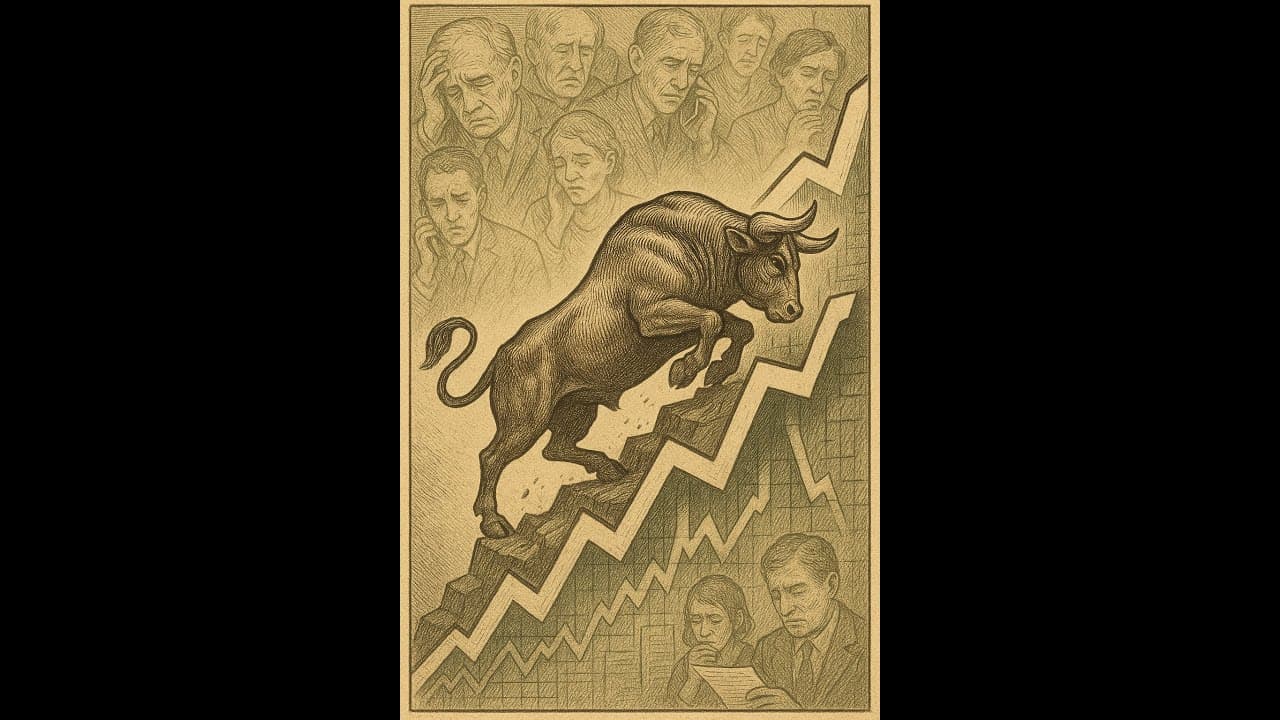
Stocks are rising because earnings growth is broadening beyond mega-cap technology while AI infrastructure spending supports manufacturing, construction, and profit margins. The S&P 500 gained 2.5% for its fourth consecutive positive month, while the Russell 2000 rose more than 7%. Bitcoin’s pullback was linked to capital rotating toward China. Read on for the earnings, PMI, banking, and construction indicators behind this outlook.
Transcript
Right. Overall, uh, fairly quiet week to end the summer. Hopefully, this video will, uh, give you some things to think about coming out as we begin September. Uh, you know, despite everything that happened, uh, in this month, all of the worries, the reciprocal tariffs, everything going on, uh, Fed drama. S&P posted its fourth monthly gain in a row,... Read More
Key Insights
- The S&P 500 posted a fourth consecutive monthly gain, rising 2.5% despite reciprocal tariffs, Federal Reserve drama, and persistent economic worries. This performance supports the view that markets can continue advancing while investors remain focused on risks and potential slowdowns.
- Small-cap stocks are benefiting from expectations for broader economic participation. The Russell 2000 gained more than 7% during the month, its strongest month since the election, as improving manufacturing indicators and a reflationary environment began supporting companies outside dominant mega-cap technology names.
- Corporate earnings growth is broadening beyond the Magnificent Seven. Those seven companies delivered 26.6% year-over-year growth, while the remaining 493 S&P 500 companies generated 8.1%, with sector-level revenue surprises showing widespread results above the expectations established before the quarter.
- AI investment is supporting profit margins and expanding infrastructure demand. Spending is moving beyond computing capacity toward power, data centers, gas turbines, transformers, cooling systems, and other physical requirements, with hyperscalers raising capital expenditure and contributing to a wider global investment cycle.
- Manufacturing has endured an unusually long contraction without the overall economy entering recession. The 20-month PMI average reached levels historically associated with recessions, leaving many value-oriented and lower-multiple companies without positive demand trends, but recent manufacturing measures indicate activity has started recovering from its April bottom.
- Construction planning is accelerating across more than data centers. The Dodge Momentum Index increased 41% year-over-year in July, with its commercial segment rising 24% and its institutional segment rising 85%. Excluding data center projects, commercial planning still increased 26%, indicating broader construction momentum.
- DDR3 DRAM prices are signaling tighter conditions in older hardware markets. These chips are used in PCs, laptops, servers, consumer electronics, routers, and embedded systems, and their price acceleration may indicate that demand and shortages are spreading from advanced AI equipment into established hardware categories.
- Oil could benefit if PMIs rise toward 60 because stronger manufacturing has historically coincided with higher year-over-year oil prices. Bullish hedge fund positioning was reported at a 2007 low amid glut concerns, creating a combination of bearish sentiment, improving potential demand, and growing AI-related power requirements.
Install to Summarize YouTube Videos and Get Transcripts
Explore YouTube Video Summarizer or Get YouTube Transcript Extractor
Questions & Answers
Q: Why are stocks rising while Bitcoin pulls back?
Stocks are benefiting from broadening earnings growth, improving manufacturing indicators, and expanding AI infrastructure investment. The S&P 500 gained 2.5% for its fourth consecutive positive month, while Bitcoin’s pullback was linked to capital rotating toward China.
Q: Why did stocks rise despite tariffs and Federal Reserve uncertainty?
Earnings, revenue surprises, and manufacturing indicators were stronger than the prevailing worries suggested. The S&P 500 gained 2.5%, while small caps and banks also advanced, showing that participation was expanding beyond mega-cap technology companies.
Q: How is earnings growth broadening beyond the Magnificent Seven?
The Magnificent Seven delivered 26.6% year-over-year growth, while the other 493 S&P 500 companies produced 8.1%. Positive three-month changes in forward revenue and earnings also increased, suggesting that more companies are participating in the growth.
Q: How could AI infrastructure spending support manufacturing?
The AI buildout is expanding beyond computing capacity into power generation, data centers, gas turbines, transformers, cooling systems, and related construction. Hyperscalers are raising capital expenditures, and shortages in essential equipment create demand for additional production capacity.
Q: What indicates that manufacturing activity may be recovering?
Manufacturing measures have begun improving from their April bottom, while durable-goods orders for non-defense capital goods excluding aircraft remained elevated. Accelerating construction planning and rising DDR3 DRAM prices also point to stronger demand for equipment, hardware, and physical infrastructure.
Q: Why do small caps and banks matter to the stock-market outlook?
Their performance indicates whether growth is reaching companies beyond the largest technology businesses. The Russell 2000 rose more than 7% during the month, and the BKX surpassed its 2021 peak to reach new all-time highs.
Q: How does the PMI relate to corporate revenue growth?
Historically, stronger PMIs have coincided with surges in S&P 500 revenue. As manufacturing activity improves, more companies can receive orders and generate revenue, potentially extending growth to the S&P 493, mid-caps, value stocks, and non-technology sectors.
Q: What does construction planning reveal about the economic outlook?
The Dodge Momentum Index rose 41% year over year in July, including gains of 24% in its commercial segment and 85% in its institutional segment. Commercial planning still increased 26% when data-center projects were excluded, indicating that construction momentum extended beyond AI data centers.
Summary & Key Takeaways
-
The S&P 500 gained 2.5% for its fourth consecutive positive month, despite tariffs, Federal Reserve uncertainty, and other worries. Small caps performed particularly well, with the Russell 2000 rising more than 7%. Banks also strengthened globally, while the BKX surpassed its previous 2021 peak and reached new all-time highs.
-
Earnings exceeded earlier expectations across sectors. The Magnificent Seven produced 26.6% year-over-year growth, while the other 493 S&P 500 companies delivered 8.1%. Positive revisions in forward revenue and earnings suggested participation was expanding beyond mega-cap technology, potentially supporting mid-caps, value stocks, and non-technology sectors as manufacturing activity improves.
-
AI infrastructure investment is expanding from computing capacity into data centers, power generation, transformers, gas turbines, cooling systems, and related construction. Durable goods orders, manufacturing activity, construction planning, and DDR3 DRAM prices indicate improving demand. If PMIs continue rising, corporate revenues could broaden further and strengthen economically sensitive markets, including energy.
Read in Other Languages (beta)
Share This Summary 📚
Summarize YouTube Videos and Get Video Transcripts with 1-Click
Try YouTube Summary with ChatGPT & Claude or YouTube Transcript Generator
Explore More Summaries from Jordi Visser 📚



Summarize YouTube Videos and Get Video Transcripts with 1-Click
Try YouTube Summary with ChatGPT & Claude or YouTube Transcript Generator