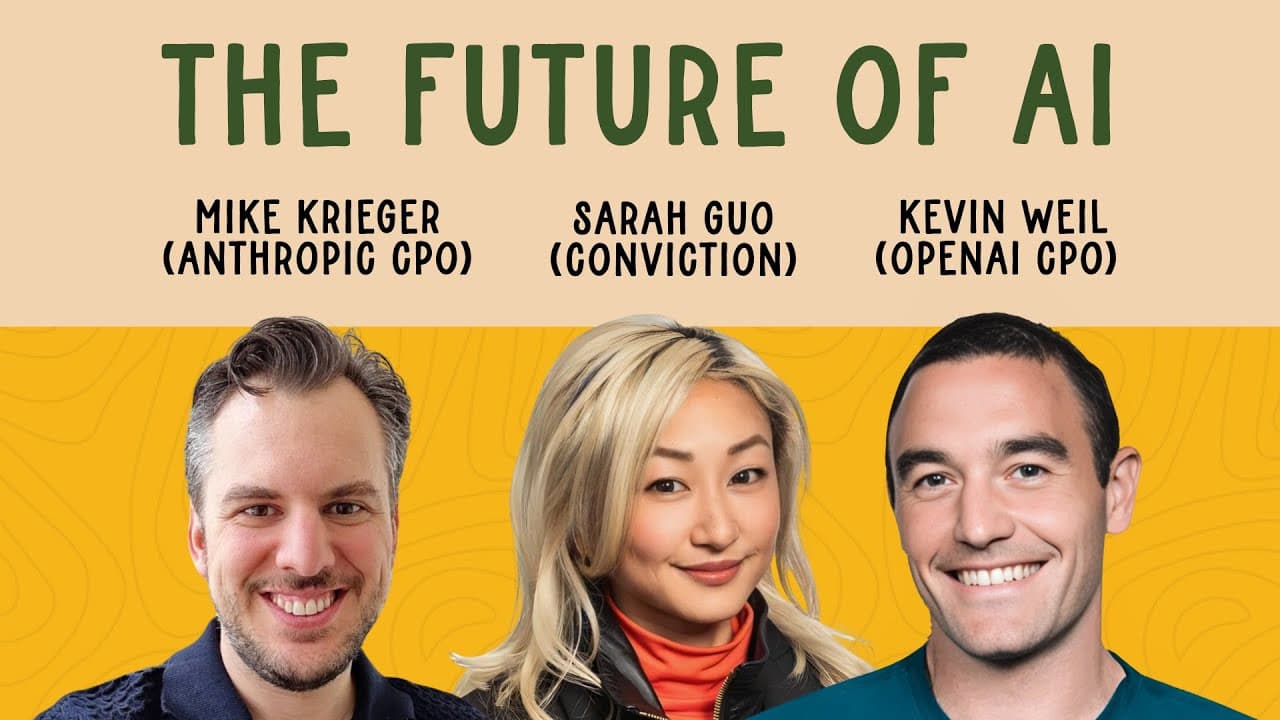
Kevin Weil and Mike Krieger on Building AI Products
TL;DR
Building AI products differs from normal product work because the technology base keeps changing: roughly every two months, models can do something computers never could before. OpenAI CPO Kevin Weil and Anthropic CPO Mike Krieger describe planning around uncertain model capabilities, working closely with research teams, and adjusting to slower enterprise sales cycles that still give direct customer feedback.
Transcript
all right hello everyone okay okay Sarah you're the queen of AI investing this is a phrase never ever to be used again but it's great to be here with both of you um so I had two different ideas for our final discussion the first was a product off because these two men have the merge to to prod button both of them and I was like oh please just relea... Read More
Key Insights
- AI product management differs from traditional product work because the technology base is not fixed. Kevin Weil says that roughly every two months computers can do something they have never done before, so the product should change with them.
- The reliability of a model capability shapes the product built on it. A feature that works 60% of the time calls for a very different product than one that works 90% or 99% of the time, and teams often cannot know which level they will get.
- New model capabilities are often emergent and hard to predict. Neither product nor research teams know in advance whether a model in training will reliably have a given capability, so early product planning is uncertain.
- Enterprise sales move far more slowly than consumer launches. Mike Krieger says a deal can sit in a requisition stage for about six months before deployment, which is a big adjustment for someone used to consumer product speed.
- Enterprise customers give direct feedback that consumer products lack. Once a product is deployed, the customer can be called and asked how it is working, while consumer feedback mostly comes from aggregate data science.
- Enterprise success depends on the buyer, not only the product. Kevin Weil notes that a company's buyer has its own goals, and one large customer asked OpenAI for 60 days' notice before any launch.
- Co-designing with research is a key part of AI product work. Anthropic's Artifacts and OpenAI's Canvas were built through joint design, research, and fine-tuning between product and research teams.
- Product work with research should aim for learning rather than predictable outputs. Krieger compares it to experimentation: the useful result is often a demo or insight that sparks product ideas, not a finished product.
Install to Summarize YouTube Videos and Get Transcripts
Explore YouTube Video Summarizer or Get YouTube Transcript Extractor
Questions & Answers
Q: How is being a product leader at an AI company different from a normal product role?
According to OpenAI CPO Kevin Weil, a normal product role builds on a fixed technology base, so you know what you can work with. At an AI company, roughly every two months computers gain abilities they have never had before, and product leaders have to keep working out how each new capability should change the product. He calls it the most challenging, interesting, and sleepless product role he has had.
Q: Why does model accuracy matter so much when designing AI products?
Kevin Weil explains that the right product depends heavily on how reliably a model performs a task. A product that makes sense for a capability that works 60% of the time is very different from one built for 90% or 99% reliability. Because new capabilities are often emergent properties of models still in training, teams usually cannot know ahead of time which reliability level they will get.
Q: How long do enterprise AI deals take compared with consumer products?
Mike Krieger, Anthropic's CPO, says enterprise sales feel much slower than consumer product work. After an initial conversation that seems positive, a deal can move into a requisition stage and take about six months before deployment even starts. He describes colleagues reminding him that things are still working their way through the organization, which was a new pace for someone who founded Instagram.
Q: What are the benefits of building AI products for enterprise customers?
Mike Krieger says the rewarding part of enterprise work is direct engagement. Once a product is deployed, he can call the customer and they can call him to discuss what works and what does not. With consumer users, feedback mostly comes from aggregate data science and a few interviews, and individual users have little financial incentive to explain in detail where a product falls short.
Q: Why is enterprise success not only about having the best product?
Kevin Weil points out that in enterprise sales there is a buyer with their own goals, so building the best product, one employees would happily use, does not guarantee success. As an example, one large OpenAI enterprise customer said their main need was to be told 60 days before anything launched. Weil joked that he would also like to know 60 days in advance.
Q: How do AI product teams work with research teams on new features?
Mike Krieger describes three ways to approach it: watching the steadily improving slope of model intelligence, choosing capabilities to invest in and fine-tuning them with research, and responding to new capability frontiers such as computer use. Features like Anthropic's Artifacts and OpenAI's Canvas came from co-design, co-research, and co-fine-tuning between product and research. Anthropic also embeds designers early in this process.
Q: What should product teams expect when partnering with AI research?
Mike Krieger says the output of working with research should be learning, much like the output of an experiment, and not a predictable product pipeline. The aim is demos or informative results that can spark product ideas. Kevin Weil adds that discovery happens both ways: researchers have sometimes said a capability the product team wanted had already existed for three months, because they did not know it mattered.
Q: How does a company's own research affect its product roadmap?
Mike Krieger compares it to his Instagram days watching Apple's WWDC announcements, which could either be great for the app or cause chaos. At an AI lab the disruption comes from inside: a new model capability from your own research team can reshape the product roadmap. Kevin Weil says checking in on model training is unpredictable, since researchers often do not know the results yet either.
Summary & Key Takeaways
-
Sarah Guo of Conviction moderates a conversation with OpenAI CPO Kevin Weil and Anthropic CPO Mike Krieger at the Lenny and Friends Summit in San Francisco. Both are relatively new to their roles. Weil calls it the most challenging and interesting product job he has had, and Krieger says he could not stay semi-retired.
-
Krieger describes adjusting to enterprise customers, where deals can take around six months to reach deployment but give direct feedback. Weil adds that enterprise buyers have goals beyond the product itself, such as one customer asking for 60 days' notice before launches, and that OpenAI serves consumer, enterprise, and developer users at once.
-
Both leaders explain that AI product planning is shaped by emerging model capabilities whose reliability is unknown in advance. They embed designers early, co-design features like Artifacts and Canvas with research, and treat early work as learning. Sometimes researchers reveal that a wanted capability has quietly existed for months.
Read in Other Languages (beta)
Share This Summary 📚
Summarize YouTube Videos and Get Video Transcripts with 1-Click
Try YouTube Summary with ChatGPT & Claude or YouTube Transcript Generator
Explore More Summaries from Lenny's Podcast 📚



Summarize YouTube Videos and Get Video Transcripts with 1-Click
Try YouTube Summary with ChatGPT & Claude or YouTube Transcript Generator