How Does the P-47 Thunderbolt Work?
TL;DR
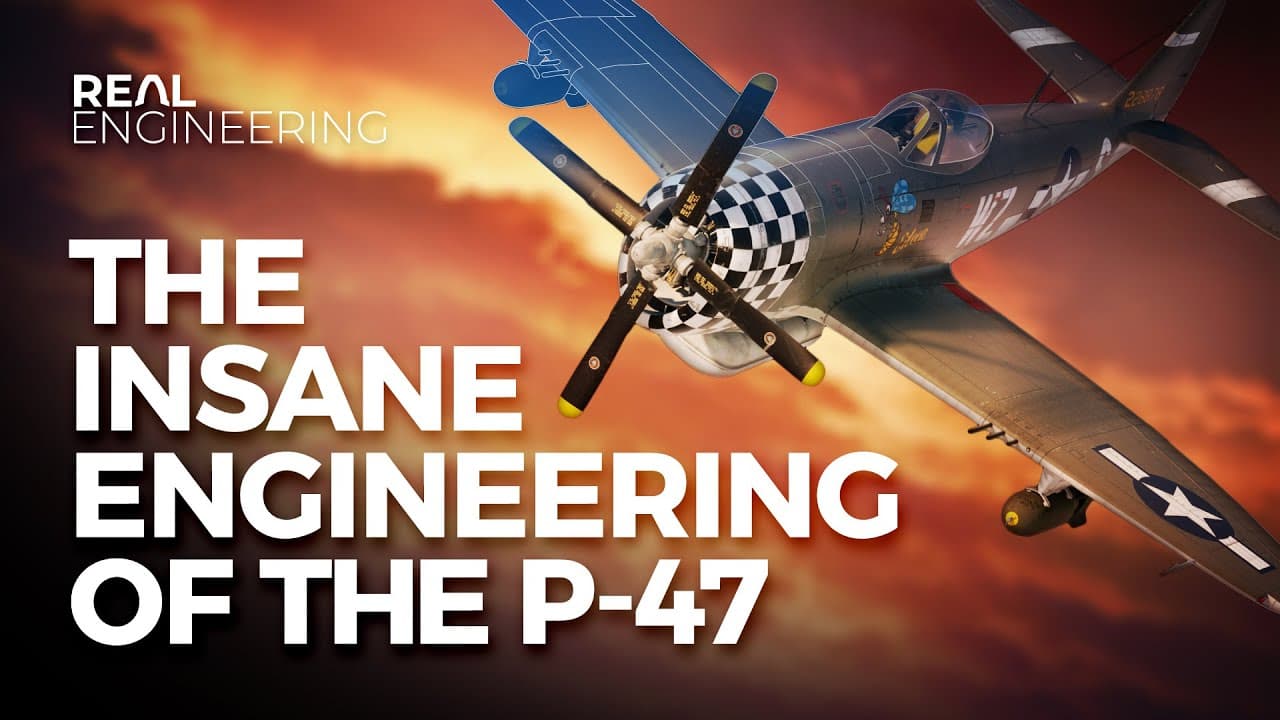
The P-47 Thunderbolt was a key aircraft in World War II, known for its powerful engine and durable design. Despite its large size and weight, it excelled in high-altitude performance and was effective in ground-attack roles. Its ability to take damage and deliver heavy payloads made it a crucial asset in the Allied invasion of Europe.
Transcript
This video was made possible by CuriosityStream, sign up for the Nebula bundle deal for just 15 dollars at curiositystream.com/realengineering to watch our logistics of close air support video that inspired this episode. Earlier this month I posed this question to my twitter followers. Was the P-47 Thunderbolt one of the best planes of World War 2?... Read More
Key Insights
- The P-47 Thunderbolt was built around the massive Pratt and Whitney R-2800 Double Wasp engine, providing significant power and high-altitude performance.
- A supercharger and intercooler system enhanced the P-47's engine efficiency, allowing it to maintain power at high altitudes.
- Water injection technology was used to temporarily boost engine horsepower, crucial during emergencies.
- Despite its large size, the P-47 was known for its durability, able to withstand significant damage and protect its pilot.
- The P-47 had a short range initially, but later models included drop tanks to extend operational range.
- The aircraft's heavy payload capacity made it effective in ground-attack missions, carrying bombs and machine guns.
- The P-47's design allowed for excellent roll rates and high-speed hit-and-run tactics, despite being outperformed in dogfights.
- The P-47 played a significant role in the Allied invasion of Europe, contributing to the destruction of enemy logistics and vehicles.
Install to Summarize YouTube Videos and Get Transcripts
Explore YouTube Video Summarizer or Get YouTube Transcript Extractor
Questions & Answers
Q: How did the P-47 Thunderbolt's engine contribute to its performance?
The P-47 Thunderbolt was powered by the Pratt and Whitney R-2800 Double Wasp engine, a two-row, 18-cylinder air-cooled radial engine with a displacement of 46 liters. This powerful engine provided the aircraft with exceptional high-altitude performance. The engine's power was further enhanced by a supercharger system, which compressed air for the engine, and an intercooler, which cooled the compressed air, allowing the P-47 to maintain power at altitudes where other aircraft struggled.
Q: What role did water injection play in the P-47's engine performance?
Water injection in the P-47's engine provided a temporary boost in horsepower during emergencies. The injected water absorbed heat during evaporation, cooling the engine and increasing air density, allowing more air/fuel mixture into the cylinders. This increased the power output during critical moments, such as evading enemy aircraft or climbing rapidly. However, due to limited water supply, this boost was reserved for emergency situations.
Q: What were the P-47 Thunderbolt's primary advantages in combat?
The P-47 Thunderbolt's primary advantages included its powerful engine, which provided high-altitude performance, and its robust construction, which allowed it to withstand significant battle damage. It also had a high roll rate and could carry a substantial payload, making it effective in ground-attack missions. Its speed and altitude capabilities enabled it to perform hit-and-run tactics, avoiding prolonged dogfights where it was at a disadvantage.
Q: How did the P-47's design impact its role in World War II?
The P-47's design, featuring a large, powerful engine and durable construction, made it ideal for ground-attack missions and high-altitude engagements. Its ability to carry heavy payloads of bombs and machine guns allowed it to disrupt enemy logistics effectively. Despite its large size, the P-47's speed and altitude performance made it a formidable adversary in the European theater, supporting Allied ground forces and contributing to the success of operations like the D-Day invasion.
Q: Why was the P-47 Thunderbolt considered a reliable aircraft?
The P-47 Thunderbolt was considered reliable due to its durable construction and ability to absorb damage. The air-cooled radial engine was less vulnerable to damage compared to liquid-cooled engines. Its robust airframe and self-sealing fuel tanks enhanced pilot survivability during combat. This reliability, combined with its heavy armament and payload capacity, made it a favored aircraft among pilots, capable of returning safely even after sustaining significant damage.
Q: What challenges did the P-47 face in terms of range and how were they addressed?
Initially, the P-47 faced challenges with limited range due to its large engine and fuel consumption. Early models had a range similar to the short-range Spitfire, frustrating bomber crews relying on its escort capabilities. This issue was partially addressed by adding drop tanks, which extended the operational range significantly. Later models incorporated wing-mounted drop tanks, allowing the P-47 to engage targets deeper into enemy territory and support Allied operations more effectively.
Q: How did the P-47 Thunderbolt's armament compare to other fighters of its time?
The P-47 Thunderbolt was heavily armed compared to other fighters of its time. It featured eight M2 heavy machine guns, providing substantial firepower. Additionally, it could carry over 1,136 kilograms of bombs, more than double the payload of the P-51 Mustang. This made the P-47 an effective ground-attack aircraft, capable of destroying enemy vehicles and infrastructure, earning it a reputation as a formidable fighter-bomber during World War II.
Q: What was the strategic impact of the P-47 Thunderbolt in the European theater?
The P-47 Thunderbolt had a significant strategic impact in the European theater by providing close air support and disrupting German supply lines. Its ability to carry heavy payloads allowed it to destroy railway cars, locomotives, and armored vehicles, hindering German logistics. The P-47's presence over Normandy and its role in the Allied invasion contributed to delaying and blunting German counteroffensives, supporting the overall success of Allied operations in Europe.
Summary & Key Takeaways
-
The P-47 Thunderbolt was a robust World War II fighter, built around a powerful engine that provided exceptional high-altitude performance. It was heavily armored and capable of carrying large payloads, making it effective for ground attacks. Despite its drawbacks in dogfighting, its speed and durability made it a formidable aircraft.
-
The Thunderbolt's design featured a supercharger and intercooler system, optimizing engine performance at high altitudes. Water injection technology provided emergency power boosts. While initially limited by range, later models incorporated drop tanks to extend operational reach, allowing it to support Allied forces deeper into enemy territory.
-
The P-47's strengths lay in its ability to take damage and deliver heavy firepower, earning it the nickname 'Juggernaut.' It played a crucial role in disrupting German logistics during the Allied invasion of Europe, proving to be a versatile and reliable aircraft despite its size and weight.
Read in Other Languages (beta)
Share This Summary 📚
Summarize YouTube Videos and Get Video Transcripts with 1-Click
Try YouTube Summary with ChatGPT & Claude or YouTube Transcript Generator
Explore More Summaries from Real Engineering 📚





Summarize YouTube Videos and Get Video Transcripts with 1-Click
Try YouTube Summary with ChatGPT & Claude or YouTube Transcript Generator