Ordered Dithering - Computerphile
TL;DR
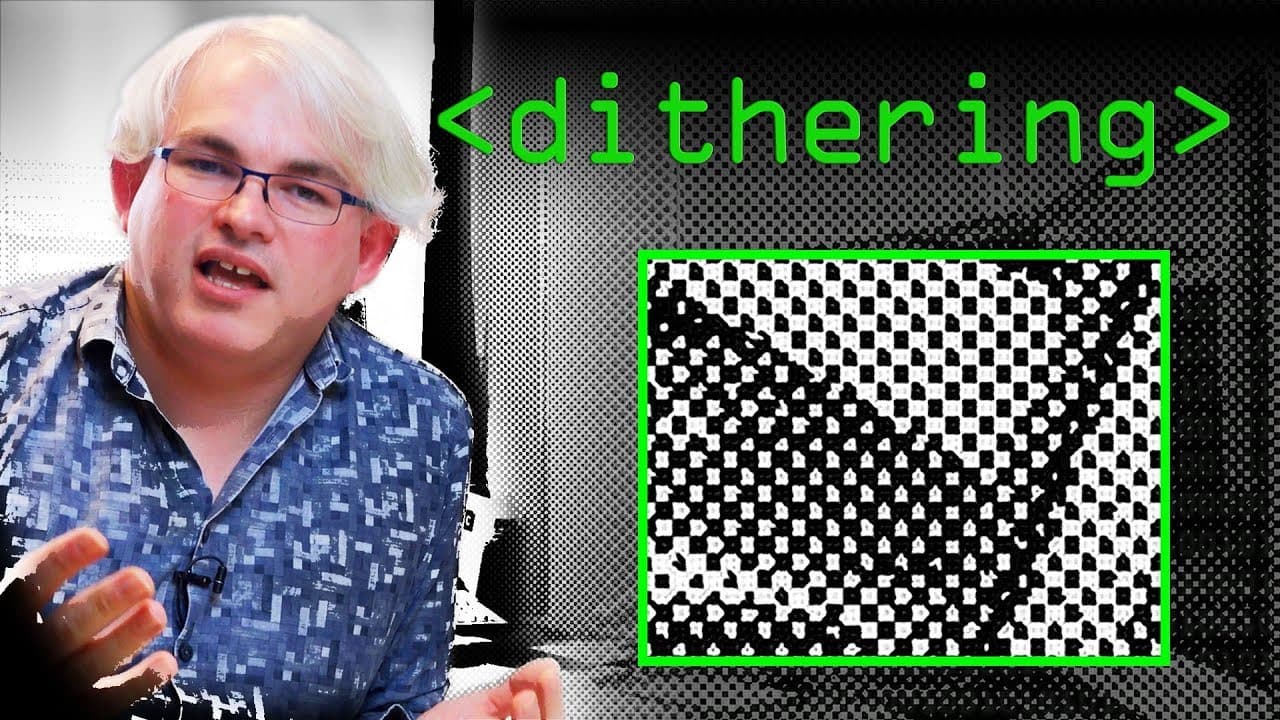
Ordered dithering simulates extra grayscale levels by arranging available black and white pixels into patterns that the eye blends into intermediate shades. While one bit provides only black or white, a 2×2 grid can represent five apparent levels, including roughly 25%, 50%, and 75% gray. Read on to see why simple thresholding loses useful detail and how pixel-value thresholds generate dithered patterns.
Transcript
You can reduce the file size of an image by Removing the number of bits you need to represent Each the colors and if you remove that number of bits You have less colors, you can display so the image looks worse If you've got eight bits, you've got 256 levels of gray or levels of each color if you've got four bits You've only got sixteen if you've g... Read More
Key Insights
- 🖤 Dithering is a technique used to create the illusion of different shades of gray in an image using strategic placement of black and white pixels.
- 💁 Newspapers have long used halftoning, a form of dithering, to print grayscale images.
- 🖤 Dithering can be programmatically implemented using patterns and thresholds to determine which pixels should be black or white.
- 🫥 Increasing the size of the dithering matrix allows for more shades of gray but reduces the resolution and increases the visibility of individual dots.
- 🧡 Dithering can also be used to simulate a wider color range by using patterns of colored pixels.
- 😃 Dithering is effective because the human eye acts as a low-pass filter, blending the pixels together to perceive different shades of gray.
Install to Summarize YouTube Videos and Get Transcripts
Explore YouTube Video Summarizer or Get YouTube Transcript Extractor
Questions & Answers
Q: What is ordered dithering, and how does it simulate grayscale?
Ordered dithering maps grayscale values to patterns of black and white pixels. Viewed from far enough away, the eye stops distinguishing the individual pixels and perceives their average as an intermediate shade of gray.
Q: Why is dithering useful when reducing an image's color depth?
Reducing the number of bits reduces both file size and the number of colors or gray levels available. Dithering attempts to simulate some of the missing levels with patterns made from the remaining colors.
Q: How many grayscale levels can different bit depths represent?
The transcript states that eight bits provide 256 gray levels, while four bits provide sixteen. With one bit, each pixel can only be black or white.
Q: Why does a simple black-and-white threshold produce a poor image?
A naive conversion makes every value below a chosen threshold black and every value above it white. The result contains large areas of pure black and white, so it may work as a special effect but is not useful for clearly watching or printing the image.
Q: How does a 2×2 dithering grid create different shades of gray?
A 2×2 grid contains four pixels that can be selectively filled. Filling one, two, or three pixels produces roughly 25%, 50%, or 75% gray, while filling none or all produces white or black, giving five apparent gray levels.
Q: Why do black-and-white dither patterns look gray from a distance?
The eye acts like an optical low-pass filter. When the pattern is sufficiently fine or viewed from a distance, individual pixels become indistinct and their black-and-white mixture appears as an average gray.
Q: How did newspapers reproduce grayscale photographs with dots?
The image was placed before a camera with a screen in front of it and rephotographed at very high contrast. Small points of light produced larger or smaller discs on the photographic plate depending on brightness, creating printable tonal variations.
Q: How can a computer generate an ordered dither pattern from pixel brightness values?
A sampled image assigns brightness values to pixels, with zero representing black and 255 representing fully white. The computer compares those values with thresholds arranged across a grid, for example, values greater than 0, 64, or 128, to decide which output pixels to set.
Summary & Key Takeaways
-
Dithering reduces the file size of an image by reducing the number of bits used to represent each color, resulting in fewer available colors and a potentially lower quality image.
-
Naively converting an image to black and white can result in a lack of detail and useful information in the image.
-
The technique of dithering involves strategically placing black and white dots in patterns to create the appearance of different shades of gray in an image.
Read in Other Languages (beta)
Share This Summary 📚
Summarize YouTube Videos and Get Video Transcripts with 1-Click
Try YouTube Summary with ChatGPT & Claude or YouTube Transcript Generator
Explore More Summaries from Computerphile 📚





Summarize YouTube Videos and Get Video Transcripts with 1-Click
Try YouTube Summary with ChatGPT & Claude or YouTube Transcript Generator