How to Generate LLM Training Data with Nemotron
TL;DR
NVIDIA Nemotron-4 340B can generate and evaluate synthetic data for training custom large language models. Its model family includes base, instruct, and reward variants, while the reward model scores responses for helpfulness, correctness, coherence, complexity, and verbosity, enabling developers to compare candidate answers and retain stronger examples for fine-tuning.
Transcript
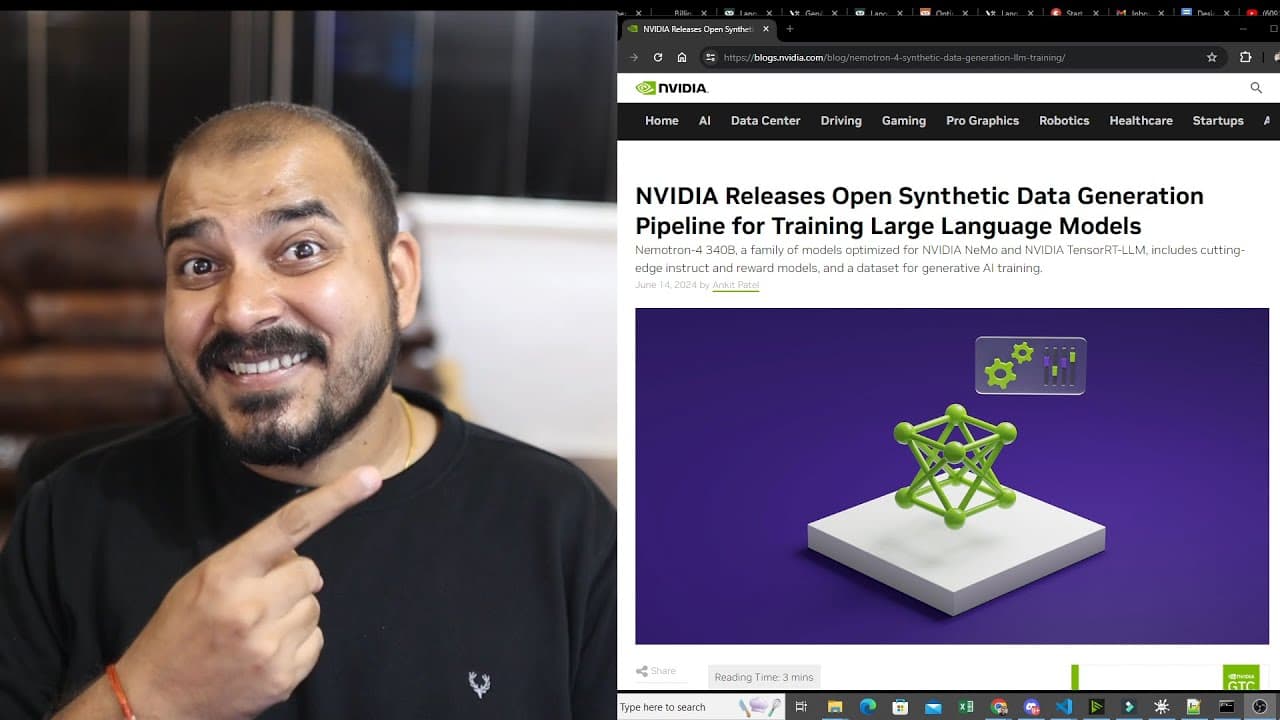
hello all my name is krishn and welcome to my YouTube channel so guys recently Nvidia has released one of the amazing large language model uh for synthetic data generation pipeline for training large language models okay so that entire model name is neotron 4 340b and uh it is nothing but it is a family of models optimized for an Nvidia Nemo and Nv... Read More
Key Insights
- Nemotron-4 340B is a family of open models designed to generate synthetic data for training and refining large language models. The family is optimized for NVIDIA NeMo and TensorRT-LLM, and the transcript describes it as available for commercial use.
- The model family includes base, instruct, and reward variants that support different stages of a synthetic-data pipeline. Together, these models can help researchers and developers create training examples, evaluate generated responses, and prepare data for custom language-model development.
- The base model was pretrained on a corpus of 9 trillion tokens. According to the transcript, that corpus includes English text, more than 50 natural languages, and more than 40 coding languages, providing broad material for the model family.
- The instruct model is a fine-tuned version of the base model that is optimized for English single-turn and multi-turn chat. It can also be accessed as a hosted chatbot through NVIDIA's build platform, as demonstrated with a machine-learning question.
- The reward model scores responses across five dimensions: helpfulness, correctness, coherence, complexity, and verbosity. These attributes measure overall usefulness, factual quality, clarity and consistency, intellectual depth, and the amount of detail contained in a candidate answer.
- Synthetic response selection works by generating or supplying multiple answers to the same prompt, scoring each answer, and retaining the stronger candidate. The selected responses can then become training examples for fine-tuning a custom large language model without manually reviewing every comparison.
- The reward model achieved 88.8 on Reward Bench when used with a Llama 3 70B base model, according to the transcript. The description also states that benchmark-topping performance was achieved despite using only 10K human-annotated response pairs.
- Hosted model access is available through build.nvidia.com using an API key and NVIDIA NIM. The demonstration uses an OpenAI-compatible client, specifies the hosted Nemotron reward model, sends a user prompt with an assistant response, and prints the resulting attribute scores.
Install to Summarize YouTube Videos and Get Transcripts
Explore YouTube Video Summarizer or Get YouTube Transcript Extractor
Questions & Answers
Q: What is NVIDIA Nemotron-4 340B used for?
NVIDIA Nemotron-4 340B is a family of models intended for synthetic data generation when building, training, or refining large language models. Developers can use its base, instruct, and reward variants as parts of a pipeline that produces candidate examples and evaluates their quality. The transcript presents this approach as useful for custom models that require additional data from a particular domain.
Q: How does the Nemotron-4 340B reward model evaluate an answer?
The reward model receives a text prompt and a corresponding response, then returns floating-point scores associated with five HelpSteer2 attributes. Those attributes are helpfulness, correctness, coherence, complexity, and verbosity. Together, the scores indicate whether the answer is useful, accurate, clearly expressed, intellectually demanding, and appropriately detailed, allowing candidate responses to be compared systematically.
Q: How can Nemotron help create synthetic LLM training data?
Nemotron can support a pipeline in which prompts receive candidate answers and the reward model evaluates those answers across five quality dimensions. If several responses exist for the same prompt, developers can compare their scores and keep the stronger example. Repeating that process produces a collection of selected prompt-response pairs that can be used to train or fine-tune a custom language model.
Q: What models are included in the Nemotron-4 340B family?
The family contains three principal variants described as base, instruct, and reward models. The base model provides the pretrained foundation, the instruct model is optimized for English single-turn and multi-turn chat, and the reward model evaluates response quality. These variants are designed to form a broader pipeline for generating synthetic data and refining large language models.
Q: What data was used to pretrain the Nemotron base model?
The transcript states that the base model was pretrained on a corpus containing 9 trillion tokens. That corpus includes English text, more than 50 natural languages, and more than 40 coding languages. These figures describe the breadth of the pretraining material presented for the model, although the transcript does not provide a detailed breakdown of each language or source.
Q: How do you access the hosted Nemotron reward model?
The demonstrated workflow starts at build.nvidia.com, where the user logs in, locates the Nemotron reward model, and obtains an API key. The provided code uses an OpenAI-compatible client with NVIDIA's base URL and the selected hosted model. It then submits a user prompt and assistant response before printing the returned quality scores from the reward model.
Q: What do the five Nemotron reward scores mean?
Helpfulness represents whether the response is useful overall, while correctness reflects accuracy and the absence of errors. Coherence covers consistency, clarity, and quality of expression. Complexity describes the intellectual depth required to produce the response. Verbosity reflects the response's level of detail. These separate dimensions provide more information than a single overall preference score.
Q: How well did the Nemotron reward model perform on Reward Bench?
The transcript reports a Reward Bench score of 88.8 when the reward model was used with a Llama 3 70B base model, describing it as the fourth-best reward model in that context. The supplied description further says it achieved benchmark-topping performance despite containing only 10K human-annotated response pairs. No comparison with GPT-4 is substantiated by the transcript or description.
Summary & Key Takeaways
-
Nemotron-4 340B is presented as an open family of models for creating synthetic training data for large language models. Its base, instruct, and reward variants form a pipeline for producing and refining examples, particularly when developers need more data for a specialized domain or commercial application.
-
The multidimensional reward model evaluates a response against five HelpSteer2 attributes: helpfulness, correctness, coherence, complexity, and verbosity. Scores can be used to compare multiple answers to the same prompt. Developers can then select the stronger response and include it in a synthetic dataset for subsequent model training.
-
The practical demonstration accesses the hosted reward model through build.nvidia.com using an API key, a provided base URL, and an OpenAI-compatible client. A user prompt and a custom assistant response are submitted together, after which the model returns floating-point evaluations for all five response-quality dimensions.
Read in Other Languages (beta)
Share This Summary 📚
Summarize YouTube Videos and Get Video Transcripts with 1-Click
Try YouTube Summary with ChatGPT & Claude or YouTube Transcript Generator
Explore More Summaries from Krish Naik 📚


Summarize YouTube Videos and Get Video Transcripts with 1-Click
Try YouTube Summary with ChatGPT & Claude or YouTube Transcript Generator