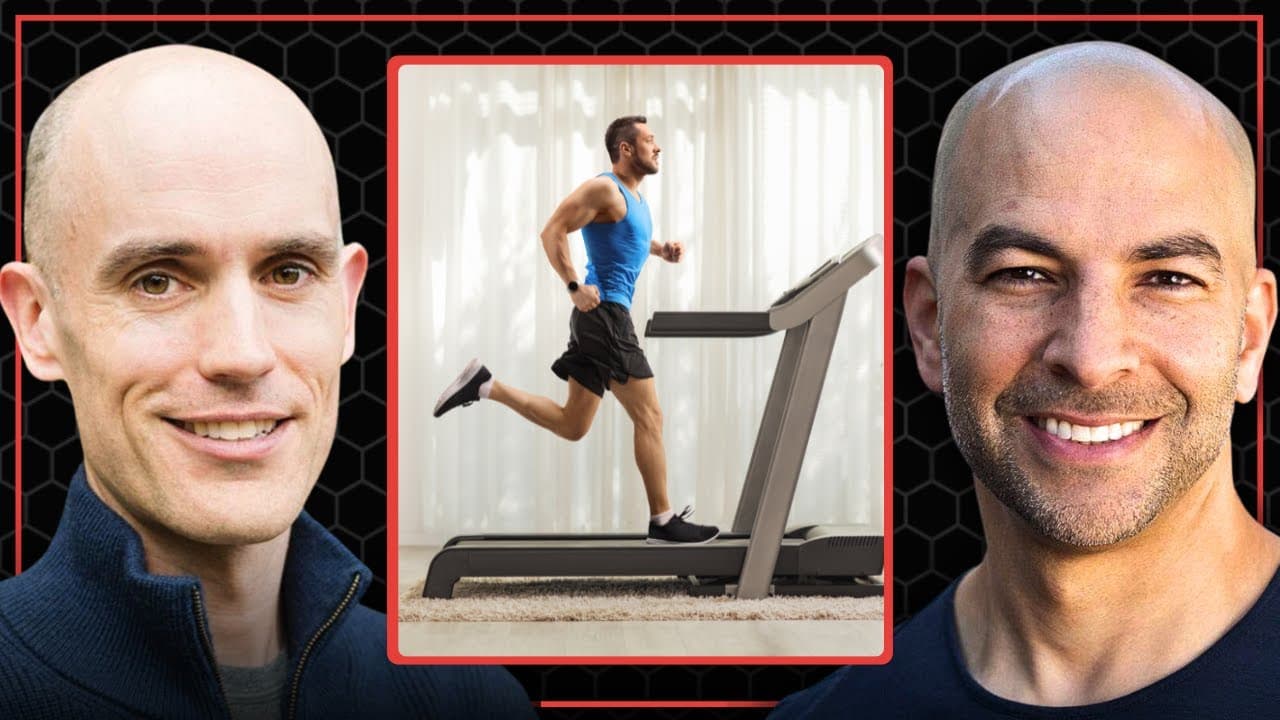
How does exercise dose affect longevity and health?
TL;DR
The minimum effective dose of exercise is small, roughly an hour per week, but health benefits accumulate with a mix of activities, including strength training. Pushing into extreme volumes may offer diminishing returns and potential risks. For most people, starting small and adding variety yields the best long term health gains.
Transcript
where do you think this fits into health so there's I mean this is clearly uh an important topic when we're talking about sports right when we're talking about Endurance Sports like you know running and cycling and swimming the purpose of the sport is to be fast is to have endurance and speed at that right combination um many of the people listenin... Read More
Key Insights
- Endurance exercise remains an important pillar of health, not something to discard in pursuit of longevity checks.
- Discomfort during exercise should be interpreted as information about current limits, not a sign of imminent danger or failure.
- There is an ongoing debate about whether exercise and mortality follow a J shaped curve or a monotonic improvement with more activity.
- The dose needed to gain most health benefits is surprisingly small according to some studies.
- A rough minimum effective dose mentioned is around 5 to 10 minutes per day, roughly an hour per week, for substantial health gains.
- For longevity optimization, prioritizing strength training can be more impactful than purely increasing endurance activity.
- Extremely high volumes of endurance training can carry risks such as rhythm disturbances or endothelial damage, implying a need for balanced programming.
- Most people should recognize that they can gain significant health benefits without extreme exercise volumes, emphasizing sustainable routines and gradual progression.
Install to Summarize YouTube Videos and Get Transcripts
Explore YouTube Video Summarizer or Get YouTube Transcript Extractor
Questions & Answers
Q: What is the minimum effective dose of exercise for health, and how was this determined?
The discussion cites studies suggesting that a very small dose yields most health benefits, with Cooper Clinic data indicating around 5 to 10 minutes per day as a starting point, roughly an hour per week. The implication is that meaningful longevity gains can be achieved without extreme training volumes, though individual factors may modify this.
Q: Why should someone consider strength training when aiming for longevity?
The speakers suggest prioritizing strength training because it can enhance health outcomes related to aging and metabolic health, potentially delivering benefits even if endurance volume remains moderate. Strength work complements cardio by building muscle, supporting mobility, and improving overall functional health over time.
Q: How should a person interpret feelings of breathlessness or burning during exercise?
Breathlessness and muscle burning are described as information about your current state rather than signs that you are failing. Understanding these signals helps people push within safe limits, avoid unnecessary stops, and gradually progress toward higher activity levels without fear.
Q: What does the debate about a J shaped curve versus a monotonic curve imply for exercisers?
The debate centers on whether increasing exercise volume eventually harms health, or whether more activity continues to yield gains. The discussion acknowledges both sides and emphasizes that for the vast majority, additional activity is beneficial, while acknowledging that extreme levels could carry risks and should be approached carefully.
Q: For a sedentary adult in middle age, what practical steps should they take to improve health through exercise?
A practical approach includes starting with a minimal dose, then adding short, progressively challenging sessions and including some strength training. The aim is to improve metabolic health and fitness gradually, avoiding injury and maintaining consistency over time while prioritizing sustainable routines.
Q: What role does the concept of dosage play in exercise recommendations?
Dosage, defined by duration, intensity, and frequency, plays a central role in determining health outcomes. The discussion highlights that even small, regular amounts can be beneficial, and that adjusting dosage to include strength work and higher intensity sessions can optimize longevity benefits.
Q: What cautions are raised about pushing endurance training too far?
The conversation notes that excessive endurance training can raise risks such as rhythm disturbances or endothelial damage due to high volumes. This suggests a need for balanced programming, listening to the body, and not assuming more always equals better health outcomes.
Q: How might one balance running or cardio with other fitness elements to maximize healthspan?
Balance is achieved by combining modest endurance activity with strength training and occasional higher intensity work. This mixed approach supports metabolic health, maintains mobility, and reduces injury risk, aligning exercise habits with long term health goals rather than chasing extreme performance metrics.
Summary & Key Takeaways
-
A small, practical amount of exercise can deliver meaningful health benefits, while excessive volumes may provide diminishing returns and potential risk. The discussion emphasizes that many people can gain most benefits with modest activity.
-
A key takeaway is to start with a minimal dose, such as several minutes daily, then add strength training and occasional higher intensity work to improve health and longevity.
-
The conversation also highlights understanding bodily discomfort during exercise as information rather than signs of imminent failure, guiding safer progression and adherence.
Read in Other Languages (beta)
Share This Summary 📚
Summarize YouTube Videos and Get Video Transcripts with 1-Click
Try YouTube Summary with ChatGPT & Claude or YouTube Transcript Generator
Explore More Summaries from Peter Attia MD 📚
Summarize YouTube Videos and Get Video Transcripts with 1-Click
Try YouTube Summary with ChatGPT & Claude or YouTube Transcript Generator