How to Fix Your Cortisol Rhythm and Beat Burnout
TL;DR
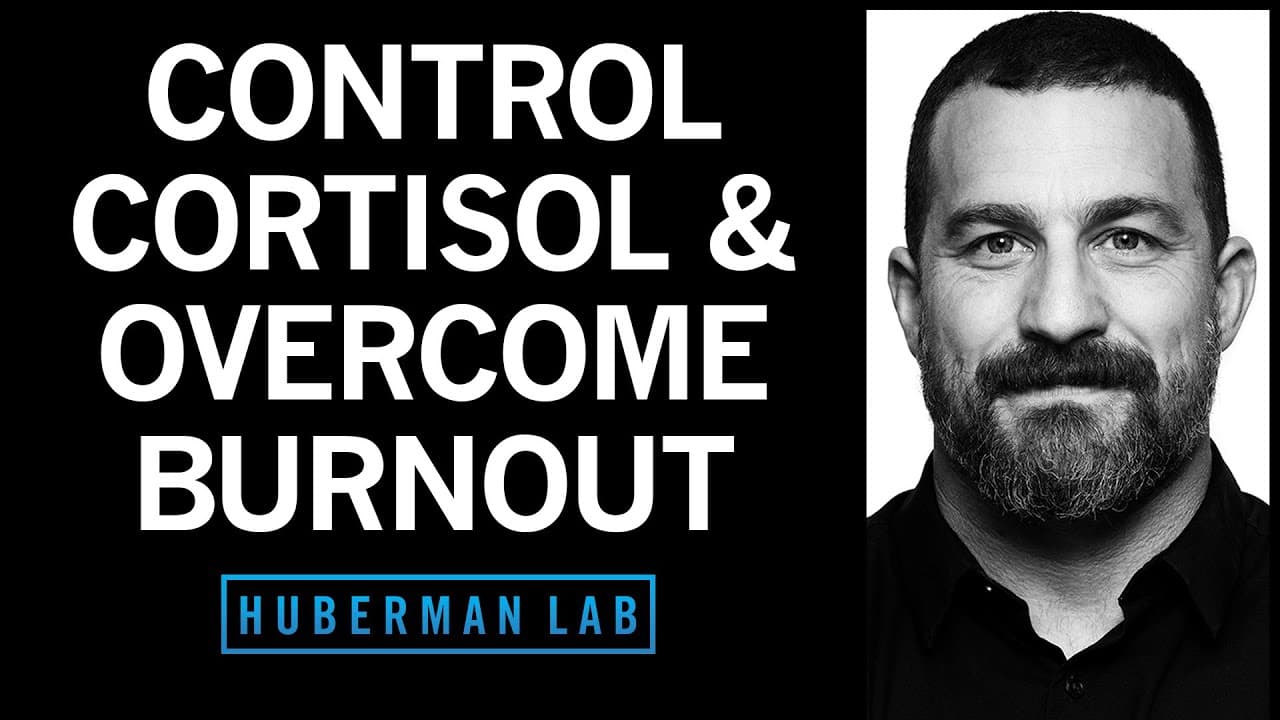
Keep cortisol high early in the day, shortly after waking, and low in the hours before sleep and during the first hours of sleep. Cortisol is not a stress hormone per se: its main job is deploying energy by releasing glucose from the liver and muscles into the bloodstream, especially for the brain. Burnout symptoms like being wired and tired, morning anxiety, or no morning energy can largely be resolved by fixing that rhythm.
Transcript
Welcome to the Huberman Lab podcast, where we discuss science and science-based tools for everyday life. I'm Andrew Huberman and I'm a professor of neurobiology and opthalmology at Stamford School of Medicine. Today we are discussing cortisol. In particular, how to control your cortisol in order to avoid burnout or should you already be feeling bur... Read More
Key Insights
- Cortisol is not a stress hormone per se. Its primary job is deploying and directing energy to the tissues that need it most, especially the brain, by causing the release of glucose into the bloodstream from the liver and muscles.
- The correct cortisol rhythm has two anchors: high cortisol early in the day shortly after waking, and low cortisol in the hours right before sleep and during the first hours of sleep. Getting these two right reinforces health, wellness, and performance.
- Cortisol is made in the adrenal glands, not in the brain. The adrenals also release epinephrine, which is the same thing as adrenaline, and they release it in response to a stressor very quickly.
- Cortisol acts on a slower time scale than adrenaline during stress because the adrenals must first make the cortisol and then release it, whereas adrenaline can be released almost immediately in response to a stressor.
- Cortisol is lipophilic, meaning it can move through cell membranes because those membranes are made of lipid. Unlike adrenaline, it crosses the blood brain barrier, where many receptors for it exist.
- The hippocampus, a brain region involved in memory, holds a high density of cortisol receptors. It is central to understanding why cortisol becomes dysregulated under conditions of chronic stress.
- Typical burnout presents as being wired and tired: no energy in the morning, low energy all day, inability to sleep at night, or morning anxiety. Huberman says this can be mostly and sometimes entirely resolved by fixing the cortisol rhythm.
- Many health and performance challenges stem from a disrupted cortisol rhythm rather than from levels that are simply too high, which is what most people mistakenly assume about their own cortisol.
Install to Summarize YouTube Videos and Get Transcripts
Explore YouTube Video Summarizer or Get YouTube Transcript Extractor
Questions & Answers
Q: When should cortisol be high and when should it be low?
Cortisol should be high early in the day, shortly after waking, and low in the hours right before sleep and during the first hours of sleep. Huberman calls this the single most important thing to remember from the episode, because getting those two points correct reinforces everything else in health, wellness, and performance. The framework here is the 24-hour circadian rhythm in cortisol rather than a single absolute level, so timing matters more than the number alone.
Q: Is cortisol actually a stress hormone?
Not per se, according to Huberman. Cortisol is made and released in response to stress, so the association makes sense, but thinking of it only as a stress hormone misses that it does many other things unrelated to stress that are important and positive. Its main job is deploying and directing energy to the tissues that need it most, especially the brain. Huberman states one of his biggest wishes is that people come to understand cortisol as an energy producing hormone, particularly a brain energy producing hormone.
Q: How does cortisol give you energy?
Cortisol causes the release of glucose, meaning blood sugar, into the bloodstream. It does this by controlling energy released from the liver and from the muscles. Much of that glucose is directed toward brain energy so that neurons, or nerve cells, can use it to think and to deal with whatever confronts you during the day, whether that is good or bad, stressful or nonstressful. This is why energy for getting out of bed, a hard work task, or driving kids to school requires cortisol release.
Q: Where is cortisol made in the body?
Cortisol is not made in the brain. It is made in the adrenal glands. The adrenals are also associated with adrenaline, which is also called epinephrine, and Huberman notes that epinephrine and adrenaline are the same thing. The adrenals release adrenaline in response to a stressor very quickly. They can also release cortisol in response to a stressor, but they need to make that cortisol first and then release it, which is why cortisol acts on a slightly slower time scale.
Q: What does it mean that cortisol is lipophilic?
Cell membranes are made of lipid, meaning fat, and because cortisol is lipophilic it can move through cell membranes. Functionally this makes cortisol unique compared with adrenaline or norepinephrine. Cortisol is released from the adrenals and circulates in the blood just as adrenaline would, but unlike adrenaline it can cross the blood brain barrier, and it readily does so because there are a lot of receptors for cortisol in the brain, particularly in the hippocampus.
Q: Why does the hippocampus matter for cortisol?
The hippocampus is a brain region involved in memory, and it holds a lot of receptors for cortisol. Huberman flags it as vital for understanding what happens during situations of chronic stress and why cortisol can become dysregulated under those conditions. Because cortisol is lipophilic and crosses the blood brain barrier, it reaches these receptors directly, which is what links prolonged stress to changes in this memory related brain region rather than to the body alone.
Q: What are the signs of burnout related to cortisol?
Huberman describes the typical presentation as feeling wired and tired: no energy in the morning, or somehow low energy all day but then an inability to sleep at night. Morning anxiety is another listed sign. He says literally all of that can be resolved, perhaps not entirely but mostly, and in some cases entirely, by fixing your cortisol rhythm. The episode covers what stress does to cortisol in the short term, which is good for you, and over long bouts of stress that eventually become burnout.
Q: Why do most people misunderstand their own cortisol levels?
Most people mistakenly think cortisol is bad, and many assume their own levels are too high. In fact, many health and performance challenges simply stem from a disrupted cortisol rhythm rather than from elevated levels. Huberman notes we normally hear phrases like elevated cortisol or my cortisol is too high, when in reality you need cortisol released to get glucose into the bloodstream. Getting the rhythm right, he says, can be transformative for health and performance.
Summary & Key Takeaways
-
Andrew Huberman, a professor of neurobiology and ophthalmology at Stanford School of Medicine, frames this cortisol episode as possibly the single most beneficial one for listeners' health and well-being. Cortisol affects mood, sleep, the immune system, and long-term feelings of well-being, making the ability to control it across the day and night one of the most powerful levers available.
-
The central reframe is that cortisol is not a stress hormone per se. It is an energy hormone, and in particular a brain energy hormone. It causes glucose to be released into the bloodstream by controlling energy released from the liver and the muscles, supplying the fuel needed for work tasks, school tasks, relationship demands, or simply getting out of bed.
-
Cortisol is produced in the adrenal glands, which also release adrenaline, also called epinephrine. Adrenaline is released quickly in response to a stressor, while cortisol must be manufactured before release, so it works on a slower time scale. Being lipophilic, cortisol crosses cell membranes and the blood brain barrier to reach receptors concentrated in the hippocampus.
-
The practical protocol centers on the 24-hour circadian rhythm of cortisol: high shortly after waking, low before and during early sleep. The description notes behavioral, nutritional, and supplement-based strategies for raising or lowering cortisol at the right times, plus specific protocols for overcoming burnout, with show notes at go.hubermanlab.com/UbpcfeH.
Read in Other Languages (beta)
Share This Summary 📚
Summarize YouTube Videos and Get Video Transcripts with 1-Click
Try YouTube Summary with ChatGPT & Claude or YouTube Transcript Generator
Explore More Summaries from Andrew Huberman 📚



Summarize YouTube Videos and Get Video Transcripts with 1-Click
Try YouTube Summary with ChatGPT & Claude or YouTube Transcript Generator