How to Build and Sell an AI SaaS Product
TL;DR
Start by validating a painful market problem, then express the product’s promise in one clear sentence before building anything substantial. AI coding agents can accelerate research, planning, implementation, testing, authentication, payments, branding, and deployment, but the founder must direct the work, demand verification, resolve security problems, and remain accountable for the final product.
Transcript
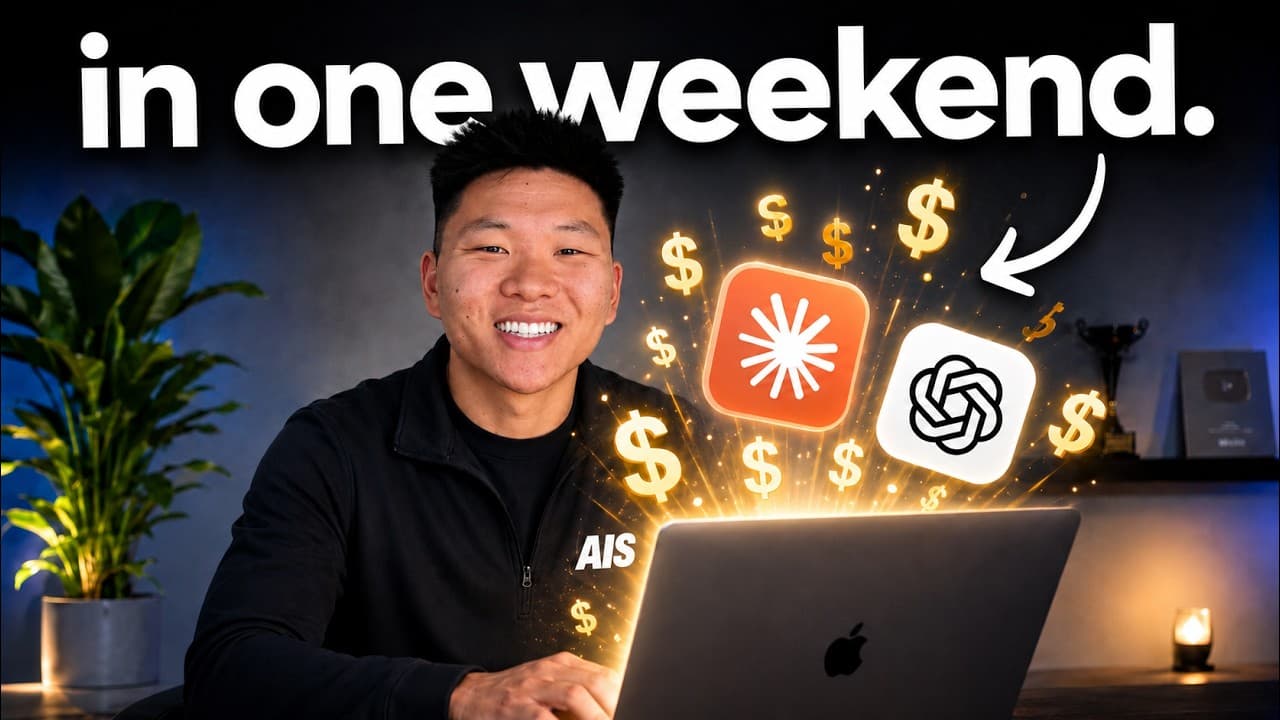
Today I'm going to be building an AI SAS product right in front of you guys pretty much live. I'm going to be basically starting at the complete beginning. I don't even have an idea yet. I'm going to go through ideation, planning, building, testing, authentication, payment processing, connecting it to a real domain. I'm going to do all of that in f... Read More
Key Insights
- Market pain is the foundation of the product because every later decision depends on solving a problem people genuinely experience. The preferred process is to collect feedback, test willingness to pay, and ideally sell the concept or validate a proof of concept before completing the build.
- A product promise is most effective when one landing-page sentence clearly states what the tool does and how it resolves the identified pain. The chosen concept should deliver visible, understandable value within five to 10 minutes instead of requiring lengthy onboarding or training.
- The six-part SaaS framework is pain, promise, product, plumbing, packaging, and proof. It connects market research and positioning with application development, infrastructure, branding, and verification, creating a practical sequence from initial problem discovery to a product customers can access and purchase.
- AI research agents can examine primary and public data sources in parallel to identify recurring problems. The described research used community material, YouTube comments, and public platforms, while separate agents handled different sources before their findings were consolidated into several product ideas.
- AI coding tools serve different roles in the workflow. Claude is treated as a creative thought partner for research and planning, while Codex is treated as an execution-focused agent that continues implementing and verifying assigned work until the requested task is complete.
- Parallel work reduces waiting during an accelerated SaaS build. While research agents investigate market pain, other work can begin after the idea becomes clear, including the product name, logo, color system, brand guidelines, landing page, and concise explanation of the promised outcome.
- Product plumbing is essential for operating beyond a demonstration. The build includes database management, Supabase authentication, Stripe subscriptions, GitHub, Vercel, and a real domain, with infrastructure planned to support growth toward potentially thousands of users.
- Proof is a continuous responsibility rather than a final checkbox. AI can produce code that the founder cannot personally read, so the founder must request repeated verification, conduct testing and security review, assess evidence, and accept responsibility when the finished product fails.
Install to Summarize YouTube Videos and Get Transcripts
Explore YouTube Video Summarizer or Get YouTube Transcript Extractor
Questions & Answers
Q: How do you find an AI SaaS idea people may pay for?
Start with a painful problem rather than a preferred technology or feature. Collect direct feedback, ask prospective users whether they would pay, and use a small proof of concept to demonstrate the result before completing the application. The course also uses AI research agents to examine YouTube comments, community discussions, Reddit, LinkedIn, X, and Instagram, then consolidate repeated complaints into several possible product ideas.
Q: What are the six P's of building an AI SaaS product?
The six P's are pain, promise, product, plumbing, packaging, and proof. Pain identifies the real problem. Promise communicates the solution in one sentence. Product covers planning, building, and testing. Plumbing includes authentication, payments, and databases. Packaging creates a consistent professional brand. Proof requires repeated verification so the founder has evidence that the application works and is ready for users.
Q: Why should an AI SaaS founder validate before building?
Validation reduces the risk of spending time on a product that nobody wants. The recommended approach is to ask prospective users how much they would pay, determine whether they would buy, or present a small proof of concept and request feedback. Selling before building is the preferred principle because a strong technical implementation cannot compensate for a weak or unproven market pain.
Q: How should an AI SaaS product promise be written?
The promise should be a single clear sentence that fits naturally on the landing page. It needs to state what the product does and how it answers the specific pain discovered during research. For the type of product built in the course, the promise should describe immediate, visible value that a new customer can understand and obtain within five to 10 minutes of signing up.
Q: How can multiple AI coding agents support one SaaS build?
Different agents can contribute complementary perspectives while sharing the same project folder. In the demonstrated workflow, Claude supports creative thinking, research, planning, and critical discussion, while Codex focuses on executing defined tasks and continuing verification. Using different models also helps the founder obtain another perspective, challenge assumptions, and stress-test the work instead of relying on one agent's output throughout the project.
Q: What infrastructure does a sellable AI SaaS product need?
A sellable product needs more than its central AI feature. The course includes database management, Supabase authentication, Stripe subscriptions, source management through GitHub, deployment through Vercel, and connection to a real domain. This plumbing allows users to create accounts and pay, while professional packaging, including a consistent name, logo, colors, and landing page, makes the service feel ready for purchase.
Q: Why is security review necessary when building with AI?
Security review is necessary because rapid AI-generated development can produce a working application while still leaving serious release risks. The described review identified four high-severity release blockers before launch. The founder must therefore request verification, inspect the evidence produced by agents, test the application, and resolve important findings rather than assuming generated code is safe merely because the visible product appears functional.
Q: How should a new AI SaaS product get its first customers?
The post-build strategy focuses on obtaining the first 50 customers, testing pricing rather than guessing, and using small creators before paid advertising. The creator says he would pay small creators before putting money into ads. This approach connects early distribution with audiences that may already trust a relevant creator, while customer responses provide evidence for refining the offer and its price.
Summary & Key Takeaways
-
The course organizes SaaS development around six elements: pain, promise, product, plumbing, packaging, and proof. The creator begins without an idea, researches real user complaints, defines an immediately understandable outcome, plans the application, and uses AI agents to move several research and development tasks forward at the same time.
-
The product workflow covers more than generating application code. It includes a professional name, logo, colors, landing page, waitlist, database management, authentication, Stripe subscriptions, GitHub, Vercel, and a real domain. Each component supports the goal of turning a functional prototype into a product that people can confidently access and purchase.
-
The completed build is only the start of commercialization. The course also addresses finding the first 50 customers, testing pricing rather than guessing, and paying small creators before spending money on advertisements. Its central lesson is that AI expands what one founder can execute, while judgment, verification, and accountability remain human responsibilities.
Read in Other Languages (beta)
Share This Summary 📚
Summarize YouTube Videos and Get Video Transcripts with 1-Click
Try YouTube Summary with ChatGPT & Claude or YouTube Transcript Generator
Explore More Summaries from Nate Herk | AI Automation 📚






Summarize YouTube Videos and Get Video Transcripts with 1-Click
Try YouTube Summary with ChatGPT & Claude or YouTube Transcript Generator