How to Read Price Action for Trading Success
TL;DR
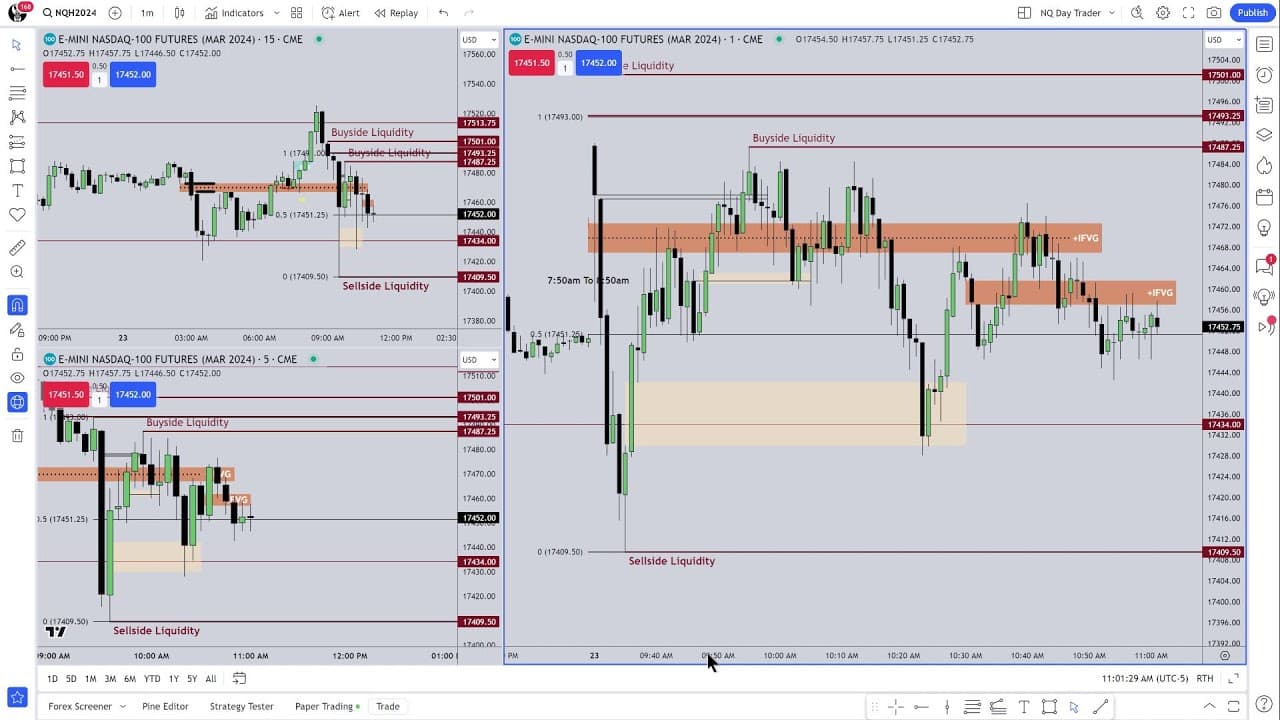
Successfully reading price action involves understanding key market movements and identifying liquidity and inefficiencies. Traders should focus on specific time frames, such as the 15-minute chart, and recognize patterns such as fair value gaps and inversion gaps. Building experience through tape reading and understanding market cycles is crucial for developing trading skills and confidence.
Transcript
e e e e e well good morning folks how are you just going to test myself here and wait for my feedback here also get a okay so it's about uh about seven or eight seconds delay all right just give me a few seconds work at my uh my settings here the audio should be loud enough should be coming through it's coming through my headphone pretty good so al... Read More
Key Insights
- Price action is best understood through the lens of liquidity and inefficiencies, rather than traditional support and resistance.
- The 15-minute chart is a critical tool for identifying salient points of liquidity and potential market reversals.
- Fair value gaps and inversion gaps are essential for anticipating market movements and identifying potential entry and exit points.
- Traders should focus on specific time frames and market cycles to enhance their understanding and execution of trades.
- Tape reading is a vital skill that involves observing price movements without executing trades, allowing traders to build experience and confidence.
- Market behavior is influenced by specific time-based patterns, such as macros, which occur at predictable intervals.
- Understanding the concept of immediate rebalances can provide a strong foundation for placing stop losses and managing trades.
- Experience and patience are key to developing a successful trading strategy, with emphasis on learning from market behavior rather than rushing into trades.
Install to Summarize YouTube Videos and Get Transcripts
Explore YouTube Video Summarizer or Get YouTube Transcript Extractor
Questions & Answers
Q: How to identify fair value gaps in trading?
Fair value gaps are identified by observing areas where price moves predominantly in one direction, creating an inefficiency. These gaps occur between the high and low of consecutive candles and are used to anticipate potential support or resistance levels. Traders look for price to return to these gaps, which often act as points of interest for market reversals or continuations.
Q: What is the importance of the 15-minute chart in trading?
The 15-minute chart is important in trading as it provides a clear view of salient points of liquidity and potential market reversals. It helps traders identify buy and sell stops, fair value gaps, and other inefficiencies that can indicate potential market movements. Using this time frame allows traders to align their trades with the broader market narrative and anticipate significant price runs.
Q: How does tape reading improve trading skills?
Tape reading improves trading skills by allowing traders to observe and analyze price movements without executing trades. This practice helps build experience and confidence, enabling traders to recognize patterns and market cycles. By focusing on price action and understanding how it behaves in different conditions, traders can develop a more intuitive sense of market dynamics and improve their decision-making.
Q: What are inversion fair value gaps?
Inversion fair value gaps occur when an old inefficiency, opposed to the current trade direction, acts as a support or resistance point. These gaps are identified by observing areas where price previously moved predominantly in one direction. When price revisits these areas, they often provide a foothold for price action, allowing traders to anticipate potential reversals or continuations in the market.
Q: How do macros influence market behavior?
Macros influence market behavior by creating predictable patterns at specific times, such as 10 minutes before and after the top of the hour. These patterns often lead to significant price movements, as the market responds to liquidity and inefficiencies. Understanding macros helps traders anticipate when the market is likely to spool and reach for liquidity, providing opportunities for strategic entries and exits.
Q: Why is patience important in trading?
Patience is important in trading because it allows traders to wait for high-probability setups and avoid impulsive decisions. Rushing into trades without proper analysis can lead to poor outcomes and increased risk. By being patient, traders can observe market behavior, identify key patterns, and make informed decisions based on experience and analysis, ultimately leading to more consistent and successful trading results.
Q: What role do immediate rebalances play in trading?
Immediate rebalances play a crucial role in trading by providing a strong foundation for placing stop losses and managing trades. When price quickly returns to a previous level after a significant move, it often indicates a strong area of support or resistance. Traders can use this information to set stop losses strategically, minimizing risk and enhancing the potential for profitable trades.
Q: How can traders develop a successful trading strategy?
Traders can develop a successful trading strategy by focusing on liquidity and inefficiencies, using time-based patterns like macros, and practicing tape reading to build experience. By understanding market behavior and aligning trades with the broader market narrative, traders can identify high-probability setups. Patience, discipline, and continuous learning are essential components of a successful strategy, enabling traders to adapt to changing market conditions and improve decision-making.
Summary & Key Takeaways
-
Successfully reading price action requires a focus on liquidity and inefficiencies, with the 15-minute chart being a key tool for identifying potential market movements. Understanding fair value gaps and inversion gaps helps anticipate price direction.
-
Tape reading, which involves observing price movements without executing trades, is essential for building trading experience and confidence. This practice allows traders to recognize market cycles and specific time-based patterns, such as macros.
-
Immediate rebalances and understanding market behavior through time-based patterns are crucial for effective trade management. Patience and experience are vital for developing a successful trading strategy, as rushing can lead to poor decisions.
Read in Other Languages (beta)
Share This Summary 📚
Summarize YouTube Videos and Get Video Transcripts with 1-Click
Try YouTube Summary with ChatGPT & Claude or YouTube Transcript Generator
Explore More Summaries from The Inner Circle Trader 📚

Summarize YouTube Videos and Get Video Transcripts with 1-Click
Try YouTube Summary with ChatGPT & Claude or YouTube Transcript Generator