How can AI agents run continuously without logging off
TL;DR
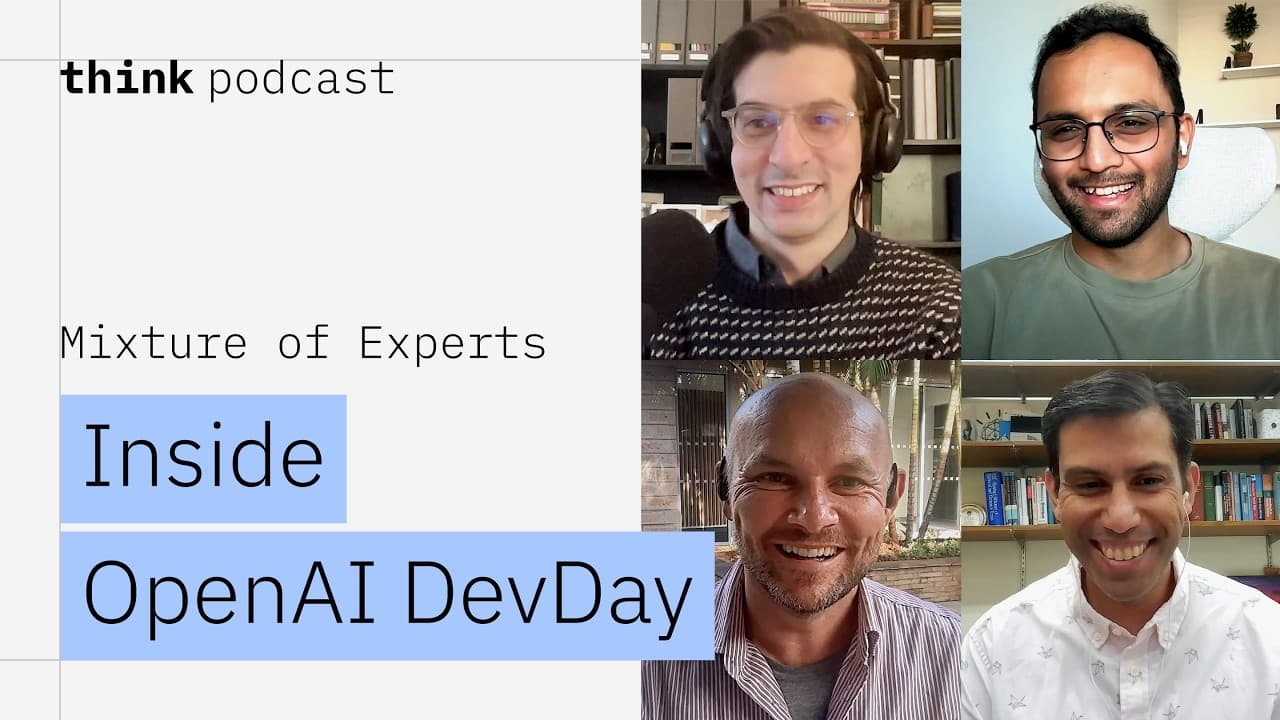
OpenAI’s DOTS aims to provide persistent, always-on AI agents that can manage tasks over time with minimal permission prompts. The panel discusses whether such agents can truly delegate work and operate reliably while remaining under user control, and compares this concept with other persistent agents and the broader impact on AI deployment.
Transcript
How much can you reliably [music] just hand over and forget about? There are instances wherein it does come to you for permission. So if it keeps uh coming back to you asking for permissions or asking for more clarifications, then you're not truly relegated. All that and more on this week's Mixture of Experts. [music] Hello, I'm David Zach and welc... Read More
Key Insights
- Dots is designed to maintain conversations and manage tasks persistently, enabling delegated work with minimal re-authorization.
- The panel questions how much reliable handover of tasks is possible before manual checks are required, stressing the importance of permission workflows.
- Cartoonish personas for agents are used as a communication strategy to broaden access and reduce perceived risk for non-technical users.
- The emergence of multiple persistent agents from different vendors signals an industry move toward ambient AI assistants rather than chat boxes alone.
- There is skepticism about the intensifying capital and rapid releases, suggesting potential over-saturation and copying across companies.
- Aesthetic design choices (cute, cuddly agents) are discussed as a way to mitigate safety concerns while deploying powerful capabilities.
- Math as a field may be impacted by AI, with hundreds of manuscripts generated, raising questions about validation, understanding, and human oversight.
- Job interviewing AI tools like HackerRank’s AI interviewer bring up bias, gatekeeping concerns, and evaluation standards for candidates.
Install to Summarize YouTube Videos and Get Transcripts
Explore YouTube Video Summarizer or Get YouTube Transcript Extractor
Questions & Answers
Q: How does DOTS aim to run continuously without constant human input
DOTS is designed to be an always-on agent system that can manage tasks and conversations over time. The idea is to delegate responsibilities, such as code health monitoring, to the agent, while still requiring permission for certain actions. The panel questions how many tasks can be handed over reliably and what happens if the agent stops or changes course, emphasizing the need for robust permission and monitoring mechanisms.
Q: What are the potential benefits and risks of persistent AI agents
The benefits include reduced need for constant human orchestration, improved task automation, and the possibility of agents acting as ambient assistants across devices and contexts. Risks include loss of control, over-reliance on automated decisions, and the possibility of agents executing tasks in unintended ways. The discussion highlights the importance of safe, transparent delegation and clear permission prompts.
Q: How did the panel compare DOTS with Meta Muse and other agents
The panel noted both DOTS and Meta Muse as part of a wave of persistent agents arriving within a short time frame. They discussed differences in design choices, such as persona and user interface, and debated whether cute, cartoonish designs help make powerful capabilities more acceptable to a broader audience, while not eliminating safety concerns.
Q: Why is there skepticism about rapid releases of AI agents by multiple firms
Skepticism stems from concerns about over-capitalization and a tendency to imitate peers rather than innovate, potentially limiting imagination. The panel observes a sense of coordination in releasing similar “cute” agents and questions whether this pace compromises safety, governance, or thoughtful deployment in favor of market momentum.
Q: How might AI agents influence the field of mathematics
AI agents generating hundreds of manuscripts could accelerate discovery and provide novel approaches, but also raises questions about validation and human understanding. The discussion suggests a tension between rapid AI-produced results and the need for rigorous verification, critical thinking, and comprehension of new mathematical ideas by humans.
Q: What are the implications of AI-driven job interviewers
AI interviewers like HackerRank’s system raise questions about bias, accessibility, and fairness in evaluating candidates. The panel discusses how such tools could help standardize assessments while also potentially perpetuating biases or creating barriers if not implemented with transparency and robust auditing.
Q: What is the role of safety and permission in persistent AI agents
Safety and permission are central to the discussion, with emphasis on how agents should ask for clarifications and obtain consent for actions. The panel explores the balance between agent autonomy and user oversight, arguing that reliable delegation depends on predictable, auditable behaviors and clear governance around decision-making.
Q: How do these developments influence everyday users
For everyday users, persistent agents could reduce friction by handling routine tasks and providing ambient assistance across devices. However, it remains critical that users understand what the agent is doing, what permissions are required, and how to intervene if a task deviates from expectations. This requires intuitive design and transparent controls.
Summary & Key Takeaways
-
A persistent, always-on AI agent concept is explored, focusing on how much work can be delegated without continuous human input and what safety controls look like.
-
The discussion contrasts DOTS and similar projects with Meta Muse, addressing user experience, safety, and the potential shift from chat-centric interfaces to ambient AI assistants.
-
The podcast also covers how AI-generated mathematics and AI-driven interviewing reshape fields like mathematics and hiring, highlighting opportunities and risks.
Read in Other Languages (beta)
Share This Summary 📚
Summarize YouTube Videos and Get Video Transcripts with 1-Click
Try YouTube Summary with ChatGPT & Claude or YouTube Transcript Generator
Explore More Summaries from IBM Technology 📚
Summarize YouTube Videos and Get Video Transcripts with 1-Click
Try YouTube Summary with ChatGPT & Claude or YouTube Transcript Generator