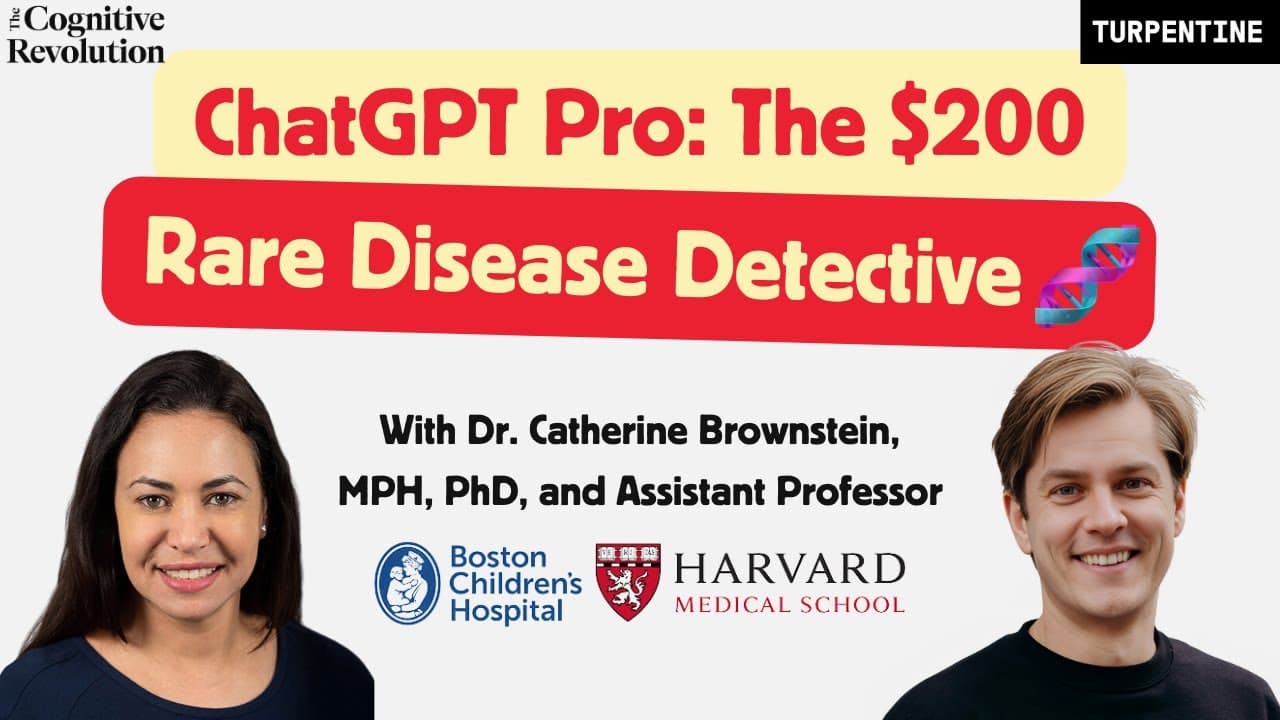
Gene Hunting with o1-pro: Reasoning about Rare Diseases with ChatGPT Pro Grantee Dr. Brownstein
TL;DR
AI models are accelerating rare disease diagnosis, saving time and improving accuracy.
Transcript
rare diseases are quite common actually there's more people with rare diseases in the united St States than there are natural blonds we need to sequence the whole world in order to understand what is actually disease causing and what is just background variation logging into the Harvard Library getting that paper skimming the abstracts it's not at ... Read More
Key Insights
- Rare diseases, despite their name, are more common than often perceived, affecting more people than the number of natural blondes in the U.S.
- The cost of genome sequencing has drastically reduced, making it a common practice, yet presenting new challenges for specialists in data analysis.
- AI is becoming a crucial tool for geneticists, aiding in the analysis of vast literature and data, and helping to connect subtle clues for diagnosis.
- Dr. Brownstein is working with OpenAI to develop AI use cases in rare disease research, aiming to enhance diagnostic speed and accuracy.
- The integration of AI into medical research is a gradual process, requiring a balance between enthusiasm for its potential and skepticism of its outputs.
- Data sharing remains a significant barrier in advancing rare disease research, with calls for more open and collaborative approaches.
- AI's ability to summarize and filter relevant research articles is saving researchers significant time, allowing them to focus on critical analysis.
- Future AI developments could further democratize access to genetic interpretations, potentially revolutionizing patient care and diagnosis.
Install to Summarize YouTube Videos and Get Transcripts
Explore YouTube Video Summarizer or Get YouTube Transcript Extractor
Questions & Answers
Q: What is the significance of AI in rare disease research?
AI plays a crucial role in rare disease research by helping researchers process vast amounts of genetic data and literature. It aids in identifying potential genetic causes of diseases more efficiently, thus accelerating the diagnostic process and potentially leading to faster and more accurate patient care.
Q: How has genome sequencing changed over the years?
Genome sequencing has seen a dramatic reduction in cost, from around $1 million in 2007 to just a few hundred dollars today. This has made it a standard practice in medical research, allowing more comprehensive genetic analysis for individual patients, but also presenting challenges in managing and interpreting the growing data.
Q: What challenges do researchers face with the current data sharing practices?
Current data sharing practices are hindered by privacy concerns and a lack of standardized protocols, leading to data being siloed and underutilized. This limits collaboration and slows down the discovery of new genetic links to rare diseases. Enhanced data sharing could significantly accelerate research and improve patient outcomes.
Q: How does Dr. Brownstein utilize AI in her research?
Dr. Brownstein uses AI to summarize and filter relevant research articles, saving significant time in literature review. AI also aids in analyzing genetic data to identify potential disease-causing variants, helping her focus on the most promising leads and improving the overall efficiency of her research process.
Q: What are the potential future applications of AI in healthcare?
AI has the potential to revolutionize healthcare by providing more personalized and precise treatments, predicting disease trajectories, and democratizing access to expert-level genetic interpretations. This could lead to significant improvements in patient care, especially for those with rare or complex conditions.
Q: What role does AI play in patient diagnosis at Boston Children's Hospital?
AI assists in patient diagnosis by analyzing genetic data and literature to identify possible genetic causes of rare diseases. It helps streamline the diagnostic process, reduce the time spent on manual data review, and improve the accuracy of diagnoses, ultimately enhancing patient care.
Q: What improvements does Dr. Brownstein hope to see in AI applications?
Dr. Brownstein hopes to see AI applications that are more user-friendly and integrated into daily research workflows. She anticipates AI will continue to improve in reasoning and accuracy, potentially solving complex cases and reducing diagnostic times even further.
Q: What is the impact of OpenAI's collaboration with Dr. Brownstein?
The collaboration with OpenAI supports Dr. Brownstein in developing AI use cases for rare disease research, providing insights into how AI can be leveraged to enhance diagnostic processes. This partnership aims to explore the limits of AI in medical research and improve its application in real-world scenarios.
Summary & Key Takeaways
-
The podcast explores how AI, particularly large language models, is transforming the field of rare disease research. Dr. Katherine Brownstein discusses the challenges and opportunities AI presents in diagnosing rare diseases faster and more accurately.
-
Dr. Brownstein highlights the drastic reduction in genome sequencing costs, which has increased data availability but also complexity, necessitating advanced AI tools to manage and interpret genetic information effectively.
-
The conversation delves into the potential of AI to revolutionize patient care by shortening diagnostic odysseys and democratizing access to genetic insights, while also addressing the need for improved data sharing practices.
Read in Other Languages (beta)
Share This Summary 📚
Summarize YouTube Videos and Get Video Transcripts with 1-Click
Try YouTube Summary with ChatGPT & Claude or YouTube Transcript Generator
Explore More Summaries from Cognitive Revolution "How AI Changes Everything" 📚






Summarize YouTube Videos and Get Video Transcripts with 1-Click
Try YouTube Summary with ChatGPT & Claude or YouTube Transcript Generator