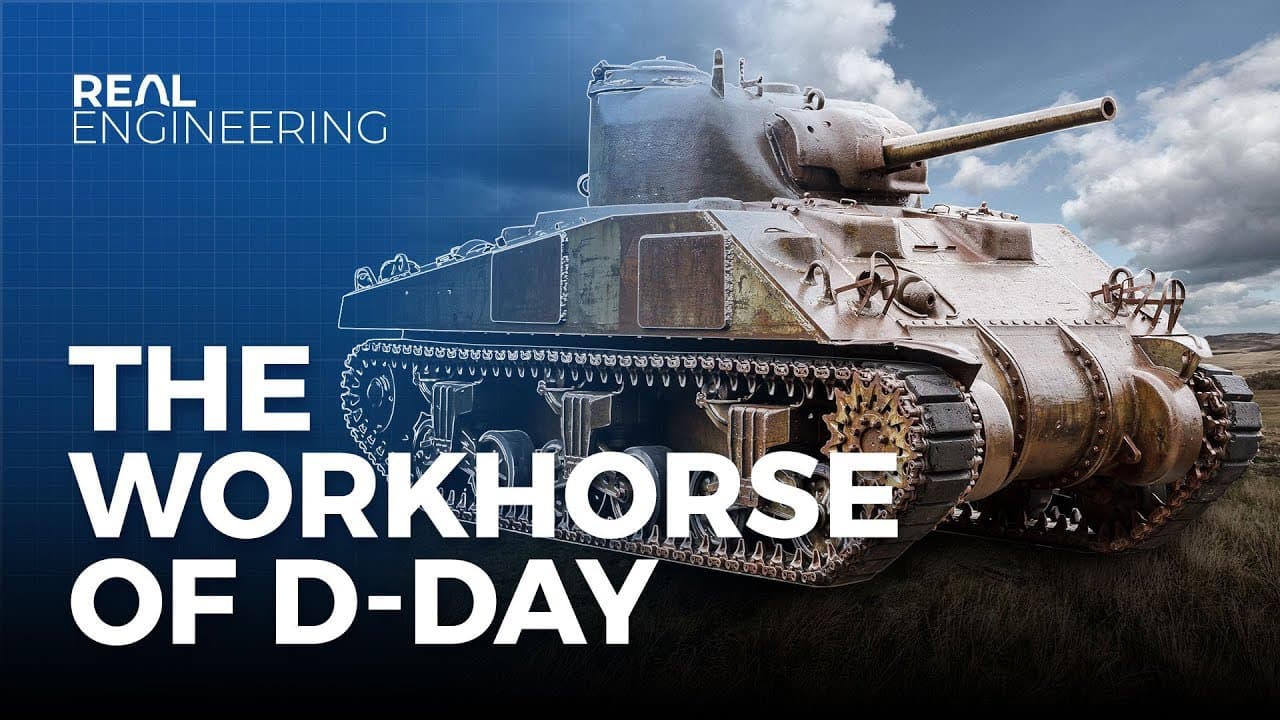
M4 Sherman - The Workhorse of D-Day
TL;DR
The M4 Sherman was a key tank for the Allies in WWII.
Transcript
This episode of Real Engineering is brought to you by CuriosityStream, watch thousands of documentaries for free for 31 days at curiositystream.com/realengineering. At the outbreak of the Second World War, the US was lagging behind many of the other nations in the industry of tank development and manufacture, and their British Allies were not much ... Read More
Key Insights
- The US and UK were initially behind in tank development during WWII, prompting the creation of the M4 Sherman to counter German advancements.
- The M3 Lee was an interim tank design that influenced the development of the M4 Sherman, despite its design limitations.
- The M4 Sherman incorporated lessons from the automotive industry, emphasizing mass production and ease of repair.
- The M4 Sherman featured a fully traversable 75mm gun turret, which was a significant improvement over its predecessor.
- The M4 underwent several design changes to improve mobility, including the horizontal volute spring suspension and wider tracks.
- Survivability improvements included larger hatches and better ammunition storage to reduce the risk of fire.
- The Sherman tank was versatile, with variants equipped for different roles such as mine-clearing and amphibious operations.
- Despite criticisms, the Sherman was a reliable and effective tank, pivotal in the Allied war effort during WWII.
Install to Summarize YouTube Videos and Get Transcripts
Explore YouTube Video Summarizer or Get YouTube Transcript Extractor
Questions & Answers
Q: What was the main purpose of developing the M4 Sherman tank?
The M4 Sherman tank was developed to address the initial disadvantage the US and UK had in armored warfare during World War II. It aimed to counter the advanced German tanks by being agile, well-armored, reliable, and cost-effective to manufacture. This design was intended to be the workhorse of the Allied forces, capable of mass production and ease of repair, which were crucial for the war effort.
Q: How did the M3 Lee influence the design of the M4 Sherman?
The M3 Lee served as an interim solution while the M4 Sherman was being developed. Although the M3 had design limitations, such as a sponson-mounted main gun and a weaker turret gun, it provided valuable insights into tank design. Its vertical volute suspension system was carried over to the M4, and the lessons learned from its production and field performance helped guide the improvements made in the Sherman's design, such as the fully traversable turret and standardized parts for easier manufacturing and repair.
Q: What were the key improvements made to the M4 Sherman over its predecessors?
Key improvements of the M4 Sherman over its predecessors included a 360-degree fully traversable 75mm gun turret, a more compact and efficient suspension system, and standardized parts for easier mass production and repair. The Sherman also featured improved survivability with larger hatches and better ammunition storage to reduce fire risk. Additionally, its design allowed for various specialized variants, making it a versatile asset on the battlefield.
Q: How did the M4 Sherman's production process contribute to the Allied war effort?
The M4 Sherman's production process was heavily influenced by the American automotive industry, emphasizing mass production techniques that allowed for rapid and efficient manufacturing. With companies like Chrysler, Ford, and General Motors involved, the Sherman could be produced at a remarkable rate, with one tank rolling off the assembly line every 30 minutes at peak production. This capability ensured that the Allies had a steady supply of tanks, which was crucial for maintaining their advantage on the battlefield and supporting various operations, including D-Day.
Q: What design changes were made to improve the M4 Sherman's mobility?
To improve the M4 Sherman's mobility, several design changes were implemented. The introduction of the horizontal volute spring suspension system allowed for a lower profile and the addition of hydraulic shock absorbers, which smoothed the ride and reduced stress on the springs. The track width was also increased, significantly decreasing ground pressure and enhancing the tank's ability to traverse various terrains. These changes made the Sherman more agile and less prone to getting stuck, improving its overall battlefield performance.
Q: How did the M4 Sherman address survivability issues faced by its crew?
The M4 Sherman addressed survivability issues by incorporating larger hatches for easier crew evacuation and relocating most ammunition storage to the floor of the tank, where it was better protected. The introduction of wet storage, where shells were separated by gel-filled canisters, further reduced the risk of ammunition fires when the tank was hit. These design changes significantly improved the crew's chances of survival in the event of a critical hit, reflecting lessons learned from early battlefield experiences.
Q: What specialized roles did the M4 Sherman variants fulfill during WWII?
The M4 Sherman variants fulfilled several specialized roles during WWII, showcasing the tank's versatility. Some variants were equipped with rocket tubes for soft target barrages, while others had flamethrowers for close combat. The Sherman Crab variant featured flails for mine-clearing operations, and the DD Sherman was designed for amphibious assaults with propellers and buoyancy screens. Additionally, some Shermans were fitted with bulldozer blades and hedgerow clearing tools to support infantry and other vehicles, demonstrating their adaptability to different combat scenarios.
Q: What misconceptions exist about the M4 Sherman's performance against German tanks?
A common misconception about the M4 Sherman is that it took five Shermans to defeat one German Tiger tank, a myth popularized by the movie 'Fury.' While the Sherman was at a disadvantage against heavier German tanks in direct combat, this statistic is exaggerated. The Sherman was designed as a medium tank, prioritizing versatility and mass production. Its effectiveness lay in its numbers, adaptability, and the strategic support it provided to the Allies, rather than direct one-on-one engagements with heavier tanks like the Tiger.
Summary & Key Takeaways
-
The M4 Sherman tank was developed by the US and UK to address their initial disadvantage in armored warfare during WWII. It was designed for mass production and ease of repair, incorporating lessons from the automotive industry.
-
The M4 Sherman featured a fully traversable 75mm gun, improved suspension systems, and better survivability features, making it a versatile and effective tank against German forces.
-
Various Sherman variants were developed for specialized roles, including mine-clearing and amphibious operations, underscoring its adaptability and importance in the Allied victory during World War II.
Read in Other Languages (beta)
Share This Summary 📚
Summarize YouTube Videos and Get Video Transcripts with 1-Click
Try YouTube Summary with ChatGPT & Claude or YouTube Transcript Generator
Explore More Summaries from Real Engineering 📚





Summarize YouTube Videos and Get Video Transcripts with 1-Click
Try YouTube Summary with ChatGPT & Claude or YouTube Transcript Generator