How to Use fork() and exec() in Linux
TL;DR
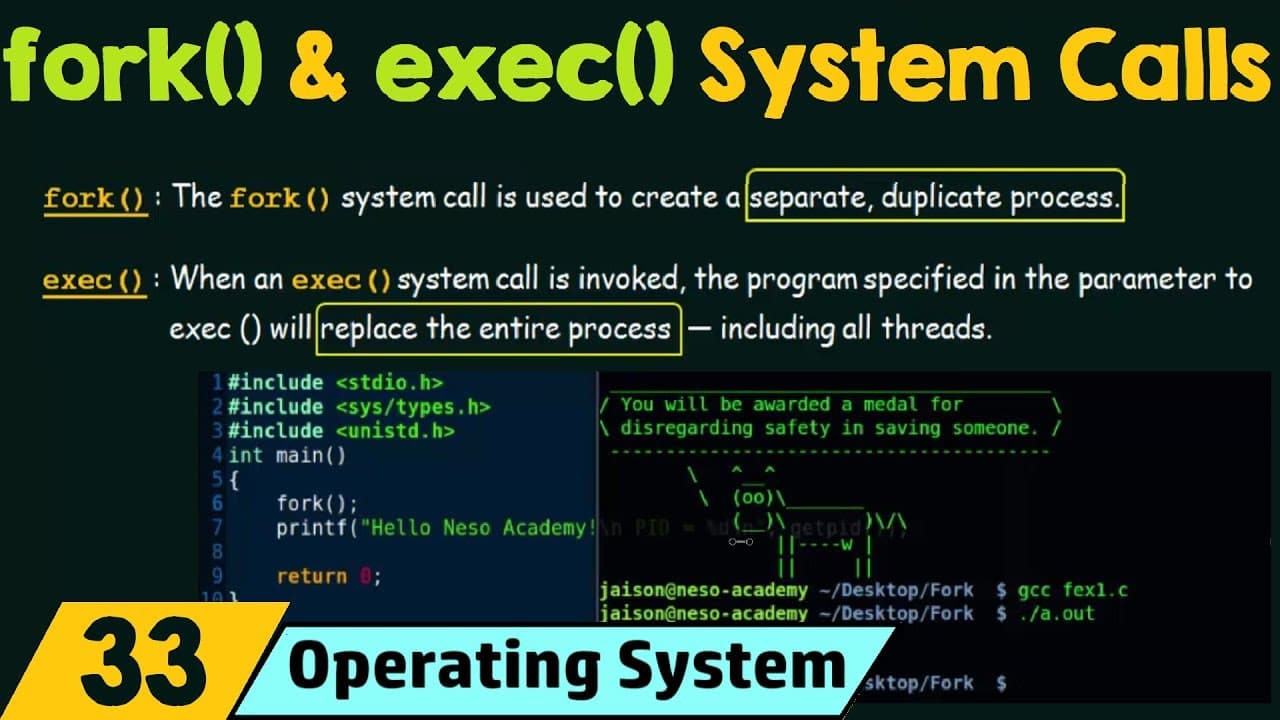
The fork() system call creates a duplicate process, known as the child process, with a different process ID but identical content to the parent process. The exec() system call replaces the current process with a new program, maintaining the same process ID but changing the process content. These calls are specific to Linux systems and are crucial for process management.
Transcript
in the previous lecture we have studied about multi-threading models and hyper threading now the next topic that we need to discuss is about issues in threading but before we go to the issues that we face in threading there are two important things that we need to understand which are the fork and exe C system calls now after understanding the fork... Read More
Key Insights
- fork() is used to create a duplicate process, known as the child process, with a different process ID.
- The parent process is the original process from which the fork() call is made.
- exec() replaces the current process with a new program, keeping the same process ID.
- When exec() is called, the new program overwrites the current process, replacing its memory space.
- fork() and exec() are specific to Linux-based systems and are essential for understanding process management.
- Multiple fork() calls create a tree of processes, each with its own unique process ID.
- exec() does not return to the original program unless there is an error in execution.
- Understanding fork() and exec() is critical before diving into threading issues in operating systems.
Install to Summarize YouTube Videos and Get Transcripts
Explore YouTube Video Summarizer or Get YouTube Transcript Extractor
Questions & Answers
Q: How does the fork() system call work?
The fork() system call creates a new process by duplicating the calling process. The new process is referred to as the child process, which is an exact replica of the parent process except for having a different process ID. This is essential for creating process trees in Linux-based systems.
Q: What is the purpose of the exec() system call?
The exec() system call is used to replace the current process image with a new program. When exec() is invoked, it loads a new program into the process's memory, replacing the existing content while retaining the same process ID. This allows for executing a different program within the same process context.
Q: Why are fork() and exec() specific to Linux systems?
fork() and exec() are specific to Linux systems because they are designed to work with the process management and memory handling mechanisms native to Linux. These system calls are integral to Unix-like operating systems for managing processes and executing programs.
Q: What happens when multiple fork() calls are made?
When multiple fork() calls are made, a tree of processes is created. Each fork() call results in a new child process, leading to an exponential growth in the number of processes. Each process has a unique process ID, and the content of the processes remains the same as the parent process.
Q: Can exec() return to the original program?
No, exec() does not return to the original program once it successfully executes a new program. The current process's memory is completely replaced by the new program, and execution continues with the new program. If exec() fails, it returns an error, and the original program continues execution.
Q: How is process ID affected by fork() and exec()?
In fork(), a new process ID is assigned to the child process, different from the parent process. In exec(), the process ID remains unchanged because the current process is not terminated but replaced by a new program, maintaining the same process ID.
Q: What is the relationship between fork() and exec()?
fork() and exec() are often used together in process management. fork() is used to create a new process, and exec() is used within the new process to replace its memory with a different program. This combination allows for creating new processes and executing different programs efficiently.
Q: Why is understanding fork() and exec() important?
Understanding fork() and exec() is crucial for managing processes in Linux-based systems. These system calls are fundamental for creating and managing process trees, executing different programs, and handling process IDs. Mastery of these concepts is essential before tackling more complex topics like threading issues.
Summary & Key Takeaways
-
The fork() system call is used to create a separate duplicate process, known as the child process, which is an exact replica of the parent process but with a different process ID. This is crucial for process management in Linux-based systems.
-
The exec() system call replaces the current process with a new program, maintaining the same process ID but changing the process content. It is used to execute a different program within the same process context.
-
Using fork() and exec(), one can manage processes effectively in Linux, allowing for the creation of process trees and the execution of different programs within the same process ID context.
Read in Other Languages (beta)
Share This Summary 📚
Summarize YouTube Videos and Get Video Transcripts with 1-Click
Try YouTube Summary with ChatGPT & Claude or YouTube Transcript Generator
Explore More Summaries from Neso Academy 📚



Summarize YouTube Videos and Get Video Transcripts with 1-Click
Try YouTube Summary with ChatGPT & Claude or YouTube Transcript Generator