What Does Apple's AI Reasoning Paper Actually Show?
TL;DR
Apple's results show that small reasoning models can hit a sharp performance cliff on highly complex logic puzzles when denied tools, search, code, and long inference time. The practical lesson is to design AI systems that recognize difficult cases and escalate them to a larger model, a tool-enabled model, or a human instead of treating the study as proof that AI reasoning is useless.
Transcript
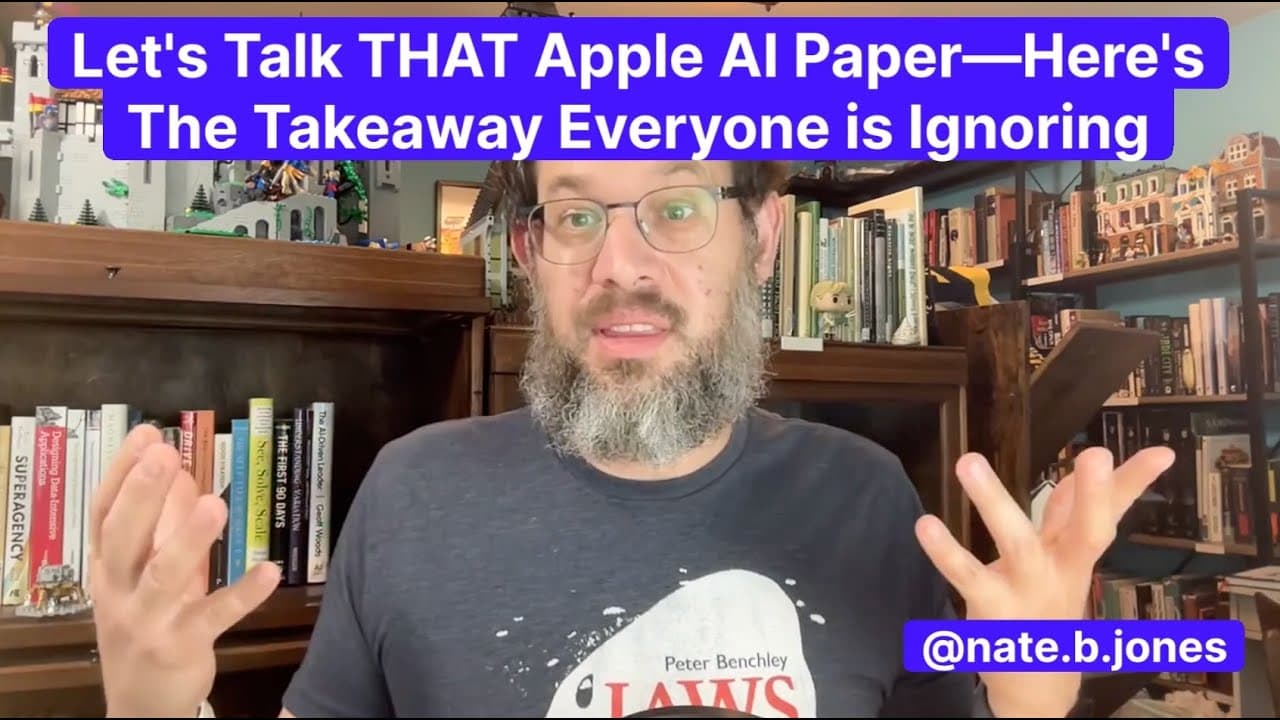
The internet is melting down over the Apple research paper. I am losing track of the number of meme posts that basically add up to the statement that AI is fake. AI is dead. Apple has proved reasoning wrong. It's become a meme. And I am begging everybody to sit down to read the paper to understand what Apple is actually claiming and to understand w... Read More
Key Insights
- Apple's experiment tested four smaller models from Claude, Gemini, DeepSeek, and OpenAI's o3-mini on custom logic puzzles. The researchers deliberately avoided larger frontier models and long inference-time configurations, narrowing the conclusions that can reasonably be drawn from the observed results.
- The test environment excluded Google search, Python, calculators, and every other external tool. Models had only a token budget for thinking, making the setup comparable to asking a person to solve an exam without paper, a pencil, a calculator, or outside assistance.
- The puzzles were selected because their complexity could be adjusted and because models were less likely to have memorized their answers through training. Tower of Hanoi, river-crossing problems, and checker-jumping games therefore served as controlled tests of novel logical problem solving.
- Additional thinking tokens improved performance on problems of medium complexity, and models without thinking or chain-of-thought behavior generally performed worse. At high complexity, however, the tested models experienced a sharp performance decline under the experiment's restricted conditions.
- The paper's findings do not establish that AI reasoning is useless. They show that smaller language models can run out of capacity to solve novel, complex problems when they lack tools, extended inference time, internet access, and assistance from more capable models.
- Stated chain of thought is an uncertain proxy for a model's actual reasoning and performance. The experiment relied on model-produced reasoning text because it preceded Anthropic's reasoning-trace framework, so its methodology does not provide a complete view of the models' internal processes.
- A production AI system needs defined triggers for recognizing when a task is unlikely to succeed within its current model, latency limit, tool access, and inference budget. Those triggers should initiate escalation to a larger model, a tool-enabled model, or a human.
- Escalation can preserve speed and cost efficiency by letting a small, low-latency model handle routine requests while sending difficult edge cases to a more expensive system. The transcript illustrates this with a small model answering 98% of customer queries and escalating the remaining 2%.
Install to Summarize YouTube Videos and Get Transcripts
Explore YouTube Video Summarizer or Get YouTube Transcript Extractor
Questions & Answers
Q: What did Apple's AI reasoning paper actually test?
Apple's research team tested four smaller models associated with Claude, Gemini, DeepSeek, and OpenAI's o3-mini. The models attempted custom logic puzzles such as Tower of Hanoi, river-crossing problems, and checker-jumping games. They could not use internet search, Python, or any other tools, and they did not receive long inference time. Researchers examined the models' stated chains of thought and performance as puzzle complexity increased.
Q: Why did reasoning models fail on highly complex puzzles?
The tested reasoning models encountered a capability cliff when puzzle complexity became high and they had only their own token budgets for thinking. They could not call tools, run Python, search the internet, or transfer the task to a more capable model. Under those constraints, they eventually lost the ability to probabilistically solve unfamiliar problems, even though additional thinking tokens had helped on problems of medium complexity.
Q: Does Apple's paper prove that AI reasoning does not work?
Apple's paper does not prove that AI reasoning is useless or nonexistent. Its results apply to selected smaller models solving adjustable logic puzzles without tools, search, extended inference time, or larger frontier models. The researchers themselves did not make the broad claim that AI was dead. That interpretation came from online reactions that extended a narrow experimental result far beyond the conditions under which it was produced.
Q: Why is stated chain of thought an imperfect measure of AI reasoning?
A model's stated chain of thought has an uncertain relationship to its actual performance and internal reasoning process. Apple's researchers nevertheless used the reasoning text produced by the models as a way to trace their behavior. The paper was written before Anthropic released its reasoning-trace framework, so that newer approach was unavailable. The methodology therefore supports limited observations rather than a complete account of how the models reason internally.
Q: How should an AI system know when to call for help?
An AI system should use defined trigger points based on task complexity, the tested limits of its current model, available tools, permitted inference time, and latency requirements. When those conditions indicate that success is unlikely, the system should escalate the request. Help could come from a larger model, a model with Python or other tools, a model allowed more reasoning time, or a human operator.
Q: Why are escalation frameworks important for production AI?
Escalation frameworks allow fast and inexpensive models to handle routine work without forcing every request through a slow, costly system. When a difficult edge case appears, the smaller model can call a more capable resource. The transcript's example has a low-latency model handling 98% of customer questions while the remaining 2% go to a smarter model, preserving efficiency without ignoring capability limits.
Q: When do AI latency limits make Apple's findings relevant?
The findings matter when an application requires an immediate decision and cannot spend substantial time or resources on reasoning. A telephone customer-service bot cannot pause for a minute and a half before responding, and a fraud system has very little time to assess a submitted card transaction. In such settings, models may lack tools or extended inference, so recognizing uncertainty and escalating gracefully becomes especially important.
Q: How should Apple's AI reasoning experiment be expanded?
The experiment should be repeated with tool use, internet access, more advanced models, longer inference time, and Anthropic's reasoning-trace framework. These additions would show whether the high-complexity capability cliff persists when models operate more like practical AI systems. The transcript argues that the same logic puzzles can be solved when models receive tools and inference time, making those broader comparisons important for understanding reasoning and alignment.
Summary & Key Takeaways
-
Apple tested four smaller models from Claude, Gemini, DeepSeek, and OpenAI on adjustable logic puzzles, including Tower of Hanoi, river-crossing tasks, and checker-jumping games. The models received no internet access, Python, external tools, or long inference time, and researchers used each model's stated chain of thought to examine its reasoning behavior.
-
Additional thinking tokens helped the reasoning models with problems of medium complexity, while models without thinking or chain of thought performed worse. At high complexity, however, performance fell sharply. The result demonstrates a capability boundary under restrictive testing conditions, not a general demonstration that AI reasoning or practical AI systems cannot work.
-
The most useful systems-design lesson is that production models need reliable triggers for requesting help. A fast, inexpensive model could handle ordinary cases and escalate difficult ones to a larger model, a tool-enabled model, or a human. Further testing should add tools, internet access, advanced models, inference time, and improved reasoning-trace methods.
Read in Other Languages (beta)
Share This Summary 📚
Summarize YouTube Videos and Get Video Transcripts with 1-Click
Try YouTube Summary with ChatGPT & Claude or YouTube Transcript Generator
Explore More Summaries from AI News & Strategy Daily | Nate B Jones 📚






Summarize YouTube Videos and Get Video Transcripts with 1-Click
Try YouTube Summary with ChatGPT & Claude or YouTube Transcript Generator