What Are Goal-Based Agents in Artificial Intelligence?
TL;DR
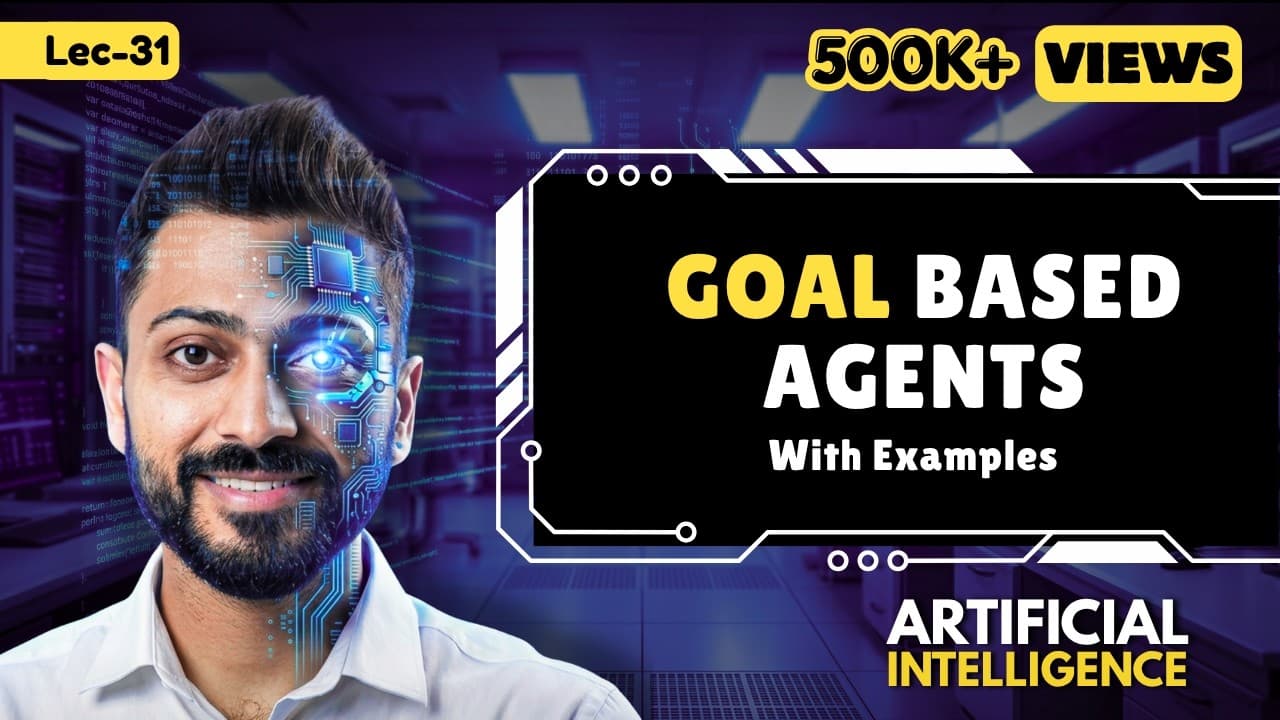
Goal-based agents enhance model-based reflex agents by incorporating planning and searching mechanisms to achieve specific goals. They operate on the principle of supervised learning, utilizing current perceptions and historical data to inform actions. Real-world examples include autonomous delivery robots from companies like Amazon and Alibaba, showcasing their practical utility in logistics.
Transcript
Hello friends! Welcome to Gate Smashers. In this video, we are going to discuss goal-based agents with real-life examples. In the last video, we discussed model-based reflexive agents. The first important point in this is that it is an expansion of model-based reflex agents. It does what model-based reflex agents can do. Plus, it can also do some e... Read More
Key Insights
- Goal-based agents expand on model-based reflex agents by incorporating planning and searching to achieve desired outcomes.
- These agents rely on current perceptions, historical data, and predefined goals to determine the best course of action.
- Supervised learning is a key component, as the input and desired output are already known, allowing the agent to plan accordingly.
- A real-life example is planning a bike trip, where the destination is set, and planning involves route selection and logistics.
- Amazon and Alibaba's G+ robots are examples of goal-based agents, using goals to determine delivery routes and processes.
- The main functionality of goal-based agents includes sensing the current environment, analyzing past data, and planning actions to reach goals.
- Theoretical models underpin the development of intelligent agents, which are implemented based on these foundational principles.
- Goal-based agents are crucial for tasks requiring complex decision-making and planning, illustrating the evolution of AI technology.
Install to Summarize YouTube Videos and Get Transcripts
Explore YouTube Video Summarizer or Get YouTube Transcript Extractor
Questions & Answers
Q: What is a goal-based agent?
A goal-based agent is an advanced type of AI agent that extends the capabilities of model-based reflex agents by incorporating planning and searching to achieve specific goals. It uses current perceptions, historical data, and predefined goals to determine the best course of action, making it suitable for tasks requiring complex decision-making.
Q: How does a goal-based agent differ from a model-based reflex agent?
While both goal-based and model-based reflex agents rely on current perceptions and historical data, goal-based agents add an additional layer of planning and searching. This allows them to achieve specific goals, making them more suitable for tasks requiring a strategic approach, unlike model-based reflex agents that react based on immediate perceptions.
Q: Can you provide a real-life example of a goal-based agent?
A real-life example of a goal-based agent is planning a bike trip to a specific destination, such as Leh & Ladakh. The goal (destination) is predefined, and the agent must plan the route, logistics, and other factors. This involves analyzing current and past data to make informed decisions and reach the goal efficiently.
Q: How do companies like Amazon utilize goal-based agents?
Companies like Amazon utilize goal-based agents in their robotics systems to optimize logistics and delivery processes. These agents determine the best delivery routes and processes by setting specific goals, such as package destinations, and planning the most efficient way to achieve them, thus enhancing operational efficiency and customer satisfaction.
Q: What role does supervised learning play in goal-based agents?
Supervised learning is crucial for goal-based agents as it involves having both the input and desired output known beforehand. This allows the agent to plan and execute tasks effectively, ensuring that each action taken is aligned with reaching the predefined goal, thus enhancing the agent's decision-making and problem-solving capabilities.
Q: Why are theoretical models important for developing intelligent agents?
Theoretical models provide the foundational principles upon which intelligent agents are developed. They guide the design and implementation of these agents, ensuring that they operate effectively and efficiently. By adhering to these models, developers can create agents that perform complex tasks, such as planning and decision-making, in a structured and reliable manner.
Q: What are the main functionalities of goal-based agents?
The main functionalities of goal-based agents include sensing the current environment, analyzing historical data, and planning actions to achieve specific goals. They operate on the principle of supervised learning, allowing them to make informed decisions that align with their predefined objectives, making them essential for tasks requiring strategic planning.
Q: How do goal-based agents contribute to advancements in AI technology?
Goal-based agents contribute to advancements in AI technology by enabling systems to perform complex tasks that require strategic planning and decision-making. They illustrate the evolution of AI by incorporating advanced functionalities like planning and searching, which enhance the capabilities of intelligent systems, making them more adaptable and efficient in various applications.
Summary & Key Takeaways
-
Goal-based agents are an advanced form of model-based reflex agents, incorporating planning and searching to achieve specific goals. They utilize current perceptions, historical data, and predefined goals to determine the best actions. This concept is illustrated through real-life examples, such as planning a trip or automated delivery systems.
-
These agents operate on the principle of supervised learning, where both input and desired output are known. This allows for effective planning and execution of tasks. Companies like Amazon and Alibaba have implemented goal-based agents in their robotics, showcasing their practical applications in logistics and delivery.
-
The development of goal-based agents is grounded in theoretical models, which provide the foundation for creating intelligent systems. These agents are essential for complex tasks requiring strategic planning and decision-making, highlighting the ongoing advancements in artificial intelligence technology.
Read in Other Languages (beta)
Share This Summary 📚
Summarize YouTube Videos and Get Video Transcripts with 1-Click
Try YouTube Summary with ChatGPT & Claude or YouTube Transcript Generator
Explore More Summaries from Gate Smashers 📚


Summarize YouTube Videos and Get Video Transcripts with 1-Click
Try YouTube Summary with ChatGPT & Claude or YouTube Transcript Generator