How to reverse electromagnetic waves in a lab
TL;DR
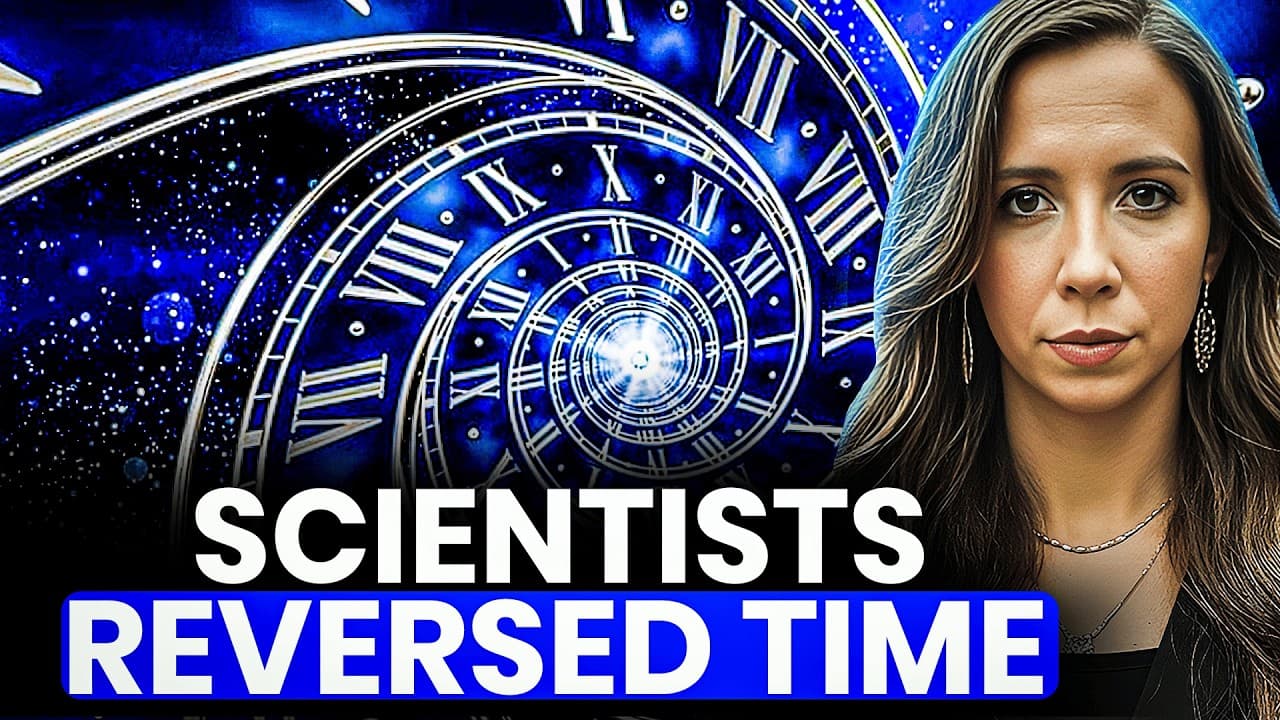
Electromagnetic waves can be reversed in time by crossing a temporal boundary created with programmable metamaterials. The researchers synchronized switches across a metamaterial so that an incident wave flips in time, producing a backward copy. This was repeatable and did not require a particle accelerator, just programmable circuits and meta materials, enabling controlled time reversal in a lab setting.
Transcript
December 26th, [music] 2025, scientists just reverse time itself. Not in a sci-fi movie, but [music] in a real laboratory. And what they discovered doesn't just challenge physics. It challenges [music] everything you thought you knew about the nature of reality. This isn't about [music] time travel. This is about something far more profound, someth... Read More
Key Insights
- Time can be engineered, not just observed, through programmable metamaterials that create temporal boundaries.
- A temporal boundary causes a part of an incoming wave to reverse in time, creating a backward copy rather than a traditional spatial reflection.
- Synchronization across all switches in the meta material is essential to produce a uniform time interface.
- The approach does not require large facilities or accelerators and relies on high-speed electronic switches and capacitor banks.
- Frequency translation occurs during time reversal, shifting signals within the electromagnetic spectrum.
- Temporal cavities and layered interfaces are being explored to trap and manipulate waves through time, enabling new interference effects.
- The concept extends beyond electromagnetism to acoustic, mechanical, and quantum systems, signaling a broad applicability of time domain control.
- This research confirms long-standing theories about temporal boundaries and moves them toward practical experimental demonstration.
Install to Summarize YouTube Videos and Get Transcripts
Explore YouTube Video Summarizer or Get YouTube Transcript Extractor
Questions & Answers
Q: What is temporal reflection and how does it differ from regular reflection?
Temporal reflection is the process by which an electromagnetic wave reverses its path in time after crossing a temporal boundary, rather than bouncing back through space as with regular reflection. In the lab, part of the wave reverses in time to form a backward copy of itself, a phenomenon previously seen only in theory and now demonstrated with programmable metamaterials.
Q: How did the researchers create the temporal boundary in the material?
The temporal boundary was created by triggering a near instant doubling of the material's electromagnetic impedance, achieved with a transmission line meta material composed of a metal strip and high-speed electronic switches connected to capacitors. This setup forms a uniform time interface when all switches flip synchronously, enabling time reversal of the wave.
Q: Why was synchronization critical in the experiment?
Synchronization was critical because any timing mismatch across the switches would destroy the uniform time interface needed to reverse the wave in time. Exactly simultaneous switching across the entire metamaterial ensures the wave experiences a consistent temporal boundary, producing a reliable backward copy rather than distorted signals.
Q: What were the key outcomes of the experiment with time reversal?
Key outcomes include repeatable, controlled time reversals in a laboratory setting, the ability to reverse electromagnetic waves on demand, and the observed frequency translation during time reversal, which shifts signals within the electromagnetic spectrum and opens new possibilities for spectrum engineering and adaptive filtering.
Q: What implications does this have for future technology?
The implications include potential advances in communications, computing, and energy systems through time domain wave control. By engineering energy flow through the temporal dimension, new architectures such as time based computing and temporal cavities could emerge, while quantum and photonic devices may integrate dynamic material conditions for realtime control.
Q: Can this time reversal technique be applied to other wave types?
Yes, the same principles could apply to acoustic waves, mechanical waves, and quantum spin systems. The core idea of creating a uniform temporal boundary through synchronized switching and impedance changes provides a blueprint for manipulating waves in time across multiple physical domains, not just electromagnetism.
Q: What does this experiment prove about long standing physics theories?
The experiment provides experimental proof of temporal boundaries that had existed only in equations since the 1960s. It confirms that sudden medium changes can induce time reflection, turning theoretical predictions into observable, repeatable phenomena in a controlled lab environment.
Q: What challenges remain for advancing time reversal technology?
Current challenges include improving switching accuracy for higher frequency implementations, exploring layered temporal and spatial interfaces, and scaling the approach for practical devices. Researchers are also examining how to integrate time reversal with existing technologies to create new architectures for communication and computation.
Summary & Key Takeaways
-
A lab demonstration shows time reversal of electromagnetic waves using a transmission line meta material and precisely synchronized switches across the material, creating a temporal boundary that flips waves in time.
-
The experiment proves temporal reflection, a past theoretical idea, by producing a backward wave copy and translating frequency, expanding the potential for spectrum engineering and new wave control methods.
-
This development points toward future technologies where time dimension manipulation could influence communications, computing, and energy systems, while remaining grounded in practical lab techniques rather than science fiction.
Read in Other Languages (beta)
Share This Summary 📚
Summarize YouTube Videos and Get Video Transcripts with 1-Click
Try YouTube Summary with ChatGPT & Claude or YouTube Transcript Generator
Explore More Summaries from Julia McCoy 📚




Summarize YouTube Videos and Get Video Transcripts with 1-Click
Try YouTube Summary with ChatGPT & Claude or YouTube Transcript Generator