What Are the Most Common Questions About Space Exploration?
TL;DR
Common questions about space exploration include inquiries about black holes, planetary shapes, and Mars colonization. For example, black holes are not truly black; they absorb all electromagnetic radiation, making them appear so. The James Webb Telescope will explore the edge of the observable universe, and the possibility of weaponizing asteroids revolves around advanced propulsion and precise calculations.
Transcript
once again it's time for questions and answers this is where you ask questions on the YouTube videos and I will answer them here so anytime you want to do this just go on to any video just ask a short questions about space and astronomy short ones are best I can't really answer the long essays in theories but if you've got sentence or two that's pe... Read More
Key Insights
- 🖤 Black holes absorb all electromagnetic radiation, appearing black due to their radiation-absorption mechanism.
- 🪐 Planets generally assume spherical shapes due to hydrostatic equilibrium and gravitational forces.
- 🫷 The James Webb telescope will probe the edge of the observable universe, pushing the boundaries of astronomical discoveries.
- 👾 China emerges as a formidable contender in the space race, with ambitious space station ventures and lunar exploration plans.
- 😘 The potential of Martian trees to grow significantly taller due to the planet's lower gravity offers intriguing possibilities for future terraforming efforts.
- 🎯 Weaponizing asteroids for targeted strikes requires precise calculations and advanced propulsion abilities.
- 🛟 The concept of panspermia remains plausible for the origin of life on Earth, with Mars not definitively ruled out as a potential source.
Install to Summarize YouTube Videos and Get Transcripts
Explore YouTube Video Summarizer or Get YouTube Transcript Extractor
Questions & Answers
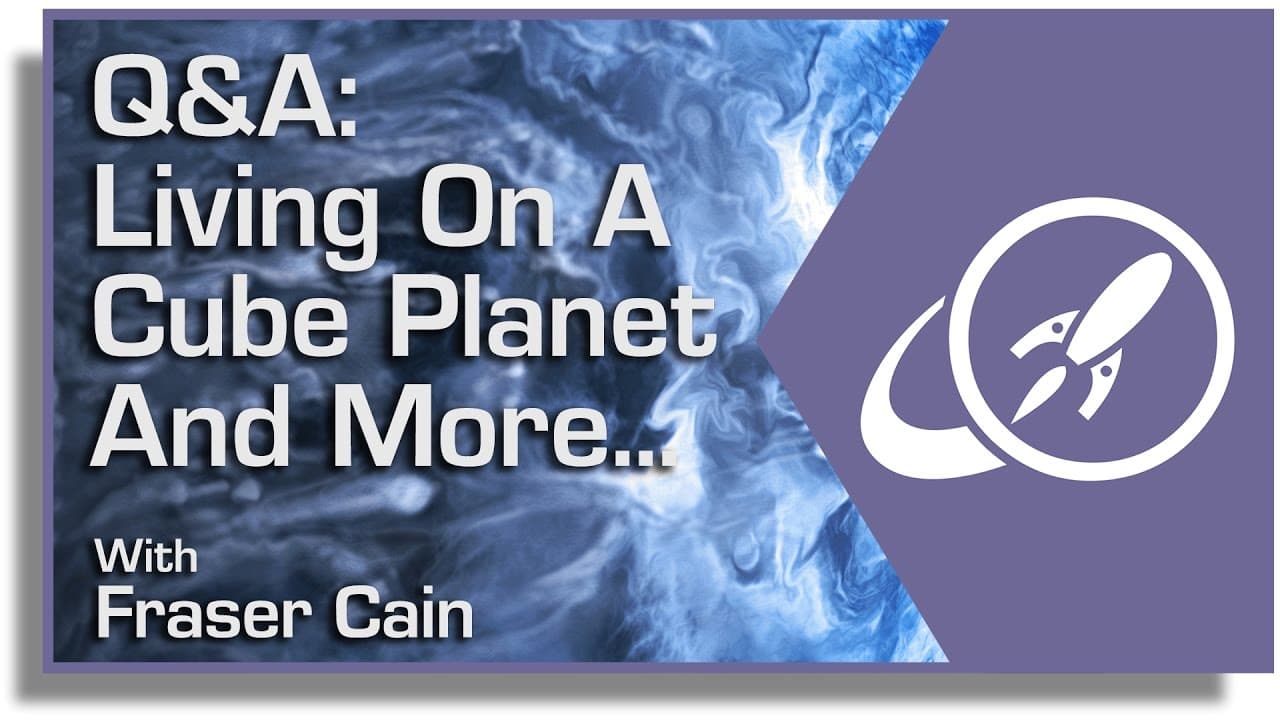
Q: Why are black holes black?
Black holes appear black because they absorb all electromagnetic radiation, including visible light, making them appear as dark spots in space.
Q: Can a planet be shaped like a cube or a disc?
Planets tend to form into spheres due to hydrostatic equilibrium, but smaller objects like certain moons can have irregular shapes due to past events affecting their gravitational balance.
Q: Could the James Webb telescope explore beyond the observable universe?
The James Webb telescope is limited to observing within the observable universe, up to the cosmic microwave background radiation, providing insights into distant cosmic phenomena but unable to probe beyond the observable boundary.
Q: What country may become a major player in the space race?
China is poised to be a leading contender in the space race, demonstrated by their successive space station launches and aspirations for lunar missions, making them a prominent force in the global space exploration landscape.
Summary & Key Takeaways
-
A seasoned astronomer responds to questions on telescope limitations, explanations about black holes, planetary shapes, Mars colonization, telescope capabilities, and more.
-
The astronomer clarifies the misconceptions of black holes being truly black and explains their absorption of electromagnetic radiation.
-
Insightful answers are given on diverse topics from astrophysics to exoplanets and space travel vehicles.
Read in Other Languages (beta)
Share This Summary 📚
Summarize YouTube Videos and Get Video Transcripts with 1-Click
Try YouTube Summary with ChatGPT & Claude or YouTube Transcript Generator
Explore More Summaries from Fraser Cain 📚

Summarize YouTube Videos and Get Video Transcripts with 1-Click
Try YouTube Summary with ChatGPT & Claude or YouTube Transcript Generator