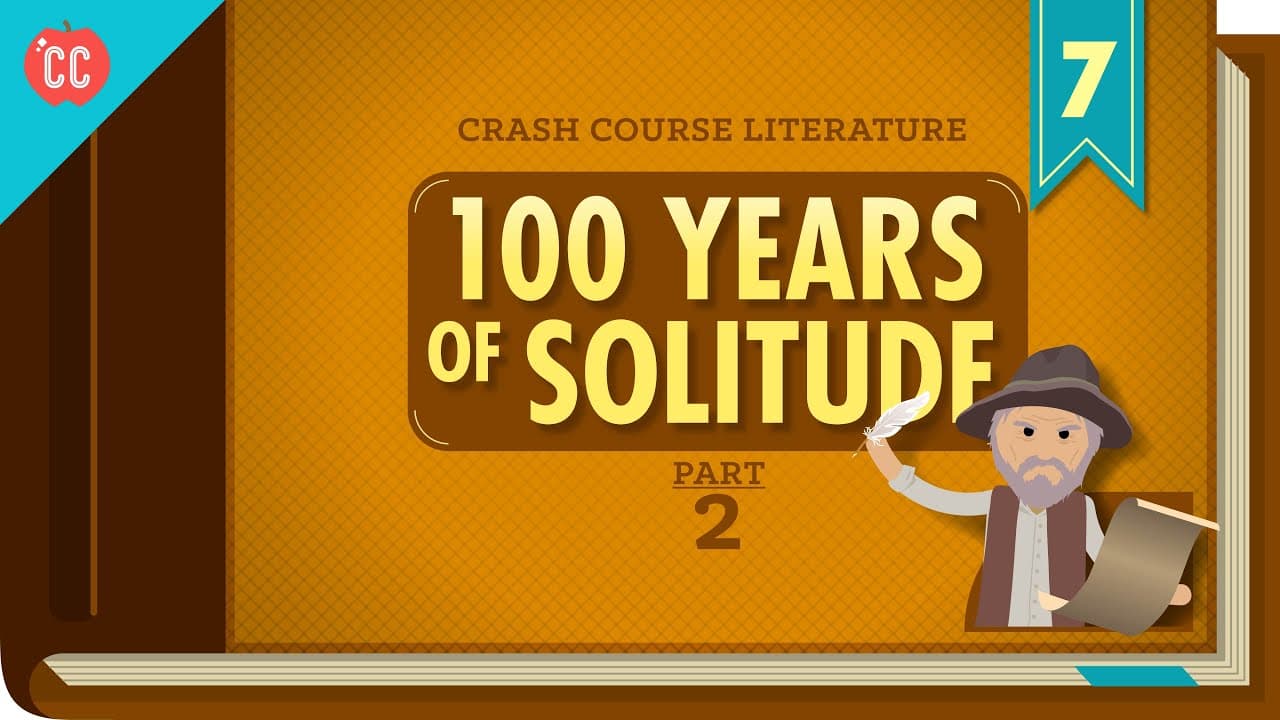
100 Years of Solitude Part 2: Crash Course Literature 307
TL;DR
Explores Latin America's colonial history through magical realism.
Transcript
Hi, I'm John Green. This is Crash Course Literature. And this week we're continuing our discussion of Gabriel García Márquez's 100 Years of Solitude. It isn't just the story of all those Buendias we talked about last time. Today we're going to zoom out a little and look at how this novel can be read as a fictionalized history of Latin America's str... Read More
Key Insights
- Gabriel García Márquez's novel is a fictionalized account of Latin America's colonial history, reflecting on exploitation and violence.
- The term 'Banana Republic' describes unstable economies tied to single exports, often manipulated by foreign companies.
- Neocolonialism involves business entities exploiting developing nations without territorial annexation, mirroring colonial practices.
- García Márquez uses documentary realism to blend historical facts with fiction, highlighting the subjective nature of historical narratives.
- Magical realism in the novel merges myth and reality, offering a counter-logic to the scientific reasoning that dehumanizes people.
- The novel critiques the use of logic to deny humanity, portraying the absurdity of proving people don't exist through legal arguments.
- 100 Years of Solitude explores the balance between remembering and forgetting, suggesting a speculative approach to history.
- Reading the novel is a solitary act that connects readers to voices of the past, highlighting shared experiences of violence and exploitation.
Install to Summarize YouTube Videos and Get Transcripts
Explore YouTube Video Summarizer or Get YouTube Transcript Extractor
Questions & Answers
Q: How does 100 Years of Solitude reflect Latin America's colonial history?
100 Years of Solitude reflects Latin America's colonial history by using magical realism to depict the exploitation and violence faced by its people. The novel combines documentary realism with myth to present a narrative that challenges traditional historical accounts, highlighting the struggles of the colonized and the impact of foreign manipulation.
Q: What is the significance of the term 'Banana Republic' in the novel?
The term 'Banana Republic' is significant in the novel as it represents the unstable economies of Latin American countries tied to single exports, often manipulated by foreign companies. This concept is central to understanding the novel's themes of economic exploitation and neocolonial practices, as depicted through the experiences of García Márquez's hometown.
Q: How does García Márquez use magical realism in the novel?
García Márquez uses magical realism in the novel to merge myth and reality, offering a counter-logic to the scientific reasoning that dehumanizes people. This approach allows him to integrate multiple realities, reflecting the perspectives of both colonizers and the colonized, and providing imaginary solutions to real social contradictions.
Q: What role does documentary realism play in the novel?
Documentary realism plays a crucial role in the novel by blending historical facts with fiction. García Márquez uses this technique to highlight the subjective nature of historical narratives, emphasizing that our understanding of the past is always filtered through the lens of witnesses or storytellers, and is never entirely objective.
Q: How does the novel critique the use of logic to deny humanity?
The novel critiques the use of logic to deny humanity by portraying the absurdity of proving people don't exist through legal arguments. García Márquez demonstrates how scientific reasoning and logic can be used to dehumanize people, emphasizing the need for a counter-logic that represents the truth of human experiences.
Q: What does the novel suggest about remembering and forgetting?
The novel suggests that there is a balance between remembering and forgetting, associating too much remembering with a kind of living death and too much forgetting with madness. It proposes a speculative approach to history, combining documentary facts with creative storytelling to include more voices in the narrative of what happened.
Q: How does reading 100 Years of Solitude connect readers to the past?
Reading 100 Years of Solitude is a solitary act that connects readers to voices of the past, highlighting shared experiences of violence and exploitation. The novel exposes readers to perspectives they may not have encountered otherwise, making them more aware of their connections to people who have experienced various forms of historical injustices.
Q: What is García Márquez's gift to readers through this novel?
García Márquez's gift to readers through this novel is the awareness of the muted voices of the past, especially those who have experienced violence and exploitation. By combining realism and myth, the novel penetrates readers' defenses, allowing them to understand the deeper truths of human experiences beyond mere historical facts, and encouraging them to reflect on their own connections to these narratives.
Summary & Key Takeaways
-
Gabriel García Márquez's 100 Years of Solitude is an exploration of Latin America's colonial history, using magical realism to depict the struggles and exploitation faced by its people. The novel combines documentary realism with myth to present a nuanced narrative that challenges traditional historical accounts.
-
The concept of 'Banana Republics' is central to understanding the novel's themes, as it represents the economic manipulation and neocolonial practices by foreign entities in Latin America. García Márquez's hometown experiences, including the Banana Strike Massacre, are woven into the narrative to highlight these issues.
-
The novel critiques the use of logic and scientific reasoning to dehumanize people, portraying the absurdity of denying the existence of workers through legal arguments. It emphasizes the importance of remembering and forgetting ethically, suggesting a balance between documentary facts and creative storytelling.
Read in Other Languages (beta)
Share This Summary 📚
Summarize YouTube Videos and Get Video Transcripts with 1-Click
Try YouTube Summary with ChatGPT & Claude or YouTube Transcript Generator
Explore More Summaries from CrashCourse 📚
Summarize YouTube Videos and Get Video Transcripts with 1-Click
Try YouTube Summary with ChatGPT & Claude or YouTube Transcript Generator