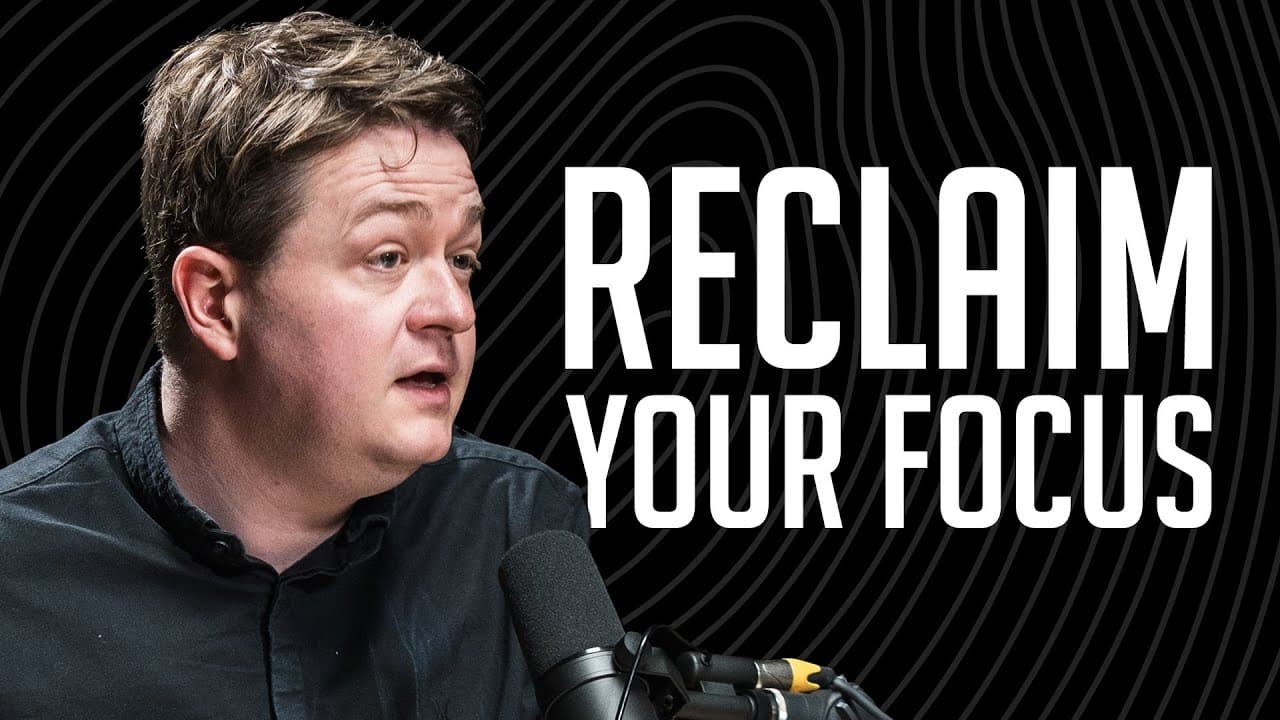
How to reclaim focus in a distraction filled world
TL;DR
Focus can be rebuilt by addressing tech addiction and sleep, plus other factors Hari cites. To reclaim attention, implement strategies addressing twelve factors, prioritize deep work, and reduce distractions. The discussion emphasizes that attention loss is solvable and driven by external forces rather than lack of willpower.
Transcript
(gentle music) I think we need to realize when we are plugged into machinery that makes us angrier and angrier, and angrier. If it's enraging, it's engaging, it will keep people scrolling. We need an attention movement to reclaim our minds. (gentle music) We are not medieval peasants, begging at the court of king Zuckerberg for a few little crumbs ... Read More
Key Insights
- Attention is being stolen by powerful forces in modern life and is not simply a personal failure.
- Sleep plays a critical role in focus, with evidence showing sleep deprivation impairs attention much like intoxication.
- The smartphone and digital tech are among the main factors that hack our attention, especially when immune system defenses are down.
- There are twelve identified factors that can enhance or impair attention, illustrating a multifactorial problem beyond just technology.
- Deep work and deliberate practice are possible solutions when we acknowledge and address the contributing factors.
- Reducing time on social media and creating offline periods can help restore concentration and cognitive capacity.
- Public awareness and collective action are important, as Hari frames this as an attention crisis needing a movement.
- Experts from multiple fields underscore that long term focus is compatible with healthy technology use and lifestyle changes.
- More videos from this channel:
- More from this channel: Rich Roll
Install to Summarize YouTube Videos and Get Transcripts
Explore YouTube Video Summarizer or Get YouTube Transcript Extractor
Questions & Answers
Q: What is the core problem Hari identifies with our attention today?
Hari identifies that attention is being stolen by powerful forces in modern life, not merely a lack of willpower. He argues that technology, design choices, and other environmental factors combine to erode our ability to focus, making deep work increasingly difficult. This framing shifts responsibility from individuals to systemic issues while offering practical paths to reclaim attention.
Q: How many factors affect attention according to Hari, and what is their nature?
Hari mentions twelve factors that can either improve or impair attention. These factors are diverse and range from technological design to sleep, stress, and environmental conditions. The key point is that attention is influenced by a complex set of interacting elements, not a single cause, which implies multifaceted strategies are needed to improve focus.
Q: What role does sleep play in maintaining attention as discussed in the podcast?
Sleep is critical for attention, with experts noting that insufficient sleep impairs focus. Hari highlights that the typical person wakes up less refreshed and that sleep duration has shortened over time, contributing to diminished attentional capacity. Achieving good sleep is portrayed as essential for sustaining deep concentration.
Q: Why is technology considered a major factor in attention decline?
Technology is considered a major factor because it is designed to hack and invade attention, especially when our immune systems for focus are already down. The discussion links smartphones and constant connectivity to reduced capacity for deep attention, illustrating how digital design can drive continuous engagement at the expense of meaningful focus.
Q: What analogy does Hari use to describe the health of our attention system in the modern era?
Hari uses the metaphor of an immune system that is down, suggesting that our attention is vulnerable to a virus-like technology that disrupts concentration. The idea is that while the tech itself is powerful, our ability to resist or manage it has weakened due to other concurrent factors, creating an attention crisis.
Q: What is the connection between The Social Dilemma and this broader discussion on focus?
The discussion positions The Social Dilemma as a stepping stone to a broader investigation, showing how the same concerns about tech and attention are connected to deeper factors like sleep, stress, and environment. Hari enlarges the conversation beyond the documentary by examining twelve contributing factors and proposing solutions for reclaiming focus.
Q: What solutions does Hari propose beyond personal willpower to improve attention?
Hari emphasizes systemic and personal strategies to reclaim attention, including addressing tech design, creating offline periods, improving sleep, and reducing chronic stress. He stresses that there is scientific evidence for multiple factors influencing attention and that coordinated action can mitigate the crisis, not just individual self-control.
Q: Why does Hari believe there is hope for solving the attention problem?
Hari believes there is hope because the problem is not an unstoppable decline but a solvable imbalance caused by external forces. By recognizing the twelve factors, reducing exposure to harmful tech patterns, and adopting healthier sleep and stress management practices, people can regain their ability to focus and direct their minds intentionally. This is framed as a collective, solvable challenge.
Summary & Key Takeaways
-
Hari argues that attention is stolen by powerful modern forces and can be reclaimed through systemic changes and personal practices.
-
The conversation covers sleep, stress, pollutants, and digital design as factors impacting focus, with a call to action for an attention movement.
-
The interview connects The Social Dilemma themes to a broader, actionable framework for improving concentration and reclaiming mental bandwidth.
Read in Other Languages (beta)
Share This Summary 📚
Summarize YouTube Videos and Get Video Transcripts with 1-Click
Try YouTube Summary with ChatGPT & Claude or YouTube Transcript Generator
Explore More Summaries from Rich Roll 📚




Summarize YouTube Videos and Get Video Transcripts with 1-Click
Try YouTube Summary with ChatGPT & Claude or YouTube Transcript Generator