What Is Vertex Connection and Merging in TU Wien Rendering #36, and How Does Path Space Regularization Work?
TL;DR
Vertex connection conditionally accepts a nearby path vertex within a merging radius, creating an initially biased technique whose bias decreases as the radius shrinks toward zero over time. Vertex connection and merging can render difficult SDS light transport and ultimately becomes unbiased. Read on to understand spatial and angular regularization, specular reflections, and comparisons with other rendering algorithms.
Transcript
now let's proceed to vertex connection and merging by Aaliyah area and colleagues so what he proposes to do is that we conditionally accept this path the vertex next to XS but we pretend that we indeed have to hit what this basically means is that we have a biased connection something that didn't really happen but we pretend that it did and we have... Read More
Key Insights
- ⌛ Vertex connection and merging combines biased and unbiased rendering, resulting in a technique that starts biased but becomes unbiased over time.
- 🙂 This technique allows for the rendering of complex light transport situations and unifies two major schools of thought in photorealistic image synthesis.
- 💦 Anton Kaplan's work on angular regularization extends vertex connection and merging to handle specular reflections in a different way.
- ⚾ Regularization in vertex connection and merging can be either spatial or angular, based on either spatial distance or outgoing angles, respectively.
- 😃 Comparisons with other rendering techniques like bi-directional path tracing and progressive photon mapping showcase the unique capabilities of vertex connection and merging.
- 🚨 The ability to render SDS light paths and capture reflections accurately makes vertex connection and merging a significant development in global illumination.
- 👻 Vertex connection and merging involves gradually shrinking the bias over time until it becomes negligible, allowing for the production of unbiased and photorealistic images.
Install to Summarize YouTube Videos and Get Transcripts
Explore YouTube Video Summarizer or Get YouTube Transcript Extractor
Questions & Answers
Q: How does vertex connection work in vertex connection and merging?
Vertex connection conditionally accepts a path when a vertex is close to the target vertex, even though the actual hit did not occur. Closeness is determined by whether the vertex lies within a circle of merging radius R, which introduces bias.
Q: How does vertex connection and merging become unbiased over time?
The merging radius R decays and becomes smaller over time. As it approaches a value very close to zero, the introduced bias disappears, so the algorithm progresses from biased rendering toward an unbiased technique.
Q: Why is vertex connection and merging significant for photorealistic rendering?
It unifies the biased and unbiased schools of photorealistic image synthesis. The algorithm starts biased to make rendering more practical, then has less and less bias as time passes until it becomes unbiased.
Q: What difficult light transport can vertex connection and merging render?
Vertex connection and merging can render difficult SDS light transport situations. This capability is presented as a major development in global illumination because such paths are challenging for other approaches.
Q: What is spatial regularization in vertex connection and merging?
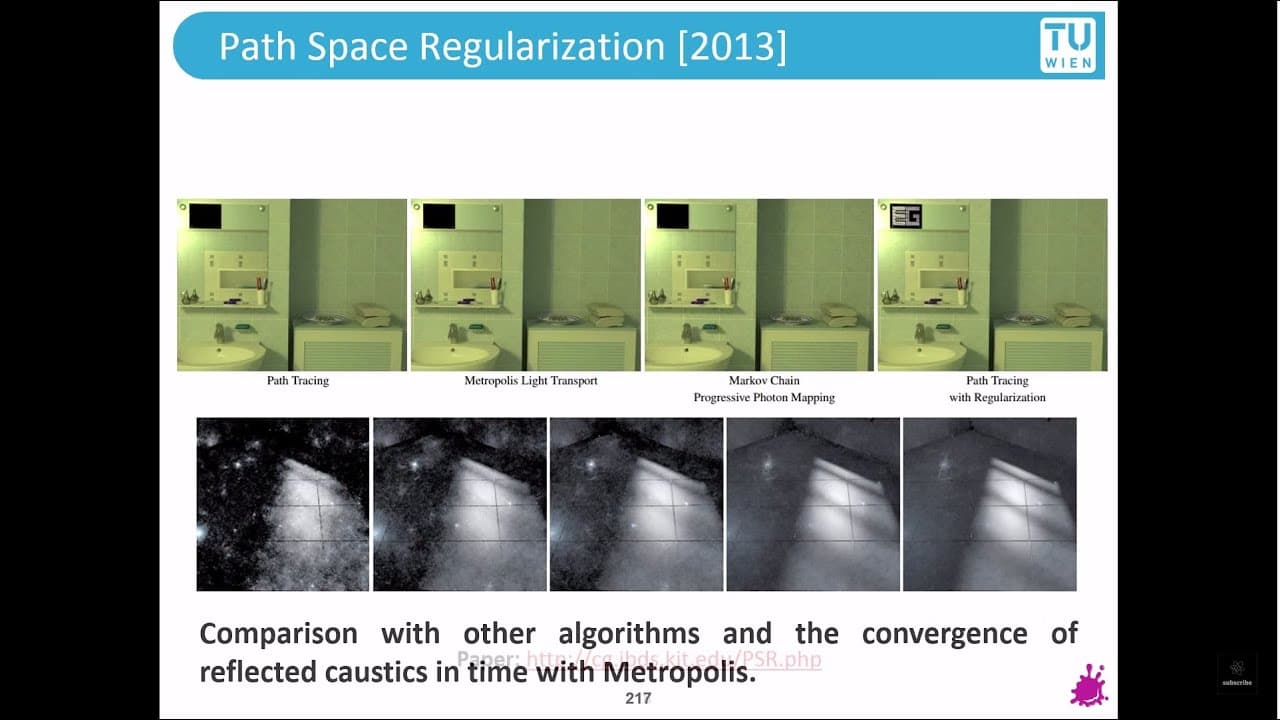
Spatial regularization uses a merging radius R around a vertex. A continued light path is accepted when it hits a point near the next specular vertex and falls inside that spatial tolerance.
Q: What is angular regularization in path space regularization?
Angular regularization, described as work by Anton Kaplan and colleagues, replaces spatial distance with a tolerance based on outgoing values. It generalizes vertex connection and merging by progressively narrowing the angular distribution toward a delta distribution.
Q: How do specular reflections change during angular regularization?
Angular regularization begins with a large angular tolerance, causing specular interreflections to be treated as diffuse. A mirror initially appears like a white or colored wall, then slowly converges to a mirror as the angular distribution is squeezed toward a delta distribution.
Q: How is vertex connection and merging compared with other rendering algorithms?
The transcript compares bi-directional path tracing, progressive photon mapping, and vertex connection and merging. It also highlights path tracing with regularization as the only shown technique capable of rendering the Eurographics logo reflected in the mirror.
Summary & Key Takeaways
-
Vertex connection and merging is a technique that creates a biased connection between vertices to improve rendering.
-
By shrinking the bias over time, the technique eventually becomes unbiased, resulting in photorealistic images.
-
Comparisons are made with other rendering techniques such as bi-directional path tracing and progressive photon mapping.
Read in Other Languages (beta)
Share This Summary 📚
Summarize YouTube Videos and Get Video Transcripts with 1-Click
Try YouTube Summary with ChatGPT & Claude or YouTube Transcript Generator
Explore More Summaries from Two Minute Papers 📚





Summarize YouTube Videos and Get Video Transcripts with 1-Click
Try YouTube Summary with ChatGPT & Claude or YouTube Transcript Generator