How Does Tesla Train Its Self-Driving Cars Using Simulations?
TL;DR
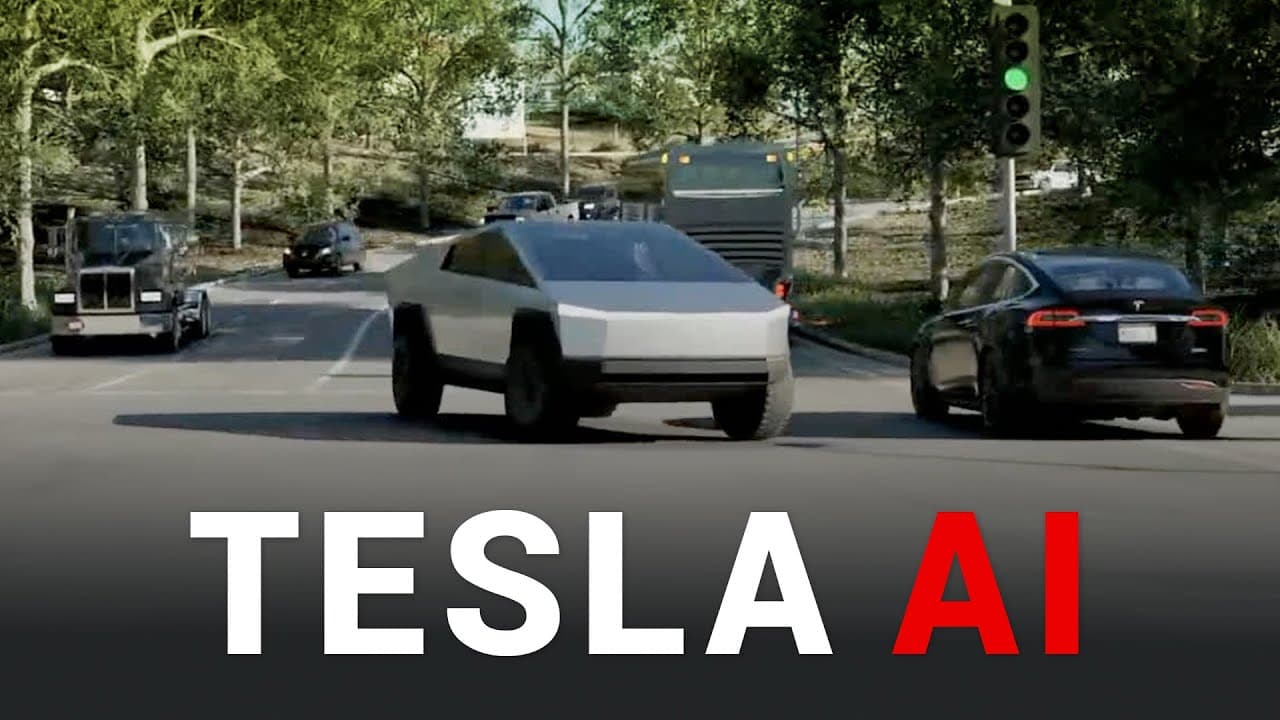
Tesla trains its self-driving cars using simulated game worlds to develop sophisticated AI systems. By integrating multiple camera feeds and recent research in neural networks, the cars can create accurate environmental maps and predict vehicle behavior. Simulations allow for safe training on challenging scenarios that may be unsafe or impractical to test in real life.
Transcript
Dear Fellow Scholars, this is Two Minute Papers with Dr. Károly Zsolnai-Fehér. Today we are going to see how Tesla uses no less than a simulated game world to train their self-driving cars. And more. In their AI day presentation video, they really put up a clinic of recent AI research results and how they apply them to develop self-driving cars. An... Read More
Key Insights
- 🎠 Tesla's self-driving cars use recent research papers and neural networks to process camera data and extract useful information.
- 🎥 The fusion of data from multiple cameras is a challenging task that is solved using a transformer neural network.
- 👻 Incorporating time in the system allows for better prediction of vehicle behavior and mapping of the environment.
- 🍵 Tesla's approach of fetching and creating training data helps improve the system's capabilities in handling unexpected situations.
- 💨 Photorealistic simulations provide a safe and flexible way to train the self-driving system and teach it to handle various scenarios.
- 😒 The advancements showcased in the presentation are just a glimpse of Tesla's current capabilities, and more advanced technology is likely already in use.
- ☺️ Tesla's self-driving system aims to make transportation safer, more affordable, and more relaxed for passengers.
Install to Summarize YouTube Videos and Get Transcripts
Explore YouTube Video Summarizer or Get YouTube Transcript Extractor
Questions & Answers
Q: How does Tesla's self-driving system process the raw camera data?
Tesla's self-driving system uses transformer neural networks, BiFPNs, and Regnet to convert raw camera data into high-level information, such as identifying cars and traffic lights.
Q: How does the system fuse information from multiple cameras?
The fusion of information from multiple cameras is achieved through a transformer neural network, which intelligently combines the data considering different calibration, location, and view directions of each camera.
Q: How does incorporating time improve the self-driving system's capabilities?
By considering time, the self-driving system can make predictions about vehicle behavior and better understand changes in the environment, leading to improved decision-making.
Q: How does Tesla handle difficult situations that lack training data?
Tesla has two solutions: fetching more training data from its fleet of cars and creating more training data through photorealistic simulations that can teach the self-driving system to handle corner cases.
Summary & Key Takeaways
-
Tesla's self-driving cars use multiple cameras to create a vector space view of the road and surrounding objects.
-
Transformer neural networks, BiFPNs, and Regnet, which are recent research papers, are utilized in the architecture to process the raw sensor data.
-
The system incorporates time to make predictions about vehicle behavior and accurately map the environment.
Read in Other Languages (beta)
Share This Summary 📚
Summarize YouTube Videos and Get Video Transcripts with 1-Click
Try YouTube Summary with ChatGPT & Claude or YouTube Transcript Generator
Explore More Summaries from Two Minute Papers 📚


Summarize YouTube Videos and Get Video Transcripts with 1-Click
Try YouTube Summary with ChatGPT & Claude or YouTube Transcript Generator