How Does NVIDIA's AI Generate Future Video Simulations?
TL;DR
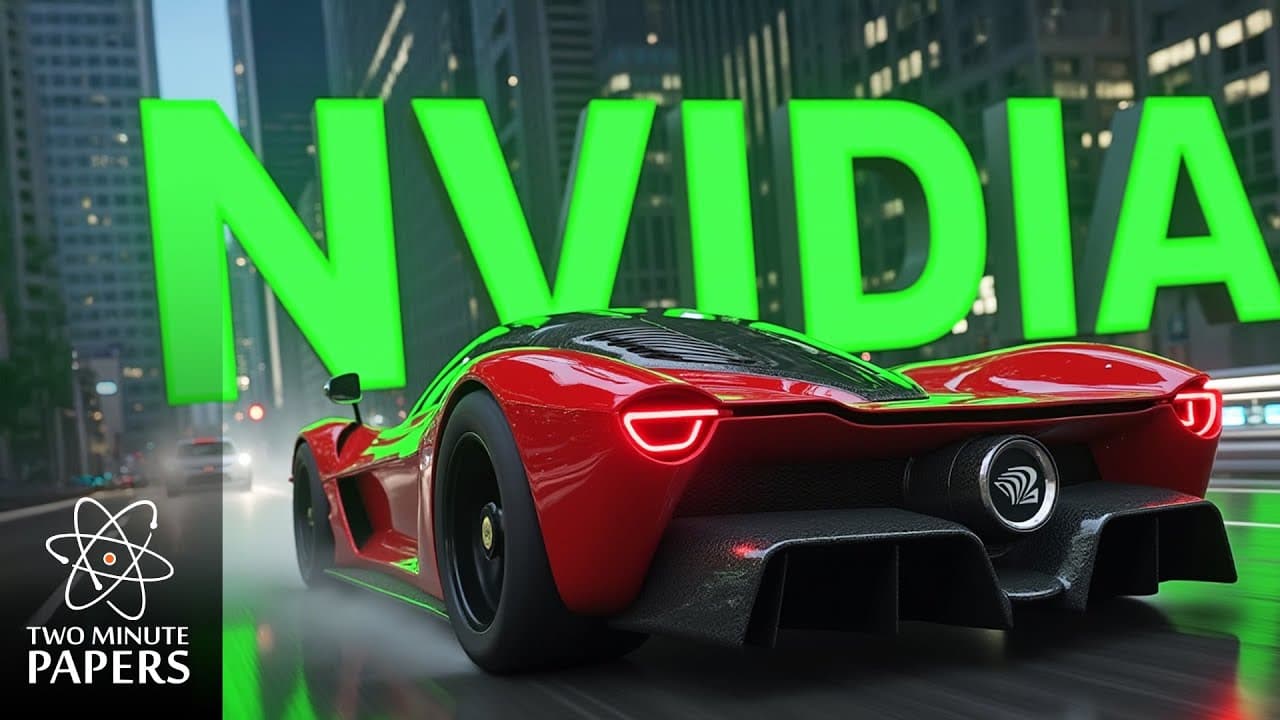
NVIDIA's new AI model simulates future scenarios by generating numerous video continuations based on input images or text prompts, aiding in the training of self-driving cars and robots. Although the model is open-source and provides valuable training data for rare situations, it currently faces limitations in video quality and generation speed.
Transcript
This is an exclusive look at a huge new 76-page AI research paper on creating the future. And not just the future, but many thousands of futures. Sort of… you see, this AI system has multiple models, one where we take an input image, add a text prompt, and bam, it continues this image into the future as a video. Or these here are text2wor... Read More
Key Insights
- 🎮 The AI model offers a unique approach to synthesizing video continuations, enhancing the training capabilities of robotic systems.
- 🤗 Open-source availability encourages widespread adaptation and innovation in various use cases across the AI community.
- 🥇 Significant emphasis is placed on training data diversity, particularly in rare situational contexts often neglected by traditional training methods.
- 🍸 Although initial results show limitations, the model represents a step-forward in addressing long-tail scenarios in AI development.
- 👤 User feedback highlights the improved perception of result quality, suggesting the potential for future enhancements to gain wider acceptance.
- 👨🔬 The research stresses the iterative nature of scientific progress, reinforcing the idea that future research could yield substantial improvements.
- 💗 There is a growing need for AI systems, particularly in self-driving technology, to accurately predict and understand dynamic real-world scenarios.
Install to Summarize YouTube Videos and Get Transcripts
Explore YouTube Video Summarizer or Get YouTube Transcript Extractor
Questions & Answers
Q: What is the primary purpose of the new AI model discussed in the research paper?
The primary purpose of the new AI model is to assist in the training of self-driving cars and humanoid robots. By generating countless video scenarios based on text or image inputs, the model helps these systems better understand complex, real-world situations, particularly those that are rare or challenging to find in existing training data.
Q: What are some specific scenarios where this AI model would be useful?
This AI model is particularly useful for training self-driving cars in handling rare situations, such as moving traffic lights or uncommon interactions in traffic. In the case of industrial robots, it can simulate various tasks, like picking up different objects, by generating numerous video variants that cover many possible outcomes of these actions.
Q: What are the limitations of the AI model mentioned in the paper?
The AI model faces several limitations, including generation times that can exceed five minutes for just a few seconds of video and imperfect visual quality. Users reported anomalies where objects behave unexpectedly, like apples not falling correctly or characters having unusual features. These issues indicate that the technology needs refinement for more realistic simulations.
Q: How does the open-source aspect of this AI model benefit users?
By being open-source, the AI model allows users to modify and fine-tune the software to suit their specific needs. This accessibility encourages innovation, as developers can create tailored training data for their hardware and applications without the constraints of proprietary systems.
Q: How does this research relate to the concept of 'long-tail problems' in AI learning?
Long-tail problems in AI refer to scenarios for which there is little or no training data available, leading to poor performance in those situations. The AI model addresses this by generating a vast number of diverse continuations, thereby filling the data gap and enabling better training for AI systems to understand rare, complex occurrences they might encounter in real life.
Q: What potential future advancements are anticipated for this AI technology?
Anticipated advancements for this AI technology include enhancing speed and accuracy in future iterations of the model. The researchers highlight the potential for improvements based on historical development trends, suggesting that subsequent versions could become significantly faster and more accurate, solving the current limitations presented in this iteration.
Q: What impact does the user study result have in the context of this research?
The user study results indicate that human subjects generally favor the quality of the AI-generated videos over those produced by previous techniques, suggesting that this model does offer a significant improvement in certain aspects of video generation. This positive response from users reinforces the research's validity and importance in the field of AI advancements.
Q: What broader implications does this research have for the future of AI and robotics?
The research holds broader implications for the future of AI and robotics by enabling machines to learn more effectively from diverse and complex environments. As this technology integrates into more applications, it could lead to more autonomous and capable systems across industries, ultimately enhancing operational efficiency and safety in real-world scenarios.
Summary & Key Takeaways
-
A groundbreaking AI research paper presents a model capable of generating numerous future video continuations from input images or text prompts, aiding in training for AI systems.
-
This open-source model is designed to help self-driving vehicles and robots learn from various scenarios, particularly aiding in understanding rare situations that are hard to simulate.
-
Despite limitations in video quality and generation times, the paper envisions significant future advancements in technology, potentially increasing speed and accuracy in subsequent iterations.
Read in Other Languages (beta)
Share This Summary 📚
Summarize YouTube Videos and Get Video Transcripts with 1-Click
Try YouTube Summary with ChatGPT & Claude or YouTube Transcript Generator
Explore More Summaries from Two Minute Papers 📚



Summarize YouTube Videos and Get Video Transcripts with 1-Click
Try YouTube Summary with ChatGPT & Claude or YouTube Transcript Generator