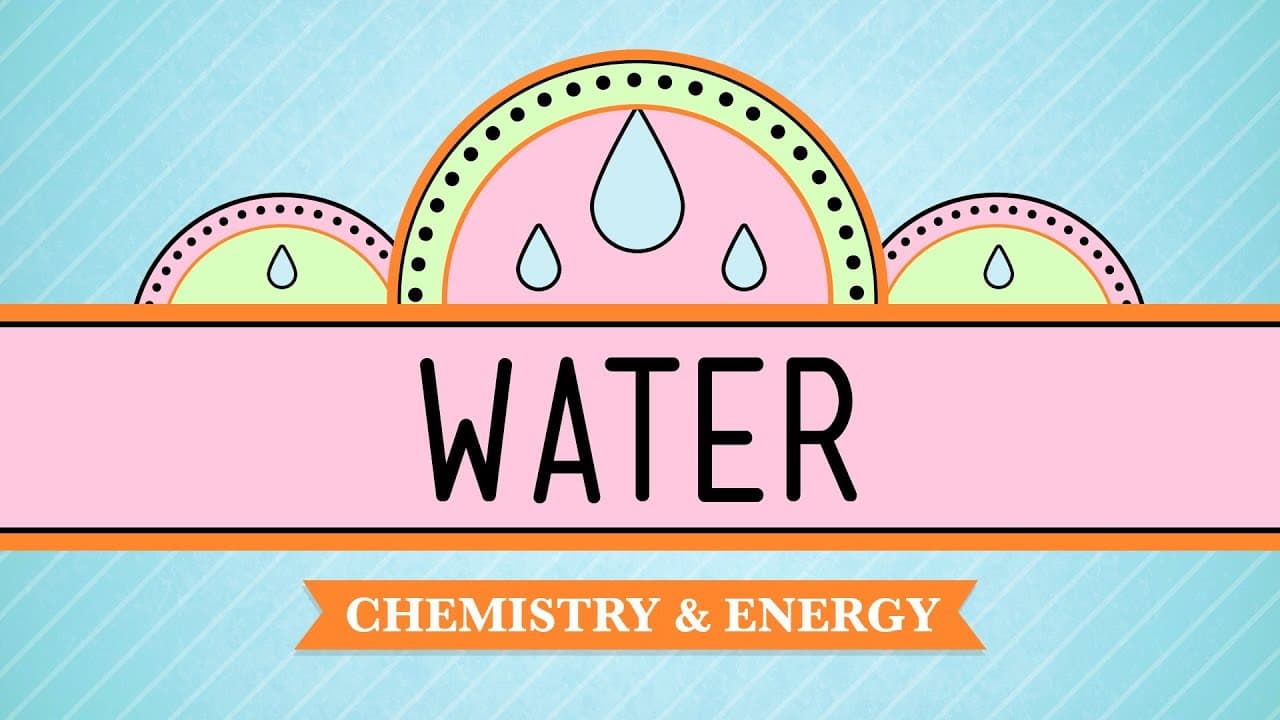
Water - Liquid Awesome: Crash Course Biology #2
TL;DR
Water is necessary for life because its polarity and hydrogen bonds give it exceptional cohesion, adhesion, solvent power, heat capacity, and density behavior. Each H2O molecule contains two hydrogen atoms and one oxygen atom, arranged in a V shape with slightly charged regions. These properties support biological processes, moderate global temperatures, move water through plants, and keep bodies of water from freezing solid. Read on to see how each property works.
Transcript
Hello there. Here at Crash Course HQ we like to start out each day with a nice healthy dose of water in all it's three forms. It's the only substance on all of our planet earth that occurs naturally in solid, liquid, and gas forms. And to celebrate this magical bond between two hydrogen atoms and one oxygen atom here, today, we are going to be cele... Read More
Key Insights
- Water is the only substance on Earth that naturally exists in solid, liquid, and gas forms, making it vital for life.
- Hydrogen bonds between water molecules result in high cohesion, giving water a high surface tension and allowing phenomena like water bugs walking on water.
- Adhesion allows water to stick to other substances, enabling capillary action, which defies gravity and is crucial for plant life.
- Water's polarity makes it an excellent solvent, dissolving more substances than any other liquid, which is essential for biological processes.
- Hydrophobic substances are non-polar and cannot dissolve in water, highlighting water's selective solubility due to its cohesive forces.
- Henry Cavendish's experiments identified hydrogen as a distinct substance and determined water's composition, contributing significantly to chemistry.
- Ice is less dense than liquid water due to hydrogen bonds forming crystalline structures, preventing aquatic ecosystems from freezing solid.
- Water's high heat capacity stabilizes Earth's climate by absorbing and retaining heat, making environments near oceans more temperate.
Install to Summarize YouTube Videos and Get Transcripts
Explore YouTube Video Summarizer or Get YouTube Transcript Extractor
Questions & Answers
Q: Why is water necessary for life?
Water’s polarity and hydrogen bonds produce several life-sustaining properties, including cohesion, adhesion, strong solvent power, high heat capacity, and unusual density when frozen. Together, these properties support biological processes, regulate temperatures, transport water through plants, and prevent bodies of water from freezing solid.
Q: How do hydrogen bonds give water its unique properties?
A water molecule has a slightly negative region around its oxygen atom and a slightly positive region around its hydrogen atoms. The positive region of one molecule forms a weak hydrogen bond with the negative region of another, producing properties such as strong cohesion and high surface tension.
Q: What are cohesion and surface tension in water?
Cohesion is the attraction between like substances, such as one water molecule and another. Water has the highest cohesion of any non-metallic liquid, causing it to bead on wax paper or some leaves and creating enough surface tension for certain bugs to walk on water.
Q: What is adhesion, and how is it different from cohesion?
Adhesion is attraction between different substances, while cohesion is attraction between like substances. Water spreads across glass when its adhesive attraction to the glass is stronger than the cohesive attraction holding the water molecules together.
Q: How does capillary action allow water to move against gravity?
Adhesion attracts water molecules to the surface of a narrow tube or straw, while cohesion pulls additional water molecules along. The resulting surface tension makes the water climb until gravity acting on its weight overcomes that force.
Q: Why is water such an effective solvent?
Water’s polarity allows it to dissolve more substances than any other liquid on Earth. Polar or ionic substances such as sugar and salt can overcome water’s cohesive forces, after which water molecules surround the dissolved particles or ions.
Q: What did Henry Cavendish discover about water?
Henry Cavendish’s experiments in the 1700s identified hydrogen as a distinct substance and helped determine that water is composed of hydrogen and oxygen. His work challenged the belief that water was an element and helped lay a foundation for understanding its composition.
Q: Why does ice float, and why does that matter for life?
When water freezes, hydrogen bonds arrange its molecules into crystalline structures that make ice less dense than liquid water. Floating ice helps prevent bodies of water from freezing solid, allowing aquatic life to survive beneath the frozen surface.
Summary & Key Takeaways
-
Water's unique properties, such as cohesion, adhesion, and being an excellent solvent, make it indispensable for life on Earth. These characteristics are due to its molecular structure and hydrogen bonds.
-
Henry Cavendish's work in the 1700s laid the foundation for understanding water's composition, despite his eccentricities and limited published works during his lifetime.
-
The high heat capacity of water helps regulate global temperatures, and its unusual density properties prevent bodies of water from freezing solid, supporting life.
Read in Other Languages (beta)
Share This Summary 📚
Summarize YouTube Videos and Get Video Transcripts with 1-Click
Try YouTube Summary with ChatGPT & Claude or YouTube Transcript Generator
Explore More Summaries from CrashCourse 📚





Summarize YouTube Videos and Get Video Transcripts with 1-Click
Try YouTube Summary with ChatGPT & Claude or YouTube Transcript Generator