What Are the Key Breakthroughs in Intelligence Evolution?
TL;DR
The key breakthroughs in intelligence evolution include steering, which allows simple organisms to navigate their environments, and reinforcement learning, enabling vertebrates to learn from trial and error. Further advancements include simulating future states, mentalizing for understanding others' intentions, and developing complex communication skills, particularly in humans. These evolutionary insights are essential for informing artificial intelligence development.
Transcript
is there going to be an artificial general intelligence is there a single principle on which intelligence in general will emerge or are we actually going to wake up in a decade or two decades and realize that there really was no such thing as AGI there's different degrees of generalization that occurs across tasks sure but all entities are speciali... Read More
Key Insights
- The first breakthrough, steering, involves simple organisms like nematodes using basic navigation and sensory mechanisms to find and avoid stimuli, which laid the groundwork for more complex cognitive processes.
- Reinforcement learning, the second breakthrough, emerged with vertebrates, allowing them to learn from trial and error, a concept mirrored in modern AI systems.
- The third breakthrough, simulating, is seen in mammals and involves the ability to model and predict future states, a concept that is still being explored in AI.
- Mentalizing, the fourth breakthrough, involves understanding the intentions and knowledge of others, a skill that developed in primates and is a frontier area in AI research.
- Speaking, the fifth breakthrough, involves complex communication and language skills, primarily developed in humans, and is mirrored in AI's natural language processing capabilities.
- AI systems benefit from understanding biological principles, but there are fundamental differences due to constraints like energy efficiency and evolutionary paths.
- The evolution of intelligence involves both incremental changes and significant leaps, a concept that can inform AI development strategies.
- The integration of neuroscience and AI can lead to new insights and potentially transformative developments in cognitive capabilities.
Install to Summarize YouTube Videos and Get Transcripts
Explore YouTube Video Summarizer or Get YouTube Transcript Extractor
Questions & Answers
Q: What is the significance of the first breakthrough, steering, in the evolution of intelligence?
The first breakthrough, steering, is significant as it represents the initial development of basic navigation and sensory mechanisms in simple organisms like nematodes. These organisms use gradients of sensory information to find food and avoid predators, laying the groundwork for more complex cognitive processes. This foundational ability to classify stimuli as good or bad and respond accordingly is a precursor to more advanced forms of learning and decision-making.
Q: How does reinforcement learning relate to the second breakthrough in the evolution of intelligence?
Reinforcement learning, the second breakthrough, emerged with vertebrates and involves the ability to learn from trial and error. This concept is mirrored in modern AI systems, where agents learn by receiving feedback on their actions. The development of structures like the basal ganglia in vertebrates allowed for more complex behaviors and decision-making, as these systems could reinforce successful actions and adapt over time. This breakthrough highlights the importance of learning from experience in both biological and artificial systems.
Q: What role does simulation play in the third breakthrough of intelligence evolution?
Simulation, the third breakthrough, plays a crucial role in the evolution of intelligence by allowing mammals to model and predict future states. This ability to simulate possible futures and plan actions accordingly is a key component of advanced cognitive processes. In AI, this concept is still being explored, with techniques like Chain of Thought and tree-based decision-making attempting to mimic this capability. Simulation enables organisms to make informed decisions and adapt to changing environments, a skill that AI systems are striving to replicate.
Q: How does mentalizing, the fourth breakthrough, contribute to primate cognition?
Mentalizing, the fourth breakthrough, contributes to primate cognition by enabling the understanding of others' intentions and knowledge. This skill allows primates to predict and interpret the behavior of others, facilitating social interactions and cooperation. In AI, mentalizing is a frontier area of research, as systems attempt to model and understand human-like social cognition. The development of theory of mind in primates represents a significant leap in cognitive complexity, providing insights into how AI might achieve similar capabilities.
Q: What is the significance of the fifth breakthrough, speaking, in human evolution?
The fifth breakthrough, speaking, is significant in human evolution as it involves the development of complex communication and language skills. Language allows for the transmission of knowledge, culture, and ideas, greatly enhancing cognitive capabilities and social organization. In AI, natural language processing mirrors this breakthrough, enabling systems to understand and generate human language. The evolution of speaking represents a major cognitive leap, providing a framework for understanding and interacting with the world in sophisticated ways.
Q: How do biological principles inform AI development according to the discussion?
Biological principles inform AI development by providing insights into how cognitive processes have evolved and function in natural systems. Understanding these principles can guide the design of AI systems, highlighting potential areas for improvement and innovation. However, there are fundamental differences between biological and artificial systems, such as energy efficiency and evolutionary constraints, that must be considered. Integrating neuroscience insights into AI requires a nuanced approach, balancing the unique opportunities and challenges each domain presents.
Q: What are the challenges of integrating neuroscience insights into AI?
Integrating neuroscience insights into AI presents challenges due to the fundamental differences between biological and artificial systems. Biological systems have evolved under constraints like energy efficiency and evolutionary pressures, which may not apply to AI. Additionally, the complexity and variability of biological processes can make it difficult to directly translate insights into AI architectures. A nuanced approach is required, focusing on identifying relevant principles and adapting them to the unique context of AI development, while also considering the potential for divergence in capabilities and design.
Q: What are the implications of the five breakthroughs for the future of AI?
The five breakthroughs have significant implications for the future of AI, as they provide a framework for understanding the evolution of cognitive capabilities. By examining these breakthroughs, AI researchers can identify key areas for development, such as reinforcement learning, simulation, and social cognition. The integration of these principles into AI systems could lead to transformative advancements in cognitive capabilities, enabling AI to better mimic human-like intelligence. However, the unique constraints and opportunities of AI must be considered, as the field continues to evolve and diverge from biological systems.
Summary & Key Takeaways
-
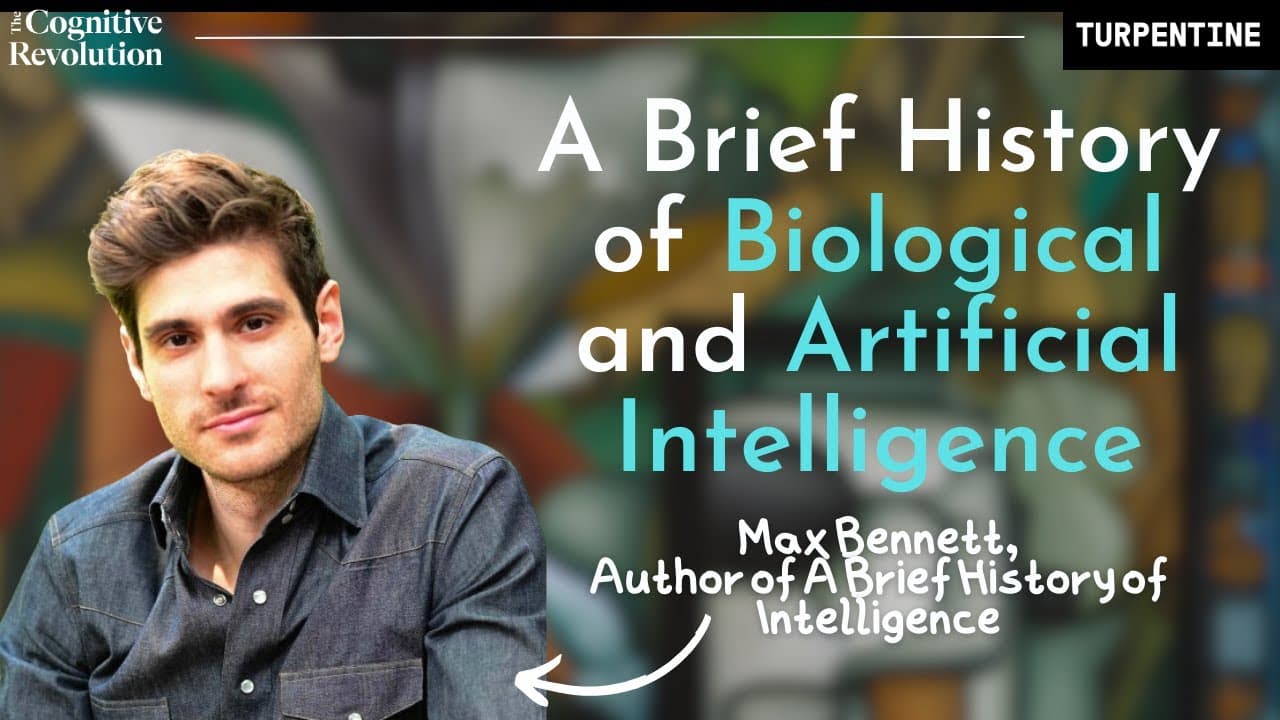
In this episode, Nathan interviews Max Bennett, discussing his book on the evolution of intelligence. They explore five major breakthroughs that have shaped human cognition, from basic navigation in nematodes to complex language skills in humans.
-
The conversation delves into how these evolutionary breakthroughs can inform AI development, highlighting similarities and differences between biological and artificial systems. They discuss the importance of reinforcement learning and simulation in both fields.
-
Max Bennett emphasizes the need for a nuanced approach to integrating neuroscience insights into AI, considering the unique constraints and opportunities each domain presents. The discussion provides a comprehensive view of intelligence evolution and its implications for AI.
Read in Other Languages (beta)
Share This Summary 📚
Summarize YouTube Videos and Get Video Transcripts with 1-Click
Try YouTube Summary with ChatGPT & Claude or YouTube Transcript Generator
Explore More Summaries from Cognitive Revolution "How AI Changes Everything" 📚





Summarize YouTube Videos and Get Video Transcripts with 1-Click
Try YouTube Summary with ChatGPT & Claude or YouTube Transcript Generator