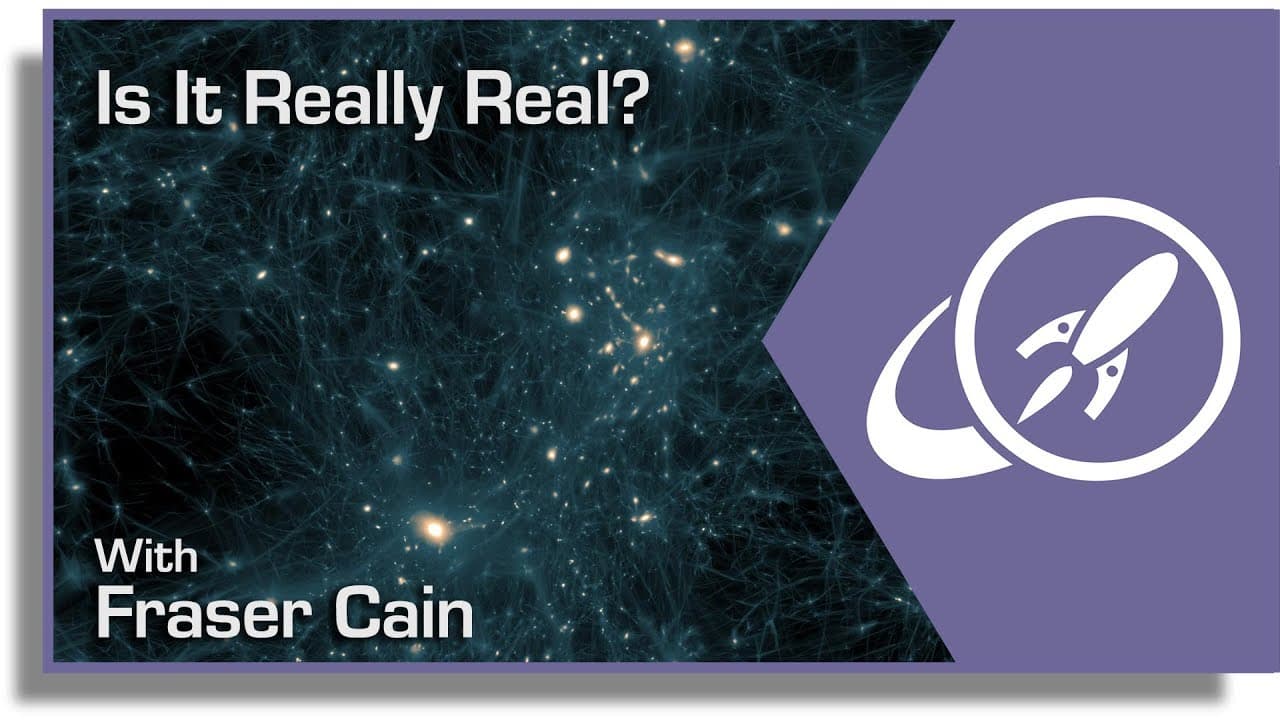
Q&A 65: Is Dark Matter Really Real? And More
TL;DR
Fraser Cain discusses dark matter, black holes, space elevators, and interstellar travel implications.
Transcript
hey everyone I'm back from Australia I'm wearing my star stuff - shirt in case you didn't know I just did three weeks in Australia with my wife we were I was the one of the speakers at the star stuff - convention in Byron Bay Australia I gave one talk sort of while everyone was just that for everyone had their dinner uh-huh and then I did one of my... Read More
Key Insights
- 🕶️ Dark matter is a legitimate astronomical mystery, not an arbitrary invention.
- 🖤 Spinning black holes can't surpass speed limits due to the theory of relativity.
- 😀 Constructing space elevators would face challenges on Earth but might be feasible elsewhere.
- 🫢 Interstellar gas presents hazards to spacecraft, necessitating protective measures.
- 🤞 Specific facilities are essential for accommodating various orbital hop methods.
- 👷 The James Webb Telescope's launch delays are due to complex construction issues.
- 🖤 Utilizing black holes for planetary slingshots requires careful navigation to prevent harm.
Install to Summarize YouTube Videos and Get Transcripts
Explore YouTube Video Summarizer or Get YouTube Transcript Extractor
Questions & Answers
Q: What is the current understanding of dark matter in astronomy?
Dark matter is a mysterious substance that astronomers study extensively, driven by observations indicating its existence. Scientists deduce its presence indirectly, uncovering the vast gaps in astronomical knowledge.
Q: How do spinning black holes influence events horizons and singularity visibility?
Spinning black holes flatten their event horizons as they rotate faster, but they can't spin fast enough to reveal the singularity due to relativity constraints.
Q: What is the status of the James Webb Telescope and its delayed launch?
NASA conducted an independent study on the James Webb Telescope's progress, attributing delays to construction difficulties. It's now rescheduled, pending Northrop Grumman's challenges.
Q: Can nano thrusters slow down light sails for interstellar travel?
Nano thrusters are impractical for slowing down light sails approaching their destinations. Alternative methods leverage natural forces or additional propulsion systems for deceleration.
Summary & Key Takeaways
-
Fraser Cain shares his recent experiences in Australia speaking at the Star Stuff convention.
-
Explains the mystery of dark matter and the ongoing scientific efforts to understand it.
-
Answers questions about event horizons of spinning black holes, NASA's James Webb Telescope, and potential hazards of interstellar gas.
Read in Other Languages (beta)
Share This Summary 📚
Summarize YouTube Videos and Get Video Transcripts with 1-Click
Try YouTube Summary with ChatGPT & Claude or YouTube Transcript Generator
Explore More Summaries from Fraser Cain 📚
Summarize YouTube Videos and Get Video Transcripts with 1-Click
Try YouTube Summary with ChatGPT & Claude or YouTube Transcript Generator