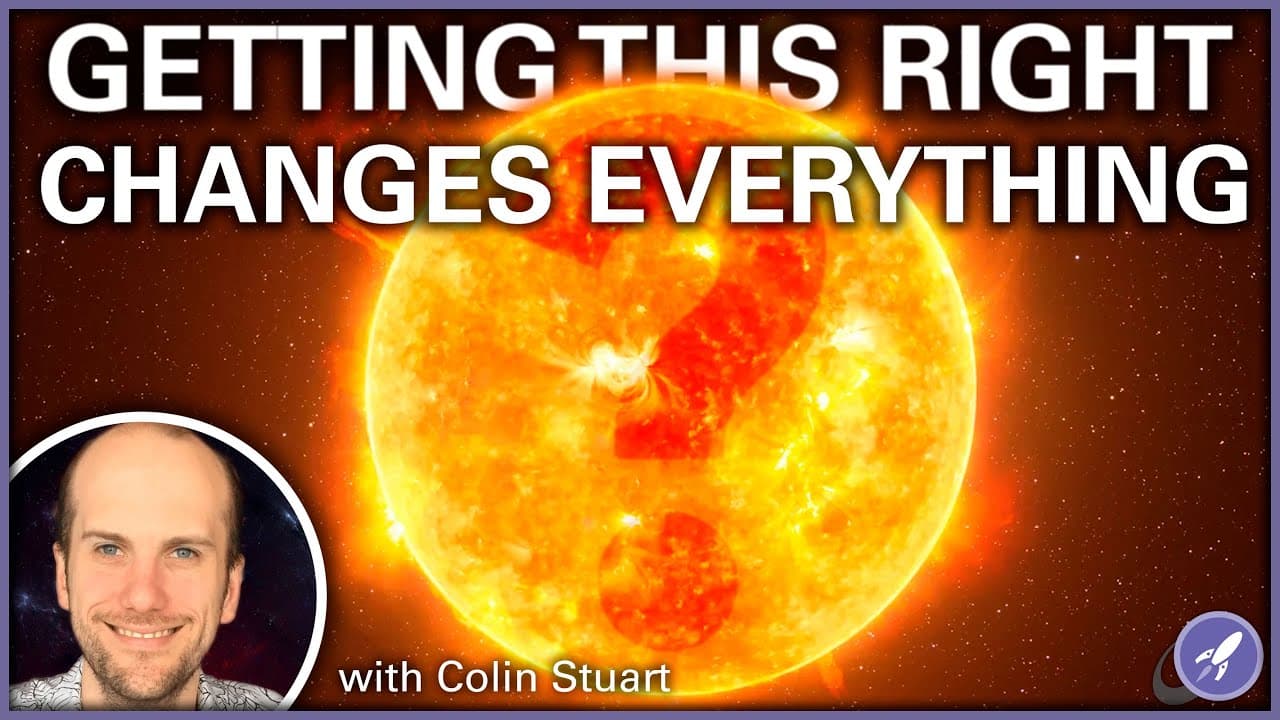
How Understanding The Sun Changes Entire Astronomy with Colin Stuart
TL;DR
- Engaging interview with science journalist Colin Stewart about solar discovery, dark matter, and exoplanets.
Transcript
today I've got an interview with Colin Stewart and and Colin is one of the hardest working science journalists that I know he's been focusing on space and astronomy stories he's written for everybody like sky and Telescope magazine uh European Space Agency New scientists many other things he's written over 20 books he does astronomy courses I it's ... Read More
Key Insights
- 👋 Helioseismology utilizes sound waves to uncover the Sun's internal structure and composition.
- 🙂 Spectroscopy dissects the Sun's light to analyze absorption lines, revealing details about solar metals.
- 👋 Gravitational waves offer revolutionary insights into cosmic phenomena, aiding in understanding primordial waves and black hole collisions.
- 🦸 Exoplanet studies emphasize unique planetary systems like mini-Neptunes and super-Earths, expanding astronomical knowledge.
- ❓ Differences in the Sun's composition calculations pose significant implications for stellar, planetary, and cosmic understanding.
- 🧑🔬 Dark matter remains a compelling astronomical mystery, challenging scientists to discover its nature and impact on the universe.
- 👋 Multi-messenger astronomy provides various observational tools such as radiation, gravitational waves, and neutrinos to explore cosmic phenomena.
Install to Summarize YouTube Videos and Get Transcripts
Explore YouTube Video Summarizer or Get YouTube Transcript Extractor
Questions & Answers
Q: What are the two primary methods astronomers use to understand what the Sun is made of?
Astronomers use helioseismology, studying vibrations within the Sun, and spectroscopy, analyzing absorption lines in the Sun's light.
Q: What implications arise if discrepancies in the Sun's composition calculations persist?
Inconsistencies could impact our understanding of stars, exoplanets, and the habitable zones of other planets, potentially altering astronomical perceptions.
Q: How do astronomers utilize gravitational lensing to study the universe?
Gravitational lensing aids in observing distant objects by bending light, offering unique insights into cosmic phenomena like the first stars and supernovae fingerprints.
Q: Why is the study of exoplanets crucial in understanding the universe?
Exoplanets reveal diverse planetary systems beyond our own, including mini-Neptunes and super-Earths, challenging the notion of our solar system's standard composition.
Summary & Key Takeaways
-
Colin Stewart, a prolific science writer, discusses solar discoveries and mysteries surrounding the Sun.
-
Detailed insights on the solar abundance problem and methods astronomers use to understand the Sun.
-
Exploration of dark matter, exoplanets, and groundbreaking advancements in space science.
Read in Other Languages (beta)
Share This Summary 📚
Summarize YouTube Videos and Get Video Transcripts with 1-Click
Try YouTube Summary with ChatGPT & Claude or YouTube Transcript Generator
Explore More Summaries from Fraser Cain 📚


Summarize YouTube Videos and Get Video Transcripts with 1-Click
Try YouTube Summary with ChatGPT & Claude or YouTube Transcript Generator