What Did Charlie Munger Reveal in His Final CNBC Interview About Mental Models, Learning, and Life?
TL;DR
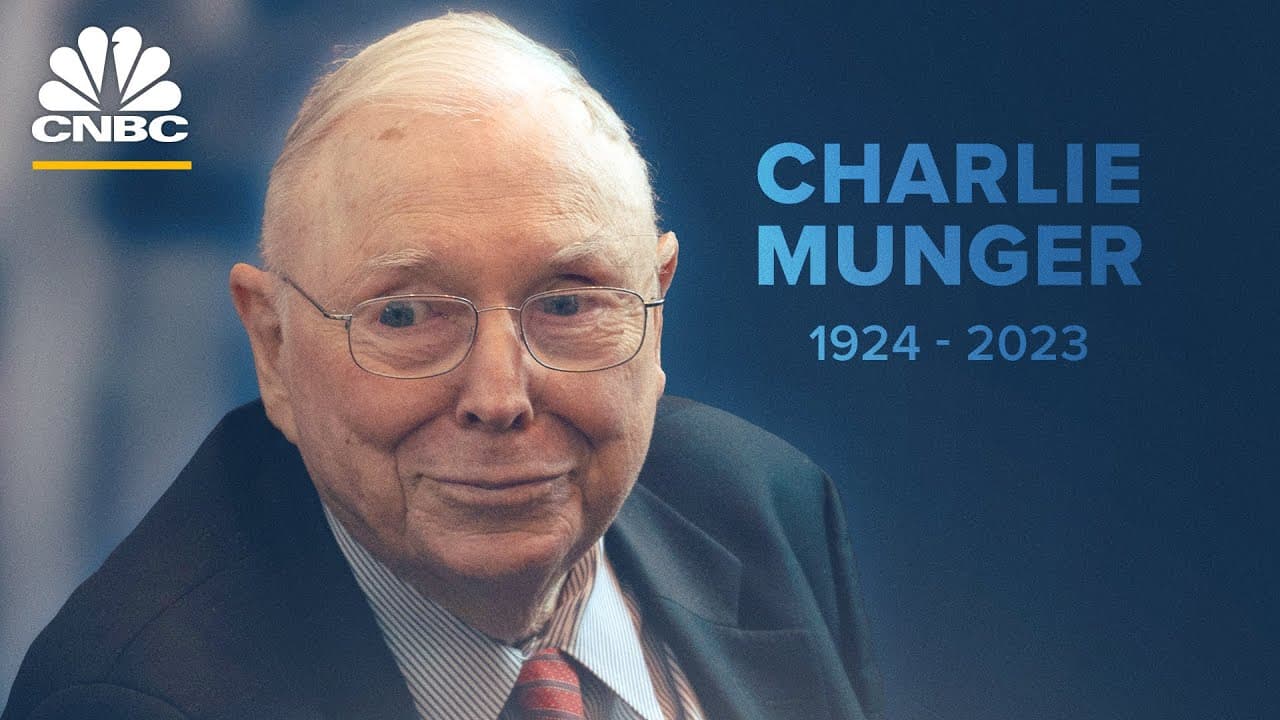
Charlie Munger’s core lesson was to gain an advantage by combining useful ideas from many disciplines and critically examining what others teach. Berkshire Hathaway’s vice chairman described himself as a top 1% mind but not a prodigy, credited Harvard contracts professor Lon Fuller with changing his life, and modeled his self-education on Benjamin Franklin. Read on for his specific views on intelligence, teachers, mental models, and human progress.
Transcript
Charlie Munger may be best known as Burkshire Hathaway's Vice chairman Warren Buffett's best friend Confidant and business partner for six and a half decades but Munger was also a giant in his own right a scold of corporate excess and greed who preached to a large flock of devout followers about how to get along in investing and in life a renaissan... Read More
Key Insights
- Charlie Munger died at age 99, one month shy of his 100th birthday and two weeks after this final CNBC interview, remembered as Berkshire Hathaway's vice chairman and Warren Buffett's partner of six and a half decades.
- Munger described his own mind as being in the top 1% but not a prodigy, so he deliberately avoided fields requiring prodigy-level genius and instead played the hand he was dealt to gain maximum advantage.
- The power of mental models came naturally to Munger, who pulled useful big ideas from many disciplines including mathematics, physics, psychology, and architecture, integrating them the way Benjamin Franklin drew on multiple fields.
- Munger's habit of critical thinking started in grade school, where he mentally revised textbooks and coursework to make them more correct because he recognized professors were teaching things wrong.
- Munger read the complete writings of Sigmund Freud in high school and concluded Freud was a lunatic, refusing to accept Freudian ideas from his Latin teacher who was a devoted Freud follower.
- Harvard professor Lon Fuller was the single most influential teacher in Munger's life because he integrated law and economics, showing why contracts make modern civilization work, echoing Adam Smith.
- Munger modeled himself partly on Benjamin Franklin, admiring his mixture of financial and regular life and his self-education, though he could not copy Franklin's musical talent, an ability Munger said God left out of him.
- Munger argued roughly 90% of human civilization's progress occurred in the last two centuries, driven by coal mines, steam engines, and the technical revolution that gave people leisure and time to think.
Install to Summarize YouTube Videos and Get Transcripts
Explore YouTube Video Summarizer or Get YouTube Transcript Extractor
Questions & Answers
Q: What did Charlie Munger reveal in his final CNBC interview?
Charlie Munger explained how mental models, multidisciplinary learning, and critical thinking shaped his approach to investing and life. He discussed his intelligence, his habit of questioning teachers, the influence of Lon Fuller and Benjamin Franklin, and his view of human progress.
Q: What did Charlie Munger think of his own intelligence?
Munger placed his mind in the top 1% but said he was not a prodigy. He therefore avoided fields requiring a prodigy’s mind and played the hand he was dealt to gain as much advantage as possible.
Q: Why did Charlie Munger use mental models from different disciplines?
Munger said he naturally recognized the power of taking useful ideas from different fields and models of life. He studied mathematics, physics, meteorology, engineering, psychology, and architecture rather than relying on a single specialty.
Q: How did Charlie Munger approach teachers and textbooks?
Beginning in grade school, Munger mentally revised textbooks and courses when he thought instructors had something wrong. He treated teachers as critical exercises rather than automatically accepting their ideas.
Q: What did Charlie Munger think about Sigmund Freud?
Munger bought and laboriously read the complete writings of Sigmund Freud while in high school. He concluded that Freud was a lunatic and refused to accept the Freudian ideas promoted by his Latin teacher.
Q: Who was the most influential teacher in Charlie Munger’s life?
Munger identified Harvard contracts professor Lon Fuller as the best teacher he ever had. Fuller integrated law and economics and helped Munger understand why contracts make modern civilization work, profoundly changing his life.
Q: Why did Charlie Munger admire Benjamin Franklin?
Munger admired Benjamin Franklin’s combination of financial life, ordinary life, and self-education across many disciplines. He emphasized that Franklin had about two years of grade-school education and later taught himself algebra from a textbook.
Q: What did Charlie Munger believe drove human progress?
Munger argued that roughly 90% of civilization’s progress occurred during the last two centuries. He connected that progress to coal mines, steam engines, and the technical revolution, which gave people more leisure and time to think.
Summary & Key Takeaways
-
Charlie Munger was best known as Berkshire Hathaway's vice chairman and Warren Buffett's best friend and business partner for six and a half decades, but he was also a giant in his own right, a critic of corporate excess and greed. A renaissance man, he modeled himself after Benjamin Franklin and died at 99.
-
Munger said the power of drawing mental models from many disciplines came naturally to him. He considered himself naturally arrogant with a top 1% mind but no prodigy, so he avoided fields requiring genius and instead maximized his advantage. From grade school he revised textbooks in his head, recognizing teachers taught things incorrectly.
-
Munger admired Benjamin Franklin's mix of financial and regular life and his self-education, and credited Harvard professor Lon Fuller as his most influential teacher for integrating law and economics. Born on the first day of 1924, Munger reflected that most human progress came in the last two centuries through the technical revolution.
Read in Other Languages (beta)
Share This Summary 📚
Summarize YouTube Videos and Get Video Transcripts with 1-Click
Try YouTube Summary with ChatGPT & Claude or YouTube Transcript Generator
Explore More Summaries from CNBC 📚






Summarize YouTube Videos and Get Video Transcripts with 1-Click
Try YouTube Summary with ChatGPT & Claude or YouTube Transcript Generator