What Are Unsupervised Learning and Generative Models?
TL;DR
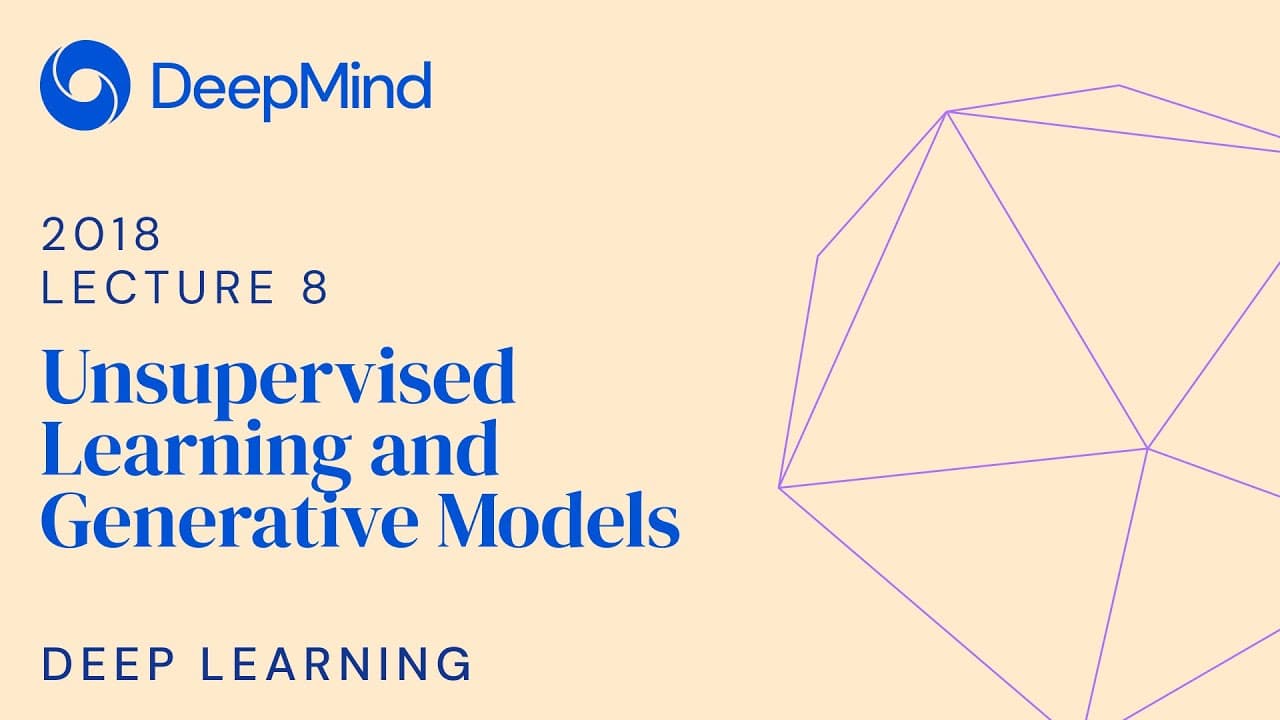
Unsupervised learning and generative models are vital for understanding data without labels and for simulating complex data distributions. This session covers essential mathematical techniques for manipulating probabilities, exploring different types of generative models, and discussing their applications in machine learning.
Transcript
thank you for coming and I'm shakir and really excited to talk to you today about unsupervised learning and generative model so I wanted to maybe just start with a quick question to all of you few people want to shout out maybe the reasons they think unsupervised learning is important in machine learning generative models may be important or maybe ... Read More
Key Insights
- 👻 Unsupervised learning is crucial for tasks where labeled data is scarce, allowing exploration and understanding of data structures.
- 🎰 Generative models, including both prescribed and implicit types, help simulate and understand data distributions, enabling various applications in machine learning.
- 🥳 Mathematical techniques such as the identity trick, bounding tricks, and density ratio tricks enhance the handling of probabilities in probabilistic models.
- ❓ Latent variable models can uncover hidden structures in data, improving the representation and prediction capabilities of generative models.
- 🖱️ Variational inference optimizes the trade-off between model complexity and fit to observed data, while amortized inference uses a shared recognition model to efficiently compute posterior distributions across data points.
- 🥺 The combination of generative modeling and inference techniques fosters deeper insights into data, leading to more robust machine learning applications.
- ❓ Understanding and manipulating gradients through various estimator techniques are essential for implementing scalable algorithms.
Install to Summarize YouTube Videos and Get Transcripts
Explore YouTube Video Summarizer or Get YouTube Transcript Extractor
Questions & Answers
Q: Why is unsupervised learning important in machine learning?
Unsupervised learning is essential as it allows exploration of input data without labeled outcomes, which is particularly valuable in situations with limited labeled data. This type of learning helps in understanding the inherent structure and distributions of the data, facilitating tasks such as clustering, anomaly detection, and generating new instances of data.
Q: What are generative models, and how do they differ from discriminative models?
Generative models aim to model the underlying distribution of data to generate new samples, focusing on learning how the data is formed. In contrast, discriminative models focus on distinguishing between classes or predicting labels from input features. Generative models can capture more complex patterns in data, making them valuable for tasks like data generation and semi-supervised learning.
Q: Can you explain the identity trick used in probabilistic modeling?
The identity trick is a method to rewrite an integral or expectation under one probability distribution by transforming it into an expectation under another distribution. This technique is useful when dealing with complex integrals, allowing flexibility in computations by choosing a more manageable distribution for the expectation, thus simplifying estimation and sampling processes.
Q: What role do latent variable models play in generative modeling?
Latent variable models introduce unobserved variables that capture hidden factors affecting the observed data. By integrating out these latent variables, the models can represent complex relationships within the data, learning from observed instances while allowing for flexibility in inferring underlying structures and dependencies within the dataset.
Q: How do variational inference and amortized inference work together in machine learning?
Variational inference provides a framework for approximating complex posterior distributions by optimizing a lower bound to the likelihood of observed data, while amortized inference allows the sharing of parameters across different data points through a recognition model. This combination streamlines the inference process, enabling efficient learning and scalability in generative models.
Summary & Key Takeaways
-
This content discusses the importance of unsupervised learning and generative models in navigating scenarios with insufficient labeled data, highlighting their applications in natural language processing and modeling complex data distributions.
-
It presents several mathematical techniques and tricks for manipulating probabilities, such as the identity trick, bounding tricks, and density ratio tricks, essential for building effective machine learning algorithms.
-
The session covers types of generative models, including prescribed and implicit models, their respective characteristics, applications, and the integration of variational inference and amortized inference in constructing robust generative frameworks.
Read in Other Languages (beta)
Share This Summary 📚
Summarize YouTube Videos and Get Video Transcripts with 1-Click
Try YouTube Summary with ChatGPT & Claude or YouTube Transcript Generator
Explore More Summaries from Google DeepMind 📚

Summarize YouTube Videos and Get Video Transcripts with 1-Click
Try YouTube Summary with ChatGPT & Claude or YouTube Transcript Generator