What is Gravitational Lensing?
TL;DR
Gravitational lensing occurs when mass curves space-time and deflects nearby light, making distant objects appear brighter and larger. First observed by Arthur Edington and Frank Watson Dyson during a 1919 solar eclipse, the effect helps astronomers study extremely distant galaxies, detect planets through microlensing, and map otherwise invisible dark matter. Read on to understand how this cosmic magnifying glass works and what different lensing effects reveal.
Transcript
everyone here is familiar with the Practical applications of gravity if not just from exposure to Looney Tunes with an abundance of scenes with anthropomorphized coyote being hurled at the ground from gravitational acceleration giant rocks plummeting to a spot inevitably marked with an X previously occupied by a member of accelerati incredibilis fa... Read More
Key Insights
- 🛟 Gravity's gravitational lensing serves as a powerful tool in magnifying distant objects for astronomers.
- ❓ The 1919 solar eclipse observation confirmed Einstein's theory of general relativity.
- 🦻 Gravitational lensing aids in discovering the most distant galaxies ever observed, including those from the early universe.
- ❓ Amateurs can contribute to planetary discoveries using gravitational microlensing events.
- 👻 Gravitational lensing allows us to indirectly observe and map out dark matter in the universe.
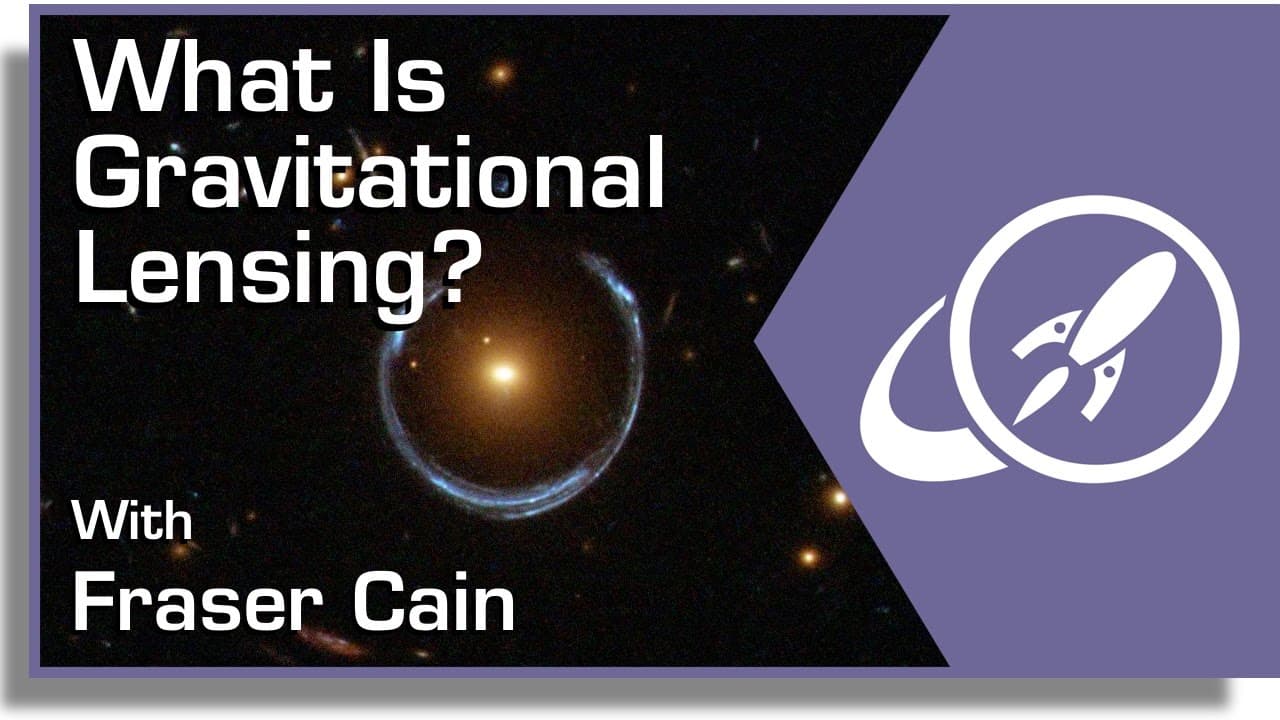
- 😋 Einstein rings, a rare phenomenon, demonstrate the perfect circular distortion of distant objects by gravity.
- 🤗 Gravitational lensing opens new possibilities for observing invisible entities like dark matter in the cosmos.
Install to Summarize YouTube Videos and Get Transcripts
Explore YouTube Video Summarizer or Get YouTube Transcript Extractor
Questions & Answers
Q: What is gravitational lensing?
Gravitational lensing is the deflection of light as it travels through space-time curved by mass. The effect can focus light from a distant object toward us, making that object appear brighter and larger.
Q: How does gravitational lensing act as a cosmic magnifying glass?
A closer massive object, such as a galaxy, can deflect light from a more distant object, such as a quasar. By focusing that light toward us, the lens makes the distant source easier to observe and lets astronomers peer deeper into the universe than conventional telescopes otherwise could.
Q: When was gravitational lensing first observed?
Arthur Edington and Frank Watson Dyson first observed gravitational lensing during a solar eclipse in 1919. Stars close to the Sun appeared slightly out of position, demonstrating that their light had been bent as predicted by the general theory of relativity.
Q: How does gravitational lensing help astronomers find distant galaxies?
Gravitational lensing brightens and enlarges distant sources, allowing astronomers to observe objects that would otherwise be beyond the reach of conventional telescopes. The most distant galaxies discussed in the transcript, seen only a few hundred million years after the Big Bang, were discovered using this effect.
Q: How can gravitational microlensing reveal planets around other stars?
In gravitational microlensing, a foreground star acts as a lens for a background star and causes it to brighten. Further distortions in that brightening can indicate the presence of planets around the foreground star.
Q: Can amateur astronomers help discover planets through microlensing?
Yes, even amateur telescopes are sensitive enough to detect the microlensing distortions described in the transcript. Amateurs regularly help discover new planets by observing these events, although each alignment happens only once.
Q: What is an Einstein ring?
An Einstein ring is a special alignment in which a nearby galaxy warps the image of a more distant galaxy into a complete circle. A few partial rings had been observed according to the transcript, but no perfect Einstein ring had been spotted.
Q: How does gravitational lensing help map dark matter?
Dark matter does not emit or absorb light, so it cannot be observed directly. Because it has mass, however, it can lens light originating behind it, allowing astronomers to use the resulting gravitational effects to map dark matter in the universe.
Summary & Key Takeaways
-
Gravity's unique properties include gravitational lensing, acting as a magnifying glass for distant objects in space.
-
Gravitational lensing was observed during a solar eclipse in 1919, confirming Einstein's theory of general relativity.
-
This phenomenon is crucial in discovering distant galaxies, planets around other stars, and mapping out dark matter in the universe.
Read in Other Languages (beta)
Share This Summary 📚
Summarize YouTube Videos and Get Video Transcripts with 1-Click
Try YouTube Summary with ChatGPT & Claude or YouTube Transcript Generator
Explore More Summaries from Fraser Cain 📚

Summarize YouTube Videos and Get Video Transcripts with 1-Click
Try YouTube Summary with ChatGPT & Claude or YouTube Transcript Generator