What Is NVIDIA's Vision for the Future of AI?
TL;DR
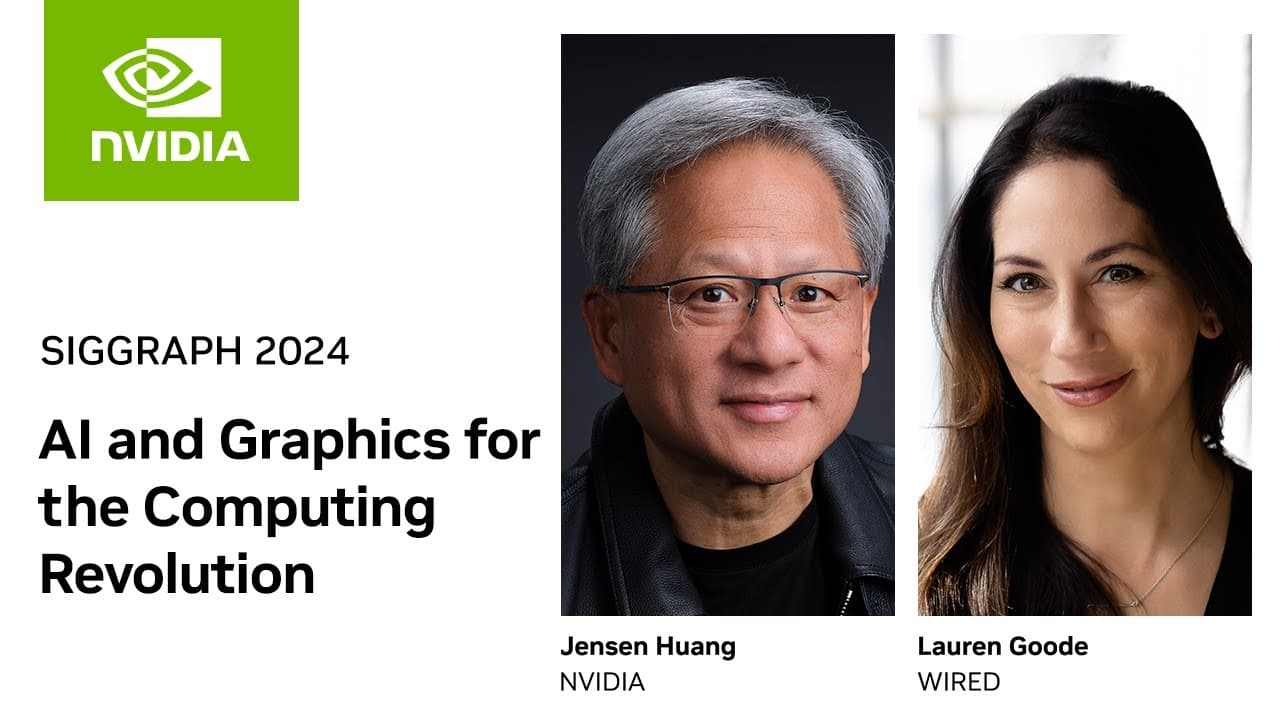
NVIDIA's vision for the future of AI centers on transforming industries through generative AI and accelerated computing. By emphasizing controllable generative AI, NVIDIA aims to enhance human creativity while tackling ethical concerns and energy efficiency. Innovations like the DGX-1 and RTX technology illustrate their pivotal role in this evolution, redefining how software and collaboration shape the digital landscape.
Transcript
Hello everyone. Welcome, Siggraph. It is my first Siggraph. I'm so excited to be here. I'm so excited to speak to all of you, and I'm so excited to speak to NVIDIA founder and CEO Jensen Huang. Thank you. Great to see you again. Thank you. Great to see you. Welcome to Siggraph Lauren. Welcome to my hood. You're a regular here, huh? Hey, everybody. ... Read More
Key Insights
- 💻 NVIDIA's journey reflects the industry's evolution from computer graphics to generative AI, showcasing remarkable adaptability over decades.
- 🈸 Innovations like DGX-1 and RTX technology illustrate NVIDIA's commitment to enhancing deep learning and graphical rendering across various applications.
- 🎰 Generative AI's integration signifies a shift in software development paradigms, moving from human-directed programming to machine-learning-driven outputs.
- 🔨 Tools like Omniverse empower collaboration and enhance creativity, streamlining the workflow in digital content creation.
- 🎮 Ethical considerations in AI usage remain a significant topic, especially concerning the accuracy and control of AI-generated outputs.
- 💍 Generative AI's role in the job market will emphasize augmentation over replacement, thereby transforming how professionals engage with technology.
- 🥺 Energy efficiency is crucial for NVIDIA, leading to a focus on accelerated computing to reduce the environmental impact of data centers.
- 🎙️ More videos with Jensen Huang:
Install to Summarize YouTube Videos and Get Transcripts
Explore YouTube Video Summarizer or Get YouTube Transcript Extractor
Questions & Answers
Q: What was NVIDIA's initial focus when it was founded?
NVIDIA was originally focused on computer graphics, specifically creating GPUs that enabled advanced rendering techniques, such as programmable shading. This focus laid the groundwork for the company, allowing it to capture technological advancements and address computational needs in the graphics sector before expanding into areas like AI and deep learning.
Q: How does generative AI differ from traditional AI models?
Generative AI models differ from traditional AI in that they learn from data to create new content, rather than merely analyzing or classifying existing data. This allows for a range of outputs like images, text, and even 3D models, making generative AI capable of transforming creative processes across various industries, from gaming to scientific simulations.
Q: What role does Omniverse play in NVIDIA's ecosystem?
Omniverse serves as a collaborative platform where creators can combine different types of data and modes to build complex virtual worlds and simulations. It facilitates the interoperation of various tools and libraries, allowing users to generate content in real time and enhancing the capabilities of both generative AI and traditional graphics tasks.
Q: How is NVIDIA addressing concerns about AI hallucinations in generative models?
NVIDIA is utilizing advancements like retrieval augmented generation, which improves the precision of AI outputs by combining generative capabilities with authoritative data sources. This technique helps ensure that AI-generated content aligns more closely with user expectations and reduces errors commonly seen in previous models.
Q: What are the implications of generative AI for the job market?
Generative AI is expected to alter the job landscape significantly by augmenting human workers rather than replacing them. This means that creative professionals will likely work alongside AI tools, leveraging them to enhance productivity and explore new creative avenues, while the foundational tasks may evolve in nature rather than disappear entirely.
Q: How does NVIDIA ensure its technology remains energy-efficient?
NVIDIA focuses on accelerated computing, which allows it to perform more tasks using less energy. By optimizing its algorithms and hardware for specific applications, NVIDIA aims to reduce the overall energy consumption required for tasks like deep learning and simulations, while also creating tools that help other industries achieve similar efficiencies.
Q: Can you explain the importance of open USD in data preservation?
Open USD stands as a universal standard for data formats in 3D graphics and simulations, allowing diverse tools to share and collaborate effectively within a unified framework. This facilitates archiving and accessing digital creations, ensuring that as technology evolves, the data remains relevant and accessible for future generations.
Q: What are the future plans for NVIDIA regarding physical AI and robotics?
NVIDIA aims to revolutionize robotics with its concept of physical AI, which involves creating humanoid robots that can understand and interact with their environment. This initiative will leverage NVIDIA's AI, simulation tools, and generative capabilities to enhance robots' real-world learning and interaction, signifying a significant step in robotics technology.
Summary & Key Takeaways
-
NVIDIA's foundational role in computer graphics has evolved significantly, now emphasizing generative AI and simulation, which reflects broader industry shifts toward these fields.
-
Jensen Huang discusses key milestones in the history of NVIDIA and AI, including significant innovations like the DGX-1 and the introduction of RTX technology, highlighting the company's adaptability and transformative impact.
-
The future direction includes a focus on controllable generative AI, where tools enhance human creativity, while also addressing ethical concerns and energy consumption in accelerated computing.
Read in Other Languages (beta)
Share This Summary 📚
Summarize YouTube Videos and Get Video Transcripts with 1-Click
Try YouTube Summary with ChatGPT & Claude or YouTube Transcript Generator
Explore More Summaries from NVIDIA 📚

Summarize YouTube Videos and Get Video Transcripts with 1-Click
Try YouTube Summary with ChatGPT & Claude or YouTube Transcript Generator