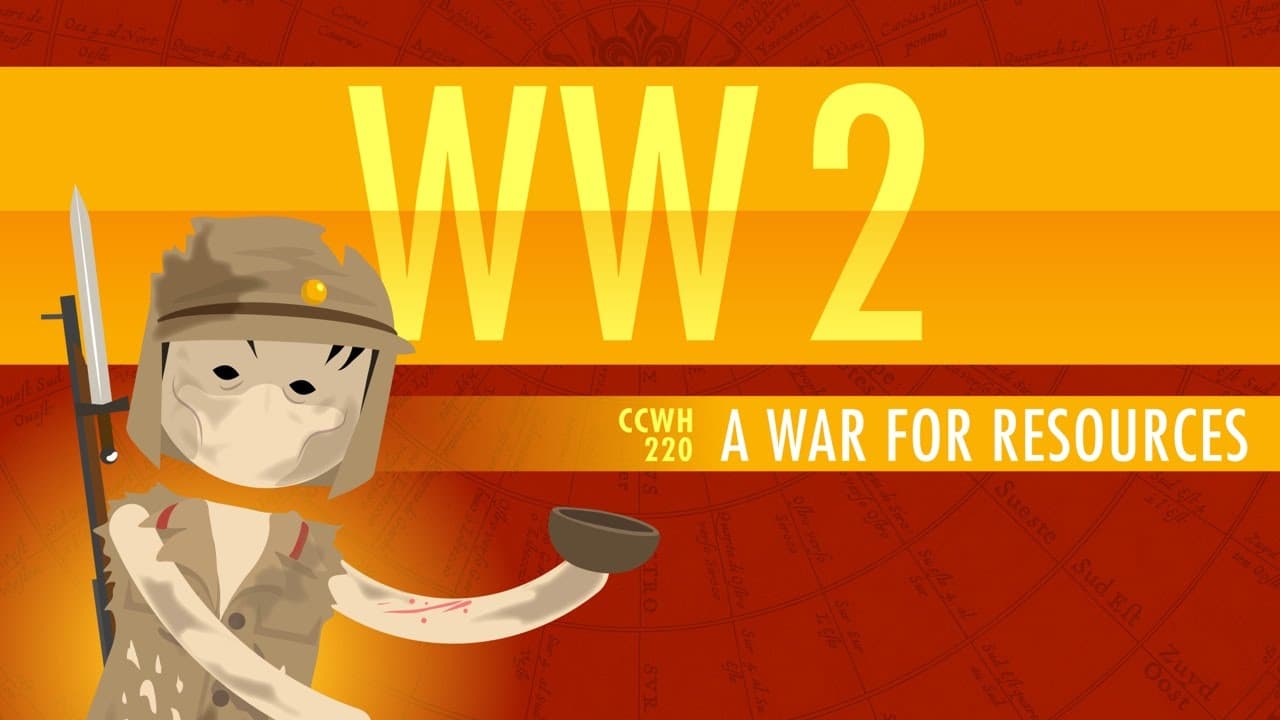
How Did Resources Influence World War II?, Crash Course World History #220
TL;DR
Resources influenced World War II by motivating German and Japanese expansion, shaping military strategy, and determining who ate and who starved. Both nations sought autarky, while Germany’s Hunger Plan targeted Ukraine and western Russia as a breadbasket and Japan pursued food-producing colonies. Food’s absence caused at least 20 million deaths, directly or indirectly. Read on to see how resource allocation affected campaigns, soldiers, and civilians.
Transcript
Hi, I’m John Green and this is Crash Course World History and today we’re going to talk about World War II. But we’re not going to look at it as a battle between good and evil, but instead as a war for resources, particularly a war for food. Wait, Mr. Green, Mr. Green, what about like Rosie the Riveter and Pearl Harbor and Nazis and Hitler? Yeah, M... Read More
Key Insights
- World War II was driven by resource allocation, notably food, shaping both causes and impacts.
- Germany and Japan sought autarky, aiming for self-sufficiency in an increasingly interdependent world.
- Hitler's concept of 'lebensraum' was about acquiring agricultural land to feed Germans.
- Japan's imperial ambitions were fueled by limited space and a growing population, leading to expansion in Asia.
- The 'Hunger Plan' influenced Germany's invasion of the Soviet Union, aiming to transform it into a breadbasket.
- The Battle of the Atlantic was crucial for Britain, relying on global resources to avoid starvation.
- British colonial policies during the war exacerbated famine in India, causing millions of civilian deaths.
- American and British soldiers were well-fed, contrasting with the severe starvation faced by Japanese troops.
Install to Summarize YouTube Videos and Get Transcripts
Explore YouTube Video Summarizer or Get YouTube Transcript Extractor
Questions & Answers
Q: How did resources influence World War II?
The pursuit and allocation of resources, especially food, helped cause the war and shaped its strategy. Germany and Japan sought autarky through territorial expansion, while access to food and supply networks affected soldiers and civilians throughout the conflict.
Q: What did autarky mean for Germany and Japan?
Autarky meant self-sufficiency at a time when countries increasingly relied on world trade for basic needs. Because Germany and Japan lacked resources needed for their growing industrial states, both pursued imperial expansion, with food as their greatest concern.
Q: What was the role of Lebensraum in Nazi expansion?
Lebensraum, or “living space,” meant acquiring agricultural land to feed Germans. Nazi leaders believed territorial expansion could make Germany self-sufficient, protect it from another blockade, and help it challenge British and American dominance.
Q: Why did Japan pursue colonies for food?
Japan’s limited space, growing population, and the Great Depression intensified concerns about food supplies. Korea and Formosa provided 20% of Japan’s domestic rice crop by 1935, while Manchuria was intended as a place to resettle farmers who would provide food for the homeland.
Q: What was the Hunger Plan?
German agronomist Hans Backe proposed the Hunger Plan as a route to German food self-sufficiency. It called for Ukraine and western Russia to become a huge breadbasket for German armies and civilians, and it helped motivate Hitler’s invasion of the Soviet Union.
Q: Why was the Battle of the Atlantic important to Britain?
The Battle of the Atlantic centered largely on shipping arms, materials, and food from the United States to Britain. Britain’s access to global supply networks prevented starvation and ultimately proved stronger than Germany’s attempt to achieve self-sufficiency.
Q: How did British wartime policies contribute to famine in India?
Japan’s seizure of Burma in early 1942 cut off 15% of Bengal’s rice supply, and failed harvests later that year turned hunger into famine. Britain declined to divert supply ships from the war effort, and between 1.5 and 3 million Indian civilians died when hunger-associated diseases are included.
Q: How deadly was the absence of food during World War II?
The absence of food caused at least 20 million deaths, directly or indirectly, during the war years. That figure exceeded the 19.5 million military deaths cited in the transcript, showing that resource allocation had consequences far beyond the battlefield.
Summary & Key Takeaways
-
World War II was significantly influenced by the quest for resources, particularly food. Germany and Japan pursued imperial expansion to achieve self-sufficiency, aiming to secure agricultural land for their populations. This resource-driven focus shaped military strategies and had profound impacts on civilians, leading to widespread suffering and death due to food shortages.
-
The concept of 'lebensraum' in Nazi Germany and Japan's limited space and growing population led to aggressive expansionist policies. These efforts were aimed at acquiring agricultural land and resources to feed their nations, demonstrating how resource scarcity can drive conflict.
-
The Battle of the Atlantic was vital for Britain, highlighting the importance of global resource networks. In contrast, British colonial policies worsened famine in India, causing millions of deaths. Meanwhile, American and British soldiers were well-fed, unlike the severely starving Japanese troops.
Read in Other Languages (beta)
Share This Summary 📚
Summarize YouTube Videos and Get Video Transcripts with 1-Click
Try YouTube Summary with ChatGPT & Claude or YouTube Transcript Generator
Explore More Summaries from CrashCourse 📚



Summarize YouTube Videos and Get Video Transcripts with 1-Click
Try YouTube Summary with ChatGPT & Claude or YouTube Transcript Generator