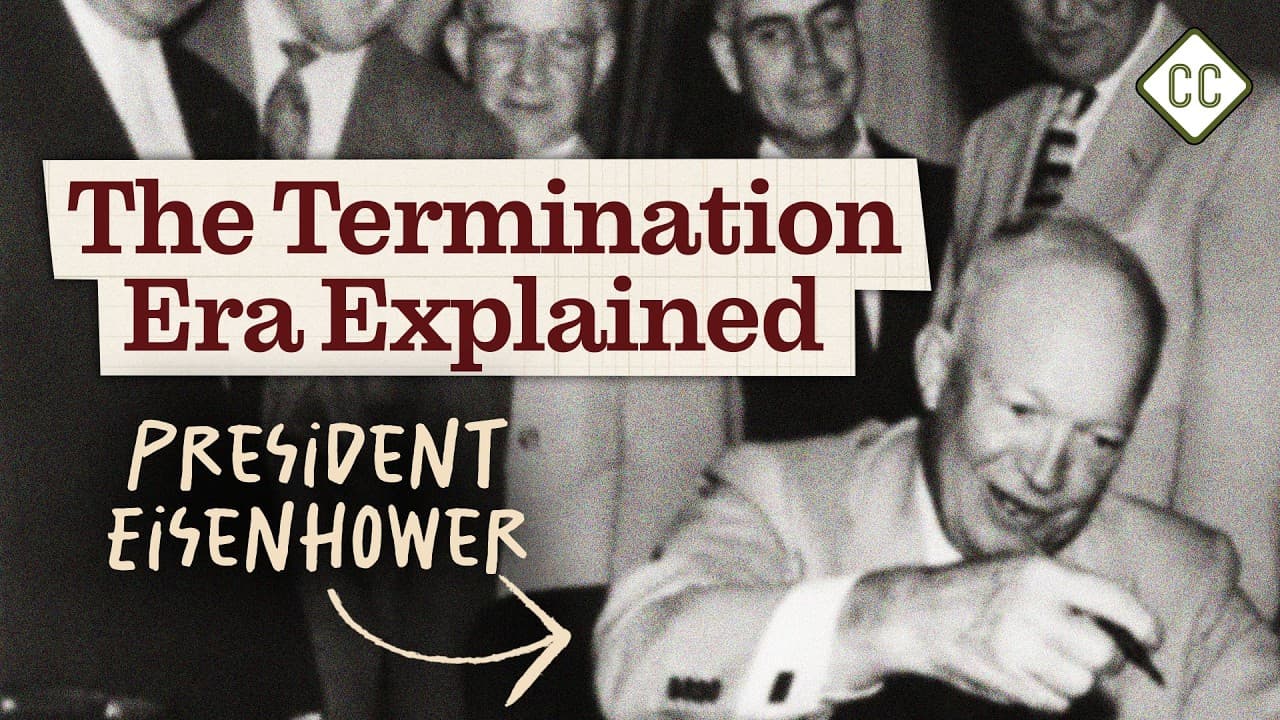
The Termination Act Explained: Ep 14 of Crash Course Native American History
TL;DR
The U.S. targeted Native nations with termination and relocation policies.
Transcript
Things were looking up for the Menominee Tribe of Wisconsin. And that’s exactly what made them a target. It was 1952. The Menominee had just won a 16-year legal battle over the U.S. government’s mismanagement of their forest, and they’d been promised $8.5 million. They now had control over how that forest was logged. And even though the average tr... Read More
Key Insights
- The Menominee Tribe was targeted for termination due to their economic success, despite previous mismanagement by the U.S. government.
- The Relocation and Termination Era aimed to assimilate Native Americans by encouraging relocation to cities and ending federal recognition of tribes.
- The Urban Indian Relocation Program promised jobs and housing in cities, but often led to cultural disconnection and poverty.
- The Termination Act stripped tribes of sovereignty, dissolved governments, and ended federal support, severely impacting Native communities.
- Termination policies resulted in the loss of federal protections for 1.3 million acres and affected 11,000 Native Americans.
- Despite termination, Native resistance led to the restoration of some tribes, notably the Menominee, through grassroots efforts.
- The Menominee and other tribes' resilience inspired new policies, emphasizing restoration and self-determination for Native nations.
- Relocation and termination policies were cost-cutting measures that sought to erase Native cultures, but ultimately failed due to Native resilience.
Install to Summarize YouTube Videos and Get Transcripts
Explore YouTube Video Summarizer or Get YouTube Transcript Extractor
Questions & Answers
Q: What was the main goal of the Relocation and Termination Era?
The main goal of the Relocation and Termination Era was to assimilate Native Americans into mainstream American culture by encouraging them to relocate to cities and terminating the federal recognition of tribes. This aimed to dissolve tribal governments, end federal support, and integrate Native people into the dominant culture, effectively erasing their distinct cultural identities.
Q: How did the Urban Indian Relocation Program affect Native Americans?
The Urban Indian Relocation Program encouraged Native Americans to move to cities with promises of jobs, housing, and education. However, many Native people faced economic hardship, social isolation, and discrimination in urban areas. The program often led to cultural disconnection and poverty, as the promised opportunities did not materialize, leaving many unable to return to their communities.
Q: What were the consequences of the Termination Act for Native tribes?
The Termination Act resulted in the loss of federal recognition for over 100 Native tribes, stripping them of sovereignty and federal support. This led to the dissolution of tribal governments, loss of land, and economic challenges. Many tribes struggled to maintain basic services, and the policy had long-lasting negative impacts on their communities and cultural identities.
Q: How did the Menominee Tribe respond to termination?
The Menominee Tribe responded to termination by organizing efforts to regain federal recognition. They formed a non-profit organization to preserve their identity and petitioned for the reversal of termination. The grassroots movement, led by figures like Ada Deer, eventually succeeded in restoring the tribe's federal recognition in 1973, setting a precedent for other tribes seeking restoration.
Q: What challenges did tribes face after termination?
After termination, tribes faced significant challenges, including the loss of federal funding and support for essential services. Many communities experienced economic decline, with increased poverty and unemployment. The dissolution of tribal governments and loss of land further exacerbated these issues, leaving tribes struggling to maintain their cultural and social structures.
Q: How did Native resistance impact termination policies?
Native resistance played a crucial role in challenging and reversing termination policies. Grassroots movements, legal actions, and advocacy efforts by tribes and organizations highlighted the negative impacts of termination and pushed for restoration of federal recognition. These efforts led to policy changes, with some tribes successfully regaining recognition and inspiring broader movements for Native self-determination.
Q: What were the long-term effects of relocation on Native communities?
The long-term effects of relocation on Native communities included cultural disconnection and fragmentation of social ties. Many Native Americans who moved to cities faced economic struggles, discrimination, and isolation. The policy disrupted traditional ways of life and weakened community structures, with lasting impacts on the cultural and social cohesion of affected tribes.
Q: What lessons can be learned from the Menominee's restoration efforts?
The Menominee's restoration efforts demonstrate the power of community organizing and resilience in the face of adversity. Their success in regaining federal recognition highlights the importance of grassroots movements, leadership, and advocacy in challenging unjust policies. It also underscores the potential for Indigenous communities to assert their rights and seek self-determination, inspiring other tribes to pursue similar goals.
Summary & Key Takeaways
-
The Menominee Tribe of Wisconsin faced termination despite winning a legal battle against the U.S. government for forest mismanagement. Termination policies aimed to assimilate Native Americans by ending federal recognition and encouraging relocation to cities, which often resulted in poverty and cultural disconnection.
-
The Urban Indian Relocation Program promised jobs and housing in cities but led to social isolation and economic hardship for many Native Americans. Termination policies dissolved tribal governments and ended federal support, impacting 109 nations and 11,000 individuals.
-
Native resistance efforts, such as the Menominee's fight for restoration, led to the reversal of some termination policies. Despite the challenges, many tribes continue to seek recognition and self-determination, highlighting the resilience and perseverance of Native communities.
Read in Other Languages (beta)
Share This Summary 📚
Summarize YouTube Videos and Get Video Transcripts with 1-Click
Try YouTube Summary with ChatGPT & Claude or YouTube Transcript Generator
Explore More Summaries from CrashCourse 📚




Summarize YouTube Videos and Get Video Transcripts with 1-Click
Try YouTube Summary with ChatGPT & Claude or YouTube Transcript Generator