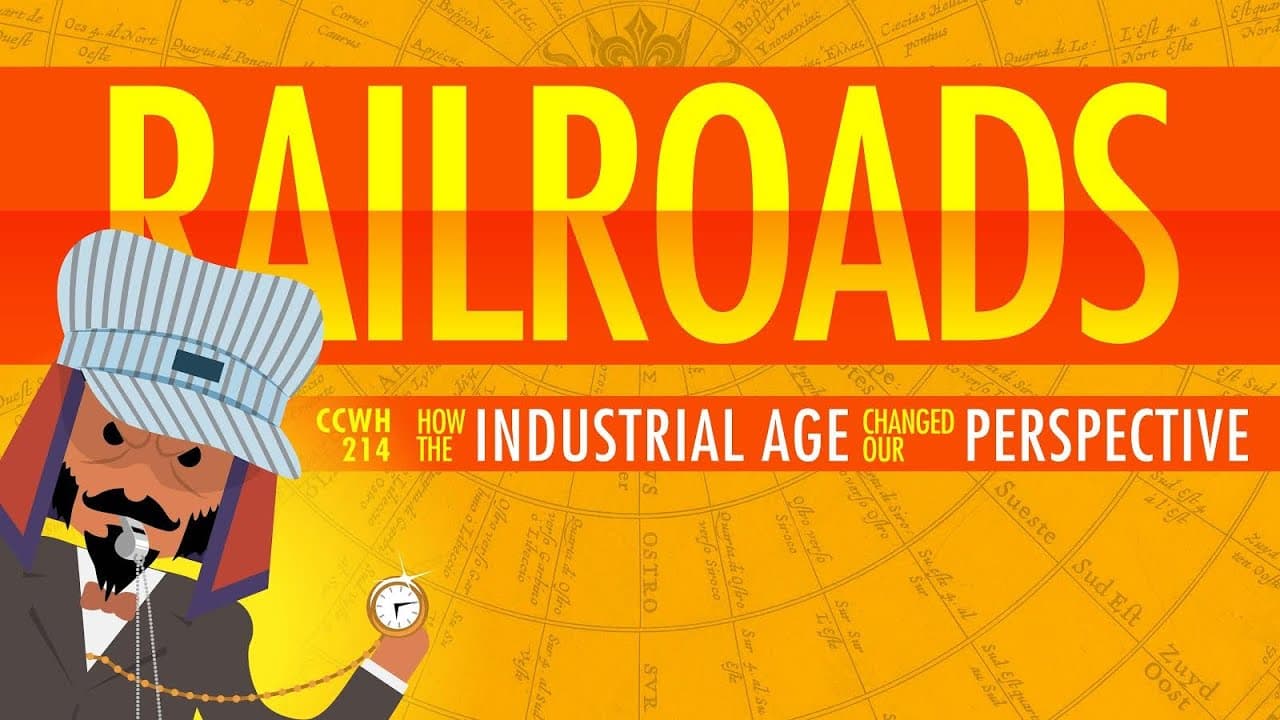
How Did Railroads Change Society During the Industrial Revolution?
TL;DR
Railroads transformed society by reshaping perceptions of time and space, allowing for faster travel and standardized time. They revolutionized social habits by making travel accessible, fostering increased reading among passengers, and impacting urban development. Railroads symbolized industrialization, bridging the gap between different social classes and introducing new anxieties that people gradually adapted to over time.
Transcript
Hi, I’m John Green, this is Crash Course World History and today we’re returning to a subject that, could have an entire Crash Course series all of its own: the Industrial Revolution. Mr. Green, Mr. Green, are you going to do a whole series on the Industrial Revolution? Because that actually sounds really boring. Yeah, Me From the Past, no. I’m a l... Read More
Key Insights
- Railroads served as a metaphor for industrialization, symbolizing the shift from muscle-powered to machine-powered transportation.
- The presence of railroads brought industrial machinery into everyday life, affecting both middle and upper classes.
- Railroads changed perceptions of time and space, standardizing time and shrinking geographical distances.
- Travel habits shifted with railroads, leading to increased reading as a means to avoid social interaction.
- Railroads introduced new fears, such as derailments, but over time people adapted and felt more secure.
- The standardization of time by railroads revolutionized scheduling and coordination across regions.
- Railroads opened up new areas for travel and migration, influencing urban development and suburbanization.
- The Internet parallels railroads in how it shrinks the world and alters perceptions of time and communication.
Install to Summarize YouTube Videos and Get Transcripts
Explore YouTube Video Summarizer or Get YouTube Transcript Extractor
Questions & Answers
Q: How did railroads serve as a metaphor for the Industrial Revolution?
Railroads symbolized the Industrial Revolution by representing the shift from muscle-powered to machine-powered transportation. They brought industrial machinery into everyday life, impacting both middle and upper classes and changing perceptions of time and space. Railroads also highlighted the broader changes industrialization brought to society.
Q: In what ways did railroads change perceptions of time and space?
Railroads changed perceptions of time by standardizing it across regions, with the establishment of Greenwich Mean Time. They also shrank geographical distances by speeding up travel, which altered the traditional understanding of space and made long-distance travel more accessible and efficient.
Q: What impact did railroads have on social habits?
Railroads changed social habits by increasing the prevalence of reading during travel. This was partly due to the design of railcars, which discouraged interaction, and the need for distractions during journeys. The shift in travel habits reflected broader changes in how people interacted with technology and each other.
Q: What were some fears associated with rail travel, and how were they addressed?
Fears associated with rail travel included derailments and the rapidity of travel causing anxiety. Over time, improvements in boiler manufacturing reduced the frequency of train explosions, which helped alleviate these fears. As people became more familiar with rail travel, their sense of security increased, reflecting a broader adaptation to new technologies.
Q: How did railroads influence urban development and suburbanization?
Railroads facilitated urban development and suburbanization by making previously inaccessible areas reachable. They enabled the creation of suburbs and new towns, as people could live further from their workplaces. This expanded space for living and altered traditional urban landscapes, influencing patterns of migration and settlement.
Q: What parallels can be drawn between railroads and the Internet?
Both railroads and the Internet shrank the world by making communication and travel faster and more accessible. They changed perceptions of time, with the Internet accelerating expectations for communication. Both technologies also faced initial fears and skepticism but eventually became integral to daily life, transforming social interactions and economic activities.
Q: How did railroads contribute to the standardization of time?
Railroads contributed to the standardization of time by necessitating consistent scheduling across regions. The Railway Clearing House established Greenwich Mean Time as the standard for all rail lines in 1847, which later became general standard time in England. This revolutionized coordination and scheduling, impacting various aspects of society.
Q: What role did nostalgia play in the perception of railroads?
Nostalgia emerged as people compared the pre-industrial past with the changes brought by railroads. Some romanticized the era of horse-powered travel, viewing it as more soulful. Railroads, by transforming travel and communication, also created a longing for simpler times, a sentiment that parallels modern nostalgia for pre-digital life.
Summary & Key Takeaways
-
John Green discusses the transformative impact of railroads during the Industrial Revolution, highlighting their role in changing perceptions of time and space. Railroads made travel faster and more accessible, altering social habits and introducing new fears.
-
Railroads symbolized industrialization, bringing machinery into daily life and affecting both middle and upper classes. They standardized time and shrank distances, revolutionizing travel and urban development.
-
Railroads changed human behavior, increasing reading to avoid social interaction. Despite initial fears, people adapted to rail travel, drawing parallels to modern technological changes like the Internet.
Read in Other Languages (beta)
Share This Summary 📚
Summarize YouTube Videos and Get Video Transcripts with 1-Click
Try YouTube Summary with ChatGPT & Claude or YouTube Transcript Generator
Explore More Summaries from CrashCourse 📚





Summarize YouTube Videos and Get Video Transcripts with 1-Click
Try YouTube Summary with ChatGPT & Claude or YouTube Transcript Generator