How Do Advanced Prompters Actually Think About AI?
TL;DR
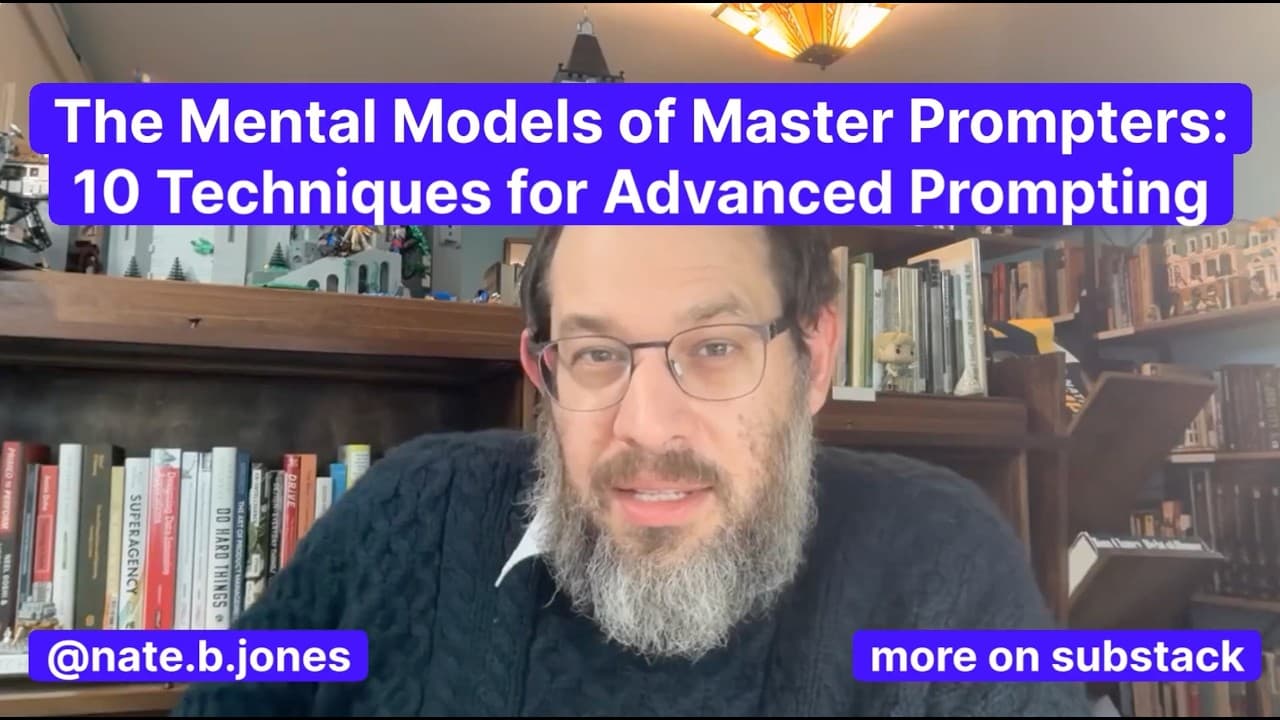
Advanced prompting is not about magic wording but about structuring how models reason, verify, and evolve. Master prompters build self-correction systems, use meta-prompting, and construct reasoning scaffolds that force thorough analysis. Techniques like chain of verification, adversarial prompting, and reverse prompting push models past single-pass generation into deeper, more trustworthy thinking.
Transcript
Teaching AI is really hard. Teaching advanced prompting is even harder. This video will make it easier. My goal is to equip you with an understanding of the mental models, the principles that advanced prompters use. We're going to go beyond the level of a prompt. I don't have a specific magical prompt to give you here. I will have lots of examples ... Read More
Key Insights
- Advanced prompting is about understanding the underlying mental models and principles, not memorizing a single magical prompt. The techniques structure how large language models reason, verify, and evolve rather than relying on clever wording alone.
- Self-correction systems force models to attack their own outputs and get past the limitation of single-pass generation. The goal is to push the model past the initial generation step into examining what it has done.
- Chain of verification requires a verification loop inside the same conversational turn. Instead of asking the model to be more careful, you structure the generation process to include self-critique as a mandatory step, activating trained verification patterns.
- Adversarial prompting is more aggressive than verification, demanding the model find problems even if it must stretch. You ask it to attack its previous design, identify specific vulnerabilities, and assess likelihood and impact for each.
- Few-shot examples teach models to distinguish edge cases and boundary conditions by including examples of subtle failure modes. Showing what looks correct versus what is correct significantly reduces false negatives in categorization work.
- Meta-prompting exploits the model's knowledge about effective prompts. Reverse prompting asks the model to design and then execute the single most effective prompt for a task, since it was trained on prompt engineering conversation.
- Recursive prompt optimization gives the model multiple iterations in one pass, refining a prompt across axes you define such as adding constraints, resolving ambiguities, and enhancing reasoning depth, without you specifying the exact new wording.
- Reasoning scaffolds control how the model thinks by providing structure that forces thorough analysis. Deliberate over-instruction, zero-shot chain of thought templates, and reference class priming all push the model toward deeper, more consistent reasoning.
Install to Summarize YouTube Videos and Get Transcripts
Explore YouTube Video Summarizer or Get YouTube Transcript Extractor
Questions & Answers
Q: What are the mental models of master prompters?
Master prompters rely on underlying principles rather than a single magical prompt. The key mental models include building self-correction systems that force models to attack their own outputs, using meta-prompting where the model designs its own prompts, and constructing reasoning scaffolds that structure how the model thinks. These principles underlie advanced techniques and push models past the limitation of single-pass generation into deeper, verifiable reasoning.
Q: How does chain of verification work in prompting?
Chain of verification requires a verification loop inside the same conversational turn. After asking the model to produce an analysis, you require it to identify ways its analysis might be incomplete, cite specific language that confirms or refutes each concern, and then revise its findings based on that verification. Rather than vaguely asking the model to be more careful, you structure the generation process so self-critique becomes a mandatory step, activating verification patterns the model was trained on.
Q: What is adversarial prompting and when should you use it?
Adversarial prompting is a more aggressive form of self-correction that demands the model find problems even if it has to stretch. You use it when you really need to be sure, such as confirming a security architecture review is complete. A good example is asking the model to attack its previous design, identify five specific ways it could be compromised, and assess the likelihood and impact of each vulnerability, ensuring thorough scrutiny of the work.
Q: How do few-shot examples help teach edge cases?
Few-shot prompting includes examples of common failure modes and boundary cases so the model learns to distinguish gray areas. Using a SQL injection example, one case might be an obvious raw string concatenation as a baseline, while another looks safe but hides a second-order injection that would fool naive analysis. By showing subtle failure modes, the model learns to tell what looks correct from what is correct, significantly reducing false negatives in categorization work.
Q: What is reverse prompting and why is it powerful?
Reverse prompting exploits the model's meta knowledge about what makes prompts effective, since it was trained on prompt engineering conversation. You ask the model to design the single most effective prompt for a defined task, considering what details matter, what output format is most actionable, and what reasoning steps are essential, then execute that prompt. People do not realize the model can write its own prompt and run it, which unlocks a lot of power.
Q: How does recursive prompt optimization improve prompts?
Recursive prompt optimization gives the model multiple iterations in one pass to refine a prompt. You define the axes you care about, for example version one adds missing constraints, version two resolves ambiguities, and version three enhances reasoning depth. You do not specify the exact new wording; that is left to the model. Repeatedly going back over the prompt forces structure and constraint that improves quality on the specific axes you care about.
Q: What is deliberate over-instruction in prompting?
Deliberate over-instruction counteracts training that compresses outputs with cues like be concise or summarize briefly, which can make models prematurely collapse their reasoning chains. You append a clear instruction not to summarize, asking the model to expand every point with implementation details, edge cases, failure modes, and historical context, prioritizing completeness over an executive summary. The purpose is to expose the model's reasoning so you can examine it and think through the problem with the model.
Q: What is zero-shot chain of thought structure and reference class priming?
Zero-shot chain of thought structure provides a template with blank steps that triggers reasoning, because the model's objective becomes filling the structure you laid out, which requires decomposing the problem. It works well for quantitative and technical problems. Reference class priming provides examples of high-quality reasoning, sometimes the model's own best output, and asks the model to match that bar. Unlike few-shot input-output pairs, it primes the model's distribution toward greater depth and more consistent quality.
Summary & Key Takeaways
-
The video lays out the principles that advanced prompters use rather than offering a single magical prompt. The core idea is that master prompters go beyond clever wording to structure how language models reason, verify, and evolve, building the cognitive architecture that makes AI output trustworthy.
-
The first bucket is self-correction systems, which force models past single-pass generation. Chain of verification builds a mandatory self-critique loop into one turn, adversarial prompting aggressively demands the model attack its own work, and strategic edge-case learning uses few-shot examples of subtle failure modes to cut false negatives.
-
The remaining techniques cover meta-prompting and reasoning scaffolds. Reverse prompting and recursive optimization let the model design and refine its own prompts, while deliberate over-instruction, zero-shot chain of thought templates, and reference class priming structure the model's thinking to produce deeper, more consistent, and examinable analysis.
Read in Other Languages (beta)
Share This Summary 📚
Summarize YouTube Videos and Get Video Transcripts with 1-Click
Try YouTube Summary with ChatGPT & Claude or YouTube Transcript Generator
Explore More Summaries from AI News & Strategy Daily | Nate B Jones 📚






Summarize YouTube Videos and Get Video Transcripts with 1-Click
Try YouTube Summary with ChatGPT & Claude or YouTube Transcript Generator