How to slow productivity without losing momentum
TL;DR
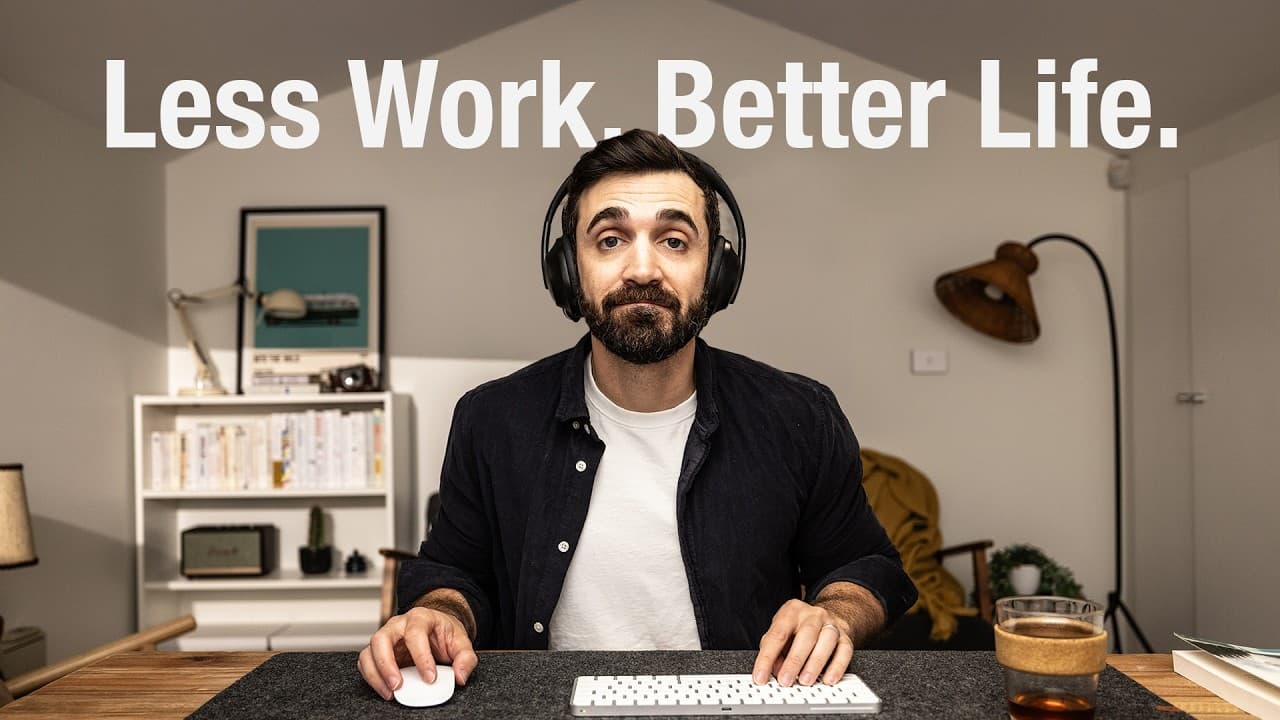
Slow productivity means doing fewer things, at a natural pace, with a focus on quality to sustain momentum. The creator reduced workload by cutting almost all extras and kept only the core work, demonstrating continued or improved output while avoiding burnout. The method centers on three principles and resisting constant busyness.
Transcript
Hustle culture is back. Louder, prouder, and somehow even more extreme. Early morning routines, bold claims, and whatever the [ __ ] this is. But a counter movement is also gaining ground. Call it anti-hustle, essentialism, or slow productivity. A generation of knowledge workers are starting to rethink what it actually means to find success. And I'... Read More
Key Insights
- Slow productivity is a sustainable approach to knowledge work, not a withdrawal from effort.
- The key to sustainable output is reducing overhead tax that comes with taking on many tasks.
- Do fewer things to free up time for deeper work and fewer distractions.
- Work at a natural pace by adjusting time estimates to be realistic.
- Quality should be the primary criterion for evaluating work, not quantity.
- Hustle culture inflates perceived productivity through visible busyness.
- Over time, limiting scope helps maintain momentum and prevent burnout.
- Personal experiments can reveal whether a slower pace maintains or enhances results.
- More videos from this channel:
- More from this channel: Matt D'Avella
Install to Summarize YouTube Videos and Get Transcripts
Explore YouTube Video Summarizer or Get YouTube Transcript Extractor
Questions & Answers
Q: What is slow productivity and why is it proposed as an alternative to hustle culture?
Slow productivity is a framework for approaching knowledge work that emphasizes doing fewer things, at a natural pace, and obsessing over quality. It contrasts with hustle culture by prioritizing sustainable effort over constant busyness. The idea is that reducing scope lowers overhead, minimizes burnout, and can actually improve the quality and impact of work over time.
Q: How did the creator change his workload to test slow productivity?
The creator tested slow productivity by drastically cutting his activities: no more weekly newsletters, little to no social content, and almost no meetings or interviews. He focused on long-form YouTube videos and essential core work, reducing the overall workload by a substantial margin to see if momentum and fulfillment could be maintained without its previous intensity.
Q: What are the three core principles of slow productivity mentioned in the video?
The three core principles are: do fewer things, work at a natural pace, and obsess over quality. Do fewer things reduces overhead and administrative burden. Working at a natural pace means adjusting expectations to be realistic about how long tasks take. Obsessing over quality ensures the output remains meaningful and valuable despite a slower tempo.
Q: What is overhead tax and how does it relate to productivity?
Overhead tax refers to the cumulative administrative costs that come with taking on more tasks, such as emails, meetings, revisions, and approvals. As you say yes to more work, these overhead costs grow and eat into the time available for real production. Reducing tasks minimizes this tax and frees time for core work.
Q: Did the creator experience burnout or anxiety while experimenting with slow productivity?
Yes, the creator describes experiencing severe anxiety and moments of consideration of quitting, noting a cycle of churn and burn. The slow productivity experiment was motivated in part by these struggles, including a shift in priorities after becoming a parent, to pursue a more sustainable and meaningful pace without losing momentum.
Q: How does the video define productivity in traditional terms, and how does slow productivity redefine it?
Traditional productivity often treats output as a ratio of input to result, which works poorly for knowledge work where outputs are multi-faceted and not easily measured by one widget. Slow productivity redefines it as the ability to produce meaningful outcomes over time with sustainable effort, focusing on quality and impact rather than sheer volume.
Q: What does the video suggest about the relationship between time spent and value created?
The video suggests that more hours do not necessarily equate to more value. Instead, reducing the number of active projects lowers overhead and allows deeper focus on high-impact work. Value comes from quality and consistent progress on meaningful tasks, not from simply filling the day with activity.
Q: How does the creator address the tension between inner hustle and a slower workflow?
The creator describes an inner voice that urges more work, a common tension in hustle culture. By embracing slow productivity, he learns to quiet that voice through deliberate choice and disciplined focus on fewer projects, which reduces mental friction and helps maintain momentum while avoiding burnout.
Summary & Key Takeaways
-
Slow productivity reframes work as sustainable effort, prioritizing fewer tasks over nonstop hustle, which reduces overhead and burnout while preserving or improving output. The approach emphasizes intentional pacing and deep focus to produce meaningful work.
-
The three core principles are to do fewer things, work at a natural pace, and obsess over quality, which together counter pseudo productivity and visible busyness. The narrative includes personal experiments and measurable shifts in workload and mindset.
-
The video positions slow productivity as a balanced alternative to hustle culture, arguing that long-term success in knowledge work comes from consistency, focus, and meaningful output rather than perpetual volume and nonstop activity.
Read in Other Languages (beta)
Share This Summary 📚
Summarize YouTube Videos and Get Video Transcripts with 1-Click
Try YouTube Summary with ChatGPT & Claude or YouTube Transcript Generator
Explore More Summaries from Matt D'Avella 📚

Summarize YouTube Videos and Get Video Transcripts with 1-Click
Try YouTube Summary with ChatGPT & Claude or YouTube Transcript Generator