How does Aquinas reconcile faith and reason in philosophy
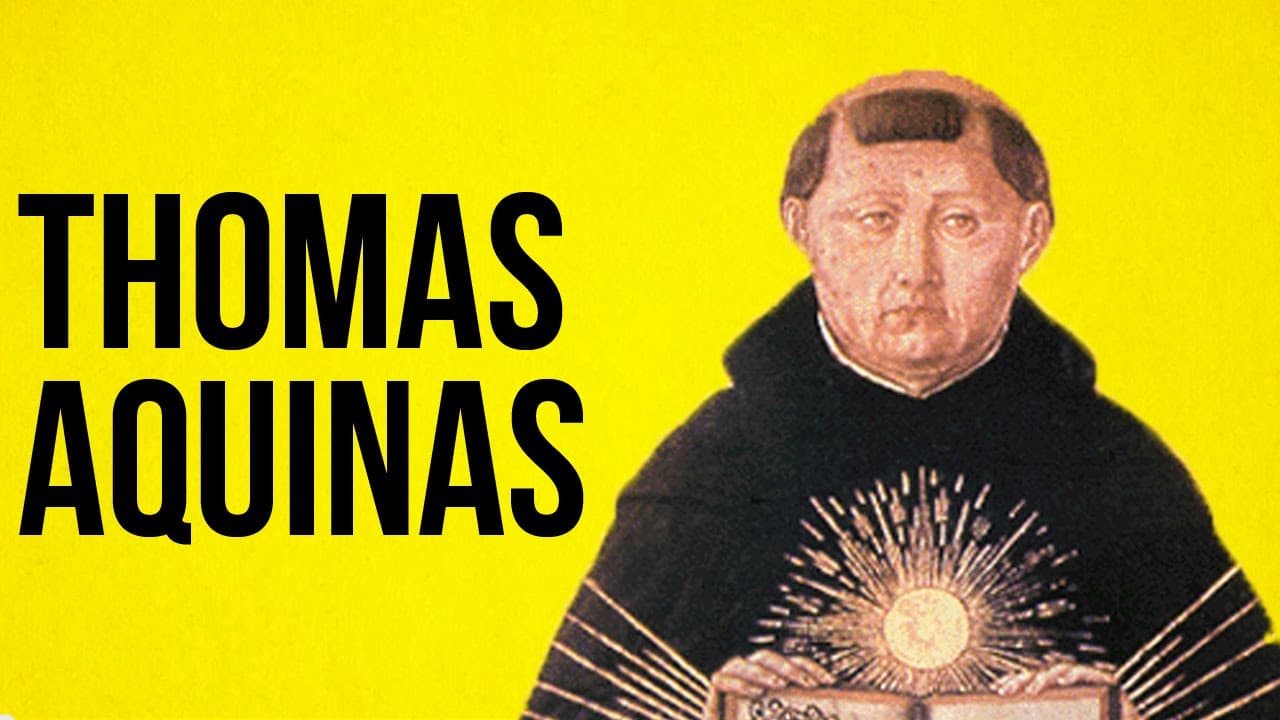
TL;DR
Aquinas shows that reason and faith can share truth by using natural law to explain everyday phenomena while reserving certain insights for revelation. He argues that non Christians can access great truths through reason, and that open inquiry supports science and moral principles within a religious framework.
Transcript
It seems at first weird that we might learn from Thomas Aquinas. He was a medieval saint, who was reputed to have levitated and had visions of the Virgin Mary. He was much concerned with explaining how angels speak and move. And yet, he continues to matter because he helps us with the problem which continues to bedevil us: how we can reconcile reli... Read More
Key Insights
- Aquinas is introduced as a medieval saint who also intellectuals in philosophy and theology.
- Reason and faith are not opposed but complementary in Aquinas, enabling universal access to truth.
- Natural law provides knowledge about the world independently of God for many cases.
- Prophetic revelations and angels are cited as cases where eternal law operates beyond human reason.
- Islamic and Christian intellectual traditions are shown as parallel in grappling with faith and reason.
- Aquinas is credited with saving Western civilization from turning away from science and Greek and Roman wisdom.
- Aquinas demonstrated that knowledge can come from multiple sources including pagan and monk alike.
- The modern world owes a debt to Aquinas for broadening the sources of truth beyond creed or background.
- More videos from this channel:
- More from this channel: The School of Life
Install to Summarize YouTube Videos and Get Transcripts
Explore YouTube Video Summarizer or Get YouTube Transcript Extractor
Questions & Answers
Q: What is the core idea behind Aquinas reconciling faith and reason?
Aquinas proposes that the world operates under natural laws discoverable by human reason, while certain aspects of divine truth require revelation. This dual framework allows people to study nature and ethics through science and philosophy without abandoning faith. In this view, reason and revelation can coexist and complement one another, expanding access to knowledge.
Q: How does Aquinas view non Christians in the realm of truth?
Aquinas argues that the greatest truths can be accessed by anyone who uses reason, even if they are not Christians. He suggests that the world’s dynamics follow natural laws which do not depend on belief in God. Thus, non Christians can contribute to, and benefit from, the search for truth through rational inquiry.
Q: What role does natural law play in Aquinas’s philosophy?
Natural law is central to Aquinas’s thought as it explains how much of the world operates independently of God. It covers practical knowledge like engineering and economics and supports moral principles across societies. It serves as a bridge between faith and reason, showing that much can be understood without belief in God.
Q: When does Aquinas say eternal law operates?
Aquinas acknowledges moments when God works through eternal law outside of human reason, such as prophetic revelations and visits of angels. These instances mark boundaries to what can be known by natural reason alone and indicate where divine revelation becomes necessary for understanding truth.
Q: How does the School of Life text describe the relationship between science and religion in Aquinas’s framework?
The text portrays Aquinas as providing a philosophical framework that permits open scientific inquiry within a religious context. It emphasizes that knowledge can come from intuition and rationality, science and revelation, pagan myths and monastic study, suggesting that intellectual diversity supports a fuller understanding of truth.
Q: What historical context is highlighted regarding Islamic thought in Aquinas’s era?
The narrative notes that Islamic culture once thrived on openness to knowledge but later became more dogmatic. This shift contrasted with Aquinas’s approach, which upheld reason against rigid literalism. The comparison shows how different intellectual communities wrestled with reconciling faith with reason and how this affected scientific progress.
Q: What is claimed about Aquinas’s impact on Western civilization?
The text credits Aquinas with saving Western civilization from turning away from science and ancient wisdom. By universalizing intelligence and allowing non Christians to access truth through reason, he helped sustain an open intellectual climate. This contributed to the modern world’s dependence on inclusive inquiry that respects multiple sources of knowledge.
Q: Why is Aquinas called the patron saint of teachers in the description?
Aquinas is celebrated for his dedication to knowledge, prolific writing, and commitment to teaching that reason can illuminate faith. His canonization and designation as patron saint of teachers reflect the view that education and intellectual inquiry are central to spiritual life. The description suggests his method as an enduring model for pedagogy.
Summary & Key Takeaways
-
Thomas Aquinas is presented as both philosopher and saint, emphasizing a balanced approach to faith and reason.
-
The text explains natural law as a means to understand the world without needing religious belief for every fact.
-
Aquinas is portrayed as opening Western thought to non Christian insights, enabling a universal search for truth.
Read in Other Languages (beta)
Share This Summary 📚
Summarize YouTube Videos and Get Video Transcripts with 1-Click
Try YouTube Summary with ChatGPT & Claude or YouTube Transcript Generator