How Do Real Gases Differ from Ideal Gases?
TL;DR
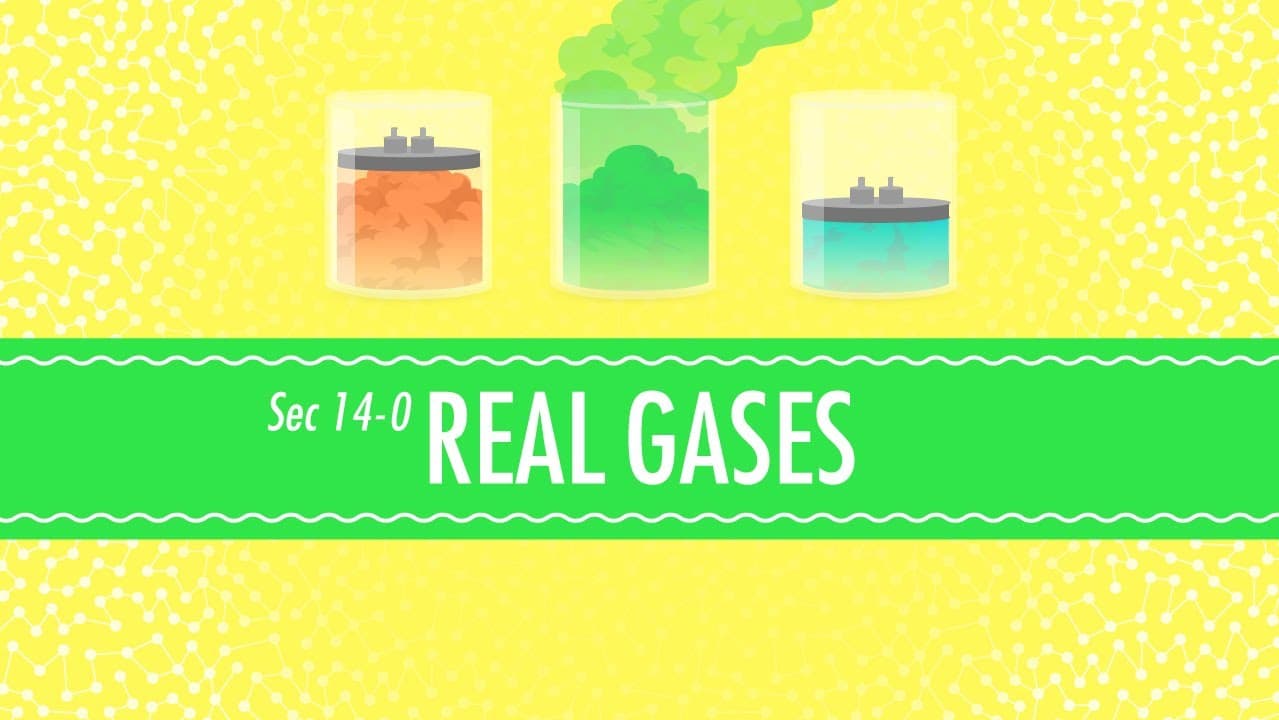
Real gases deviate from the ideal gas law due to molecular volume and intermolecular forces. The van der Waals equation corrects for these factors, providing a more accurate representation under high pressure and low temperature. Johannes van der Waals developed this equation, earning a Nobel Prize for his significant contribution to understanding gas behavior.
Transcript
One of the things that teachers who aren't me tend to say is that, you need to learn all this stuff because someday you'll be out there in the "real world" and you'll need to know how to do all the things that adults do. First of all, I don't really believe this because I think you should be learning just 'cause learning is fun. But I also remember... Read More
Key Insights
- Real gases deviate from ideal behavior due to molecular volume and intermolecular attractions.
- The ideal gas law assumes no volume for gas particles and no intermolecular forces.
- Van der Waals introduced corrections for volume and pressure in his equation.
- Volume correction accounts for the space occupied by gas molecules.
- Pressure correction accounts for intermolecular attractions reducing collisions with container walls.
- Van der Waals equation provides accurate results under high pressure and low temperature.
- The equation includes constants 'a' and 'b' specific to each gas type.
- Johannes van der Waals' work earned him a Nobel Prize, highlighting the importance of his contributions.
Install to Summarize YouTube Videos and Get Transcripts
Explore YouTube Video Summarizer or Get YouTube Transcript Extractor
Questions & Answers
Q: How do real gases differ from ideal gases?
Real gases differ from ideal gases because they have finite molecular volumes and experience intermolecular attractions. These factors cause deviations from the ideal gas law, which assumes no volume for gas particles and no intermolecular forces. The van der Waals equation corrects for these deviations, providing a more accurate representation under certain conditions.
Q: What is the van der Waals equation?
The van der Waals equation is a modified version of the ideal gas law that accounts for the finite volume of gas molecules and the intermolecular forces between them. It introduces corrections for volume and pressure, using specific constants for each gas type, to accurately describe gas behavior under high pressure and low temperature.
Q: Why is the ideal gas law not always accurate?
The ideal gas law is not always accurate because it assumes gas particles have no volume and do not interact with each other, which is not true for real gases. In reality, gas molecules occupy space and experience attractive forces, leading to deviations from the ideal behavior, especially under high pressure and low temperature.
Q: What are the corrections in the van der Waals equation?
The van der Waals equation includes two main corrections: a volume correction and a pressure correction. The volume correction accounts for the space occupied by gas molecules, while the pressure correction accounts for the reduction in collisions with container walls due to intermolecular attractions. These corrections are essential for accurately predicting real gas behavior.
Q: How do intermolecular forces affect gas behavior?
Intermolecular forces affect gas behavior by causing gas molecules to attract each other, especially when they are close together. This attraction reduces the frequency of collisions with the container walls, leading to a decrease in measured pressure. The van der Waals equation accounts for this effect, providing a more accurate model of real gas behavior.
Q: What role did Johannes van der Waals play in understanding gases?
Johannes van der Waals played a crucial role in understanding gases by developing the van der Waals equation, which corrects the ideal gas law for real gas behavior. His work introduced corrections for molecular volume and intermolecular forces, earning him a Nobel Prize and significantly advancing the field of theoretical physics.
Q: When is the van der Waals equation most applicable?
The van der Waals equation is most applicable under conditions of high pressure and low temperature, where deviations from ideal gas behavior are more pronounced. Under these conditions, the finite volume of gas molecules and intermolecular attractions significantly affect gas behavior, making the van der Waals corrections necessary for accurate predictions.
Q: Why is understanding real gas behavior important?
Understanding real gas behavior is important for accurate scientific and industrial applications, such as laboratory measurements and designing systems that operate under extreme conditions. The van der Waals equation provides the necessary corrections to the ideal gas law, ensuring that predictions and calculations reflect the true behavior of gases in real-world scenarios.
Summary & Key Takeaways
-
Real gases deviate from ideal gas behavior due to the finite volume of molecules and intermolecular attractions. The van der Waals equation introduces corrections for these factors, providing a more accurate representation of gas behavior under conditions of high pressure and low temperature.
-
The ideal gas law, PV = nRT, assumes no volume for gas particles and no intermolecular forces, which is not the case in reality. Van der Waals' corrections include a volume correction for the space occupied by molecules and a pressure correction for reduced collisions due to attractions.
-
Johannes van der Waals developed his equation to address these deviations, using constants specific to each gas type. His work earned him a Nobel Prize, emphasizing the significance of understanding real gas behavior, especially in scientific and industrial applications.
Read in Other Languages (beta)
Share This Summary 📚
Summarize YouTube Videos and Get Video Transcripts with 1-Click
Try YouTube Summary with ChatGPT & Claude or YouTube Transcript Generator
Explore More Summaries from CrashCourse 📚




Summarize YouTube Videos and Get Video Transcripts with 1-Click
Try YouTube Summary with ChatGPT & Claude or YouTube Transcript Generator