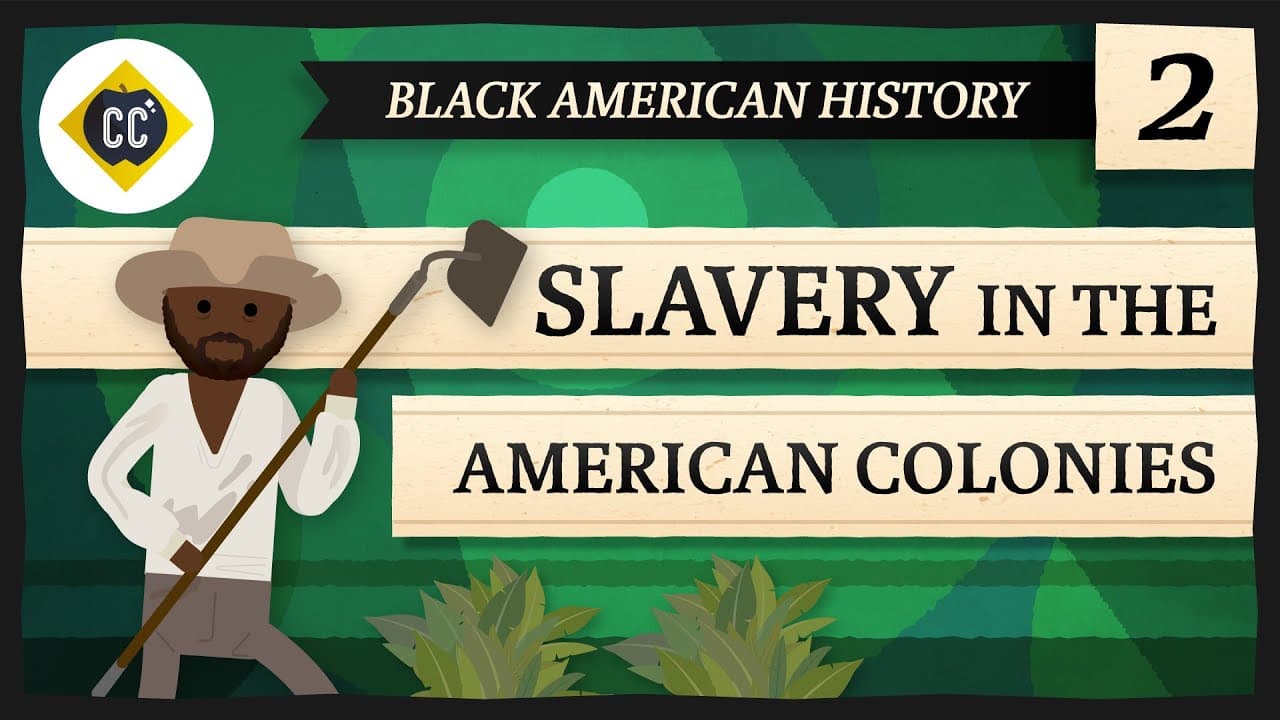
How Did Slavery Develop in the American Colonies? Crash Course Black American History #2
TL;DR
Slavery developed in the American colonies as colonists sought unpaid labor to reduce production costs and established racialized, long-term exploitation. San Miguel de Gualdape used enslaved Africans in 1526, while the arrival of 20-30 captured Africans at Point Comfort in 1619 came to represent the origins of chattel slavery in the United States. Read on to understand the labor choices and early legal transition behind this system.
Transcript
Hi, I’m Clint Smith, and this is Crash Course Black American History. Today we’re talking about slavery in the American colonies. In your high school U.S. History class, there’s a decent chance you learned about mercantilism: a system in which home countries, or "mother" countries, in Western Europe established extensions of themselves in far off p... Read More
Key Insights
- "For British colonists, the answer was to have laborers who you didn’t pay." (0:54)
- "Nearly a century later, 20-30 captured Africans, or the “20 and odd Negroes” as they were referred to, arrived at Point Comfort, Virginia, in 1619." (1:47)
- "These captives would become instrumental to the success of the Jamestown colony, which succeeded where previous colonies had failed." (2:10)
- "For one, European indentured servants could only legally be indentured for a contracted period of time, usually somewhere between 4-7 years." (2:53)
- "Slavery, however, had not yet been defined and codified by law." (3:53)
Install to Summarize YouTube Videos and Get Transcripts
Explore YouTube Video Summarizer or Get YouTube Transcript Extractor
Questions & Answers
Q: Why did British colonists turn to slavery in the American colonies?
British colonists wanted to maximize profits by minimizing production costs. Because production relied heavily on manual labor, their answer was to use laborers whom they did not pay.
Q: What was San Miguel de Gualdape?
San Miguel de Gualdape was a colony founded in 1526 by the Spanish magistrate Lucas Vázquez de Ayllón in what is now South Carolina. It included an unknown number of enslaved Africans, but the colony failed.
Q: Why is the arrival of captured Africans in Virginia in 1619 historically significant?
Between 20 and 30 captured Africans arrived at Point Comfort, Virginia, in 1619. Their arrival came to represent the origins of chattel slavery in the United States because they were the first captured Africans to arrive in an English colony that later became part of the United States.
Q: How did the captured Africans contribute to Jamestown?
The captives became instrumental to the success of the Jamestown colony. Jamestown succeeded where earlier colonies had failed.
Q: Who were the Atlantic Creoles?
Historian Ira Berlin used the term “Atlantic Creoles” for Africans who had already experienced significant contact with Europeans, particularly people from Spain and Portugal. They knew multiple languages, had some familiarity with Christianity, and sometimes worked alongside white indentured servants.
Q: Why did European indentured servitude not meet colonists’ long-term labor needs?
European indentured servants generally worked under contracts lasting 4-7 years. When those contracts ended, colonists had to find and train replacements, creating inconsistent production levels.
Q: Why did colonists increasingly prefer imported African labor over indigenous labor?
Settlers attempted to enslave indigenous people, but this did not satisfy their labor needs. Ongoing conflict with Native Americans made imported Africans a more desirable labor source, although indigenous labor continued in some places.
Q: What does Anthony Johnson’s story reveal about early slavery in Virginia?
Anthony Johnson lived in captivity but eventually became free with his family, owned recognized land and property, and received tax forgiveness after a fire. His experience shows that some allowances existed before broad restrictions made slavery a more concretely defined institution.
Summary & Key Takeaways
-
Slavery in the American colonies was a result of the desire to maximize profits and reduce production costs through unpaid labor.
-
The arrival of enslaved Africans in Jamestown, Virginia in 1619 marked the beginnings of chattel slavery in English colonies.
-
European indentured servants and indigenous labor were initially utilized, but neither proved efficient or desirable in the long term.
Read in Other Languages (beta)
Share This Summary 📚
Summarize YouTube Videos and Get Video Transcripts with 1-Click
Try YouTube Summary with ChatGPT & Claude or YouTube Transcript Generator
Explore More Summaries from CrashCourse 📚





Summarize YouTube Videos and Get Video Transcripts with 1-Click
Try YouTube Summary with ChatGPT & Claude or YouTube Transcript Generator