How Do Unistellar Smart Telescopes and Adaptive Optics Work? Dr. Franck Marchis Explains
TL;DR
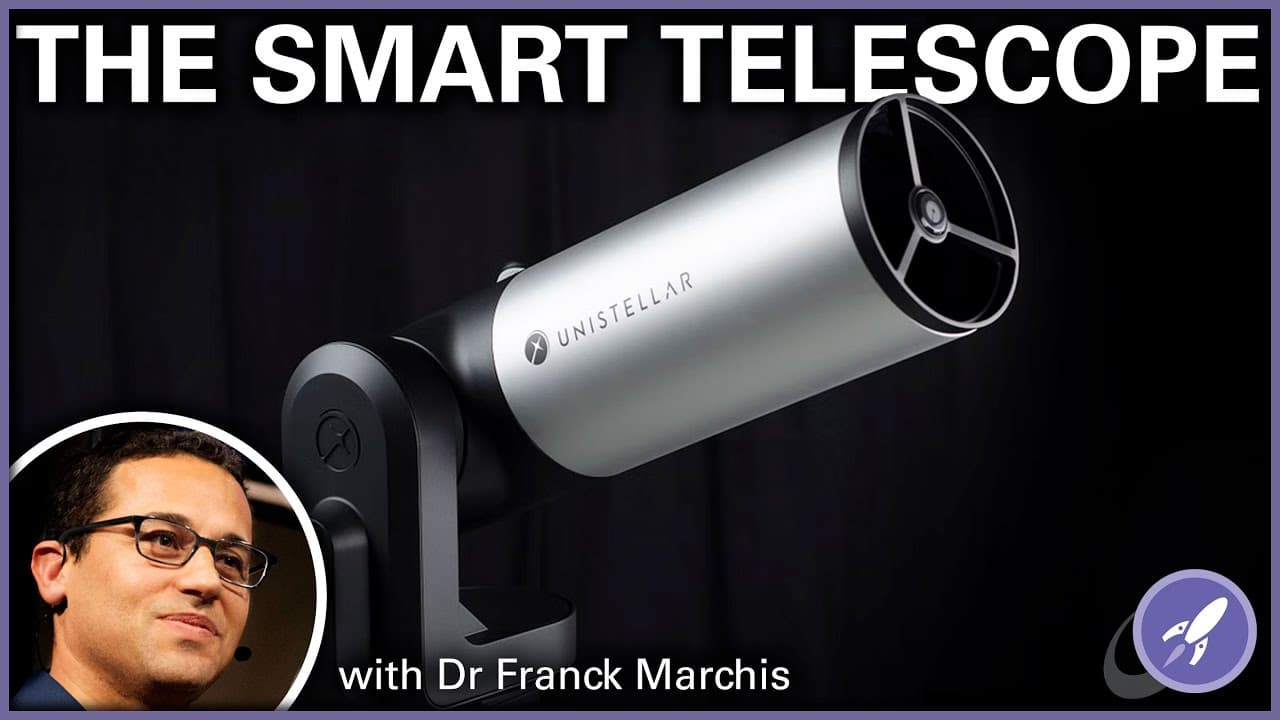
Unistellar smart telescopes aim to turn everyday users into astronomers while supporting scientific observations. Dr. Franck Marchis, a SETI Institute researcher and Unistellar co-founder, explains how adaptive optics sharpens ground-based telescope images, with newer systems achieving correction ratios above 70% and sometimes 80%. Read on to understand the technology, its research applications, and how it could advance exoplanet detection.
Transcript
Fraser Cain: Hi, everyone, I'm Fraser Cain. I'm the publisher of university. I've been a space and astronomy journalist for over 20 years. And we're constantly reporting on various topics in space and astronomy. But I like to bring you behind the scenes talk to some of the people who are actually working on the technology. And today I'm excited to ... Read More
Key Insights
- 🛝 Adaptive optics technology has transformed ground-based astronomy by improving resolution and image quality.
- 🔬 The Eeevee scope by uniStellar aims to make astronomy accessible and enjoyable for beginners and educators.
- 🔭 Collaborative observations with multiple telescopes can provide a broader perspective and enhance data quality.
- 👶 Future advancements in adaptive optics may enable new opportunities for scientific research and astronomical observations.
- 🪛 The combination of technology and community engagement is driving innovation in astronomy and citizen science initiatives.
- 👤 Simplifying telescope operation and data processing can enhance the user experience and encourage participation in scientific endeavors.
- ⚾ Ground-based telescopes are evolving to compete with space-based platforms, offering unique advantages in accessibility and flexibility.
Install to Summarize YouTube Videos and Get Transcripts
Explore YouTube Video Summarizer or Get YouTube Transcript Extractor
Questions & Answers
Q: How do Unistellar smart telescopes make astronomy and scientific observation more accessible?
Unistellar designs small digital telescopes intended to let ordinary users observe the sky and participate in science. Dr. Franck Marchis says this approach can effectively transform anybody into an astronomer, with the SETI Institute serving as a scientific partner of the company.
Q: Who is Dr. Franck Marchis, and what does he do?
Dr. Franck Marchis is a planetary astronomer and researcher at the SETI Institute. He designs instruments for ground-based telescopes, uses adaptive optics to study asteroids and search for exoplanets, and is also a co-founder of Unistellar.
Q: How has adaptive optics improved ground-based astronomy?
Adaptive optics helps ground-based telescopes correct for atmospheric distortion and take fuller advantage of their size. Marchis says the resulting resolution can reveal asteroid craters and even the central peaks of those craters, whereas earlier systems could barely make a point appear sharper.
Q: How does an adaptive optics system correct atmospheric distortion?
The described process fires a laser into the sky to create an artificial guide star. Measurements of that star reveal atmospheric distortions, allowing the system to change the mirror and correct the incoming wavefront.
Q: What performance do extreme adaptive optics systems achieve?
Marchis says previous adaptive optics systems reached a correction ratio of about 40%. New systems exceed 70% and sometimes reach 80%, providing the angular resolution and stability associated with observing from space.
Q: How quickly do modern adaptive optics mirrors move?
Modern corrective mirrors can move 1,000 times per second. Earlier mirrors moved 100 times per second, so the newer systems can respond much more rapidly while correcting distorted images.
Q: Can ground-based telescopes compete with space telescopes?
Marchis says ground-based telescopes equipped with adaptive optics can now compete with space telescopes in some observations. He considers them competitive in the near infrared, while visible-light performance is still developing.
Q: How could adaptive optics improve future exoplanet searches?
Current extreme adaptive optics systems are still limited to detecting Jupiter- or Saturn-size exoplanets, according to Marchis. He says lessons from telescopes larger than eight meters can be scaled to larger observatories, including a 39-meter telescope, with the aim of detecting Uranus-size and eventually Earth-size exoplanets.
Summary & Key Takeaways
-
Frank Martius is a researcher at the SETI Institute and a co-founder of uniStellar, focusing on adaptive optics systems for ground-based telescopes.
-
Adaptive optics technology has revolutionized ground-based astronomy by providing better resolution and image quality.
-
The Eeevee scope by uniStellar aims to democratize astronomy, making it accessible for beginners, educators, and citizen scientists.
Read in Other Languages (beta)
Share This Summary 📚
Summarize YouTube Videos and Get Video Transcripts with 1-Click
Try YouTube Summary with ChatGPT & Claude or YouTube Transcript Generator
Explore More Summaries from Fraser Cain 📚




Summarize YouTube Videos and Get Video Transcripts with 1-Click
Try YouTube Summary with ChatGPT & Claude or YouTube Transcript Generator